The ANC insists it’s still a political vanguard: this is what ails democracy in South Africa:

A common claim of the governing African National Congress (ANC) in South Africa is its commitment to participatory democracy: the involvement of citizens in decisions about issues that affect their lives. It is a principle and a system, primarily at the local government level, that has been institutionalised alongside representative democratic government.
The country has a prominent history of popular participation in the struggle for democracy. Under the largely ANC-aligned national liberation movement, mass participation and popular control characterised the struggle discourse. South Africans have shown, as opponents of apartheid and as free citizens, their desire to engage government.
Yet the post-apartheid system of participatory democracy is generally considered to have failed. This is evident in the weaknesses of institutionalised mechanisms and the growth of informal channels such as protests. Citizens still lack influence in governance processes.
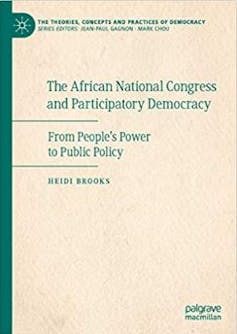
With this in mind, I set out to examine the roots of this policy failure. My findings are published in a book, The African National Congress and Participatory Democracy.
It examines the ANC’s understanding of participatory democracy – first as a liberation movement, then as a government since 1994. It seeks to show how the failure of participatory democracy can be linked to the ideas that underpin it.
A precedent for participation
Founded in 1912 by a small group of educated, middle class Africans, the ANC grew into a mass movement in the 1940s. It later became an exiled underground organisation from 1960, after its banning by the apartheid regime. In exile, its roots in African nationalism merged with Marxist-Leninist ideology.
It draws on these intellectual traditions, but has always been a “broad church”. There has never been a singular, uniform understanding of participation within the ANC. Instead, during the struggle, multiple traditions and approaches to popular participation emerged.
In the 1980s, as the struggle heightened, one of these ideas took form in the “people’s power” movement. Rooted in local, informal structures of self-governance, it represented for some participants a form of prefigurative, participatory democracy, built from the bottom up.
From 1990, with the onset of talks to end apartheid, and after the first democratic elections in 1994, some of this inspiration was woven into public policy. This was often through participation of civic and labour movements in formulating policy.
The 1994 Reconstruction and Development Programme emphasised people-driven development. This ethos informed the 1998 White Paper on Local Government and legislation that established municipal ward committees as key forums for citizen participation.
But new ideas and influences also emerged – from development theory, governance discourse and international best practice. They can be seen in various consultative mechanisms, such as ward committees and municipal development planning.
Some discomfort has arisen between an impetus for managing the public sector efficiently and allowing citizens to participate. But South Africa’s public policy on participation does allow for some popular influence.
Separately, though, the ANC as a movement has a distinct discourse about participation.
The political vanguard idea
Emerging from its dominant intellectual heritage, the ANC’s very identity as a mass movement is rooted in the notion that it exists as a political vanguard. Associated with the ideas of Vladimir Lenin, the vanguard party is a vehicle led by an enlightened, revolutionary leadership through which the people can be led to freedom.
The adoption since 1994 of a largely market-oriented economic strategy makes this discourse meaningless at a policy level. Yet the narrative continues.
ANC documents, statements and commentary still refer to the governing party as “a vanguard movement”. For example, its discussion document on organisational renewal, presented at its most recent policy conference in 2017, stated:
The ANC has to operate as a vanguard movement with political, ideological and organisational capacity to direct the state and give leadership to the motive forces in all spheres of influence and pillars of our transformation.
Why is this a problem for participatory democracy?
Vanguardism holds that a dedicated movement – or party – is needed to give ideological, moral and intellectual leadership through a process of “conscientisation”. A vanguard views itself as a true representative, able to interpret the popular will. The people must not only see the vanguard’s objectives as in their best interests. They must also see leadership by that vanguard as essential for those interests to be secured. It implies a fundamental connection between the people’s collective needs and the leadership of their vanguard organisation.
An active role for the people is a critical component of vanguardism. But the movement must guide participation. It’s not the form of participation that’s usually associated with democracy. But the ANC understands it as being the same as participatory democracy.
Vanguardism versus participatory democracy
The challenge for South Africa’s democracy is that the very existence of vanguardism prevents citizens from being empowered. It keeps the party dominant. It also contains what the political theorist Joseph V. Femia, in his book Marxism and Democracy, p.136), said was an important tension in Marxism generally, between a desire for
political control from above and popular initiative from below.
This can be framed as a tension between vanguardism and participatory democracy.
Twenty six years since the end of apartheid, South Africa has reached a critical point in its democracy. Popular disillusionment with the ANC, failures in government performance and the rise of popular protest are evident. But certain ideas continue to influence the way democracy is practised.
The ANC has been found wanting as a leader of society. Rampant corruption and abuse of office have marred its claim to the rightful leadership of South Africa’s people. It was inevitable that citizens would lose faith in formal political processes.
The difficult path from liberation movement to governing party is well-trodden in Africa. Liberation struggles across the continent were conducted in the context of state repression. Political organisations were not free to operate openly.
But the requirements of underground operations and of unity in struggle are different to those of democracy. Organisational traditions focused not on empowering citizens but on maintaining movement hegemony do not allow democratic influence and agency to flourish.
The African National Congress and Participatory Democracy: From Peoples Power to Public Policy is published by Palgrave Macmillan.

Heidi Brooks received funding from the Leverhulme Trust for the doctoral research on which this article is based.
Source: The Conversation – Articles (AFRICA)
Read more on The Conversation.
Join the fun: Add Your event | Submit a Press Release | Add your listing.


