The AU’s peace and security architecture: filling the gaps:
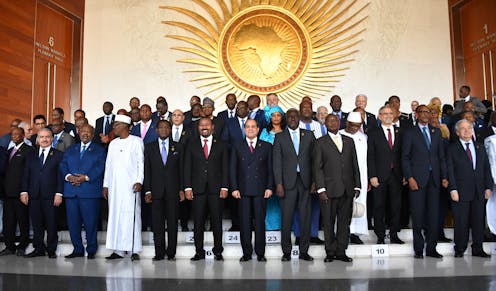
Since its inception in 2002 the African Union has been under pressure to resolve the extensive peace and security challenges facing the continent. In particular, it’s tried to address the limitations faced by its predecessor, the Organisation of African Unity’s (OAU), in this area.
The biggest change has been the shift away from the OAU’s so-called non-interference stance to the AU’s more interventionist approach. This is most explicitly found in Article 4 of the AU Constitutive Act.
The AU’s African Peace and Security Architecture was established when the organisation adopted the Protocol on the Establishment of the Peace and Security Council in July 2002. It is guided by the AU’s mandate and its interventionist approach.
The architecture, which has five pillars composed of AU organs and bodies, drives the AU’s peace and security work. Its aim is to prevent, manage and resolve conflicts by working collaboratively with the Regional Economic Communities and Mechanisms. Therefore, the peace and security architecture has a role to play from the early warning and conflict prevention stages to that of post-conflict development.
The five pillars are: the Peace and Security Council, the Panel of the Wise; the Continental Early Warning System; the Standby Force, and the Peace Fund.
While not all pillars function as intended, there have nevertheless been a number of success stories in which the architecture was instrumental.
Peace and Security Council
The Peace and Security Council is the main decision-making body of the peace and security architecture and can take decisions on a number of fronts. These include:
-
implementing the AU’s common defence policy,
-
performing peace making and building functions,
-
authorising and overseeing peace support missions,
-
recommending Article 4(h) interventions for situations of war crimes, genocide and crimes against humanity, and
-
impose sanctions for unconstitutional changes of government, to name a few.
As such, it has issued a plethora of decisions since its inception with varying degrees of success. Most recently, it suspended Mali from the African Union after the coup that ousted President Ibrahim Boubacar Keïta.
Yet, the Council does not always respond, or is sometimes slow to respond, to developing situations and conflicts. Cameroon, has proved to be one such situation where the Council has remained largely quiet on over the years.
Read more: African Union needs a more robust response to conflict in Cameroon
There are a number of reasons for these shortcomings.
First, despite only requiring a majority vote, it is subject to political constraints that hamper its decisions. This is despite the provision that disallows countries that are being discussed from participating in Council meetings concerning them. Such countries are only allowed to make a statement.
There are also financial and personnel constraints. For example, mustering enough troops to fulfil a mandate can be a challenge. And then there’s the question of financing, training and equipping them. This is a common problem for the AU’s mission in Somalia.
In addition, there has been external influence and undermining of the Council’s attempts at conflict resolution. A case in point was NATO’s intervention in Libya, which was parallel to the AU’s mediation efforts.
Panel of the Wise
The Panel of the Wise acts as the advisory body to the Peace and Security Council. It has a mediation and preventative diplomacy role.
The panel’s five elders are chosen based on their contributions to peace, security and development. They work either at the request of the Peace and Security Council, or on the panel’s own initiative.
The panel has successfully undertaken various roles, including when there’s been need for a neutral, respected diplomatic intervention.
Examples of their work includes interventions in Kenya’s post-election violence in 2008, and their reports regarding the Arab spring.
Continental Early Warning System
The mandate of the Continental Early Warning System is conflict prevention and anticipating events.
Both are notoriously difficult. Prevention and anticipation rely on accurate data and political will to act, yet the Peace and Security Council tends to react more to conflicts rather than preempt them.
Reports from the early warning system inform the Council and remain one of the ways it is prompted to meet. To be more effective, the early warning system needs to work more collaboratively with nongovernmental and international organisations, academic institutions and research centres.
While this system continues to suffer from staff and funding shortages, building capacity is ongoing.
African Standby Force
Composed of contingents from the five regions, the African Standby Force’s job is to implement decisions made by the Peace and Security Council. This includes authorised interventions, conflict and dispute prevention, observation, monitoring and any type of peace support mission, humanitarian assistance and peacebuilding.
But there were delays in getting it off the ground. Mobilising a standby force from across the 55 states was never going to be easy because the appetite for involvement in peace support operations differs. Second is the diverse states of readiness and capabilities of military, police and civilians across countries and regions.
Despite the 2003 decision to establish the force, it was only in 2016 that the force was officially considered to have obtained full operational capacity. Since then, it has yet be deployed.
Peace Fund
The Peace Fund is tasked with the mammoth role of ensuring availability of funds.
The vast majority of AU members struggle to meet their membership dues, and self-financing of the AU has yet to prove possible. This means that the fund struggles to secure support from African states.
The fund is financed from the AU’s budget, fundraising and voluntary contributions from AU Members, individuals, civil society, international partners, and the private sector.
While $ 164 million has been raised to date, it is well below the target of $ 400 million.
Overall, the success of the African Peace and Security Architecture is paramount for Africa’s development and human security. Its value in the continent’s peace and security agenda should not be underestimated.

Dominique Mystris does not work for, consult, own shares in or receive funding from any company or organization that would benefit from this article, and has disclosed no relevant affiliations beyond their academic appointment.
Source: The Conversation – Articles (AFRICA)
Read more on The Conversation.
Join the fun: Add Your event | Submit a Press Release | Add your listing.


