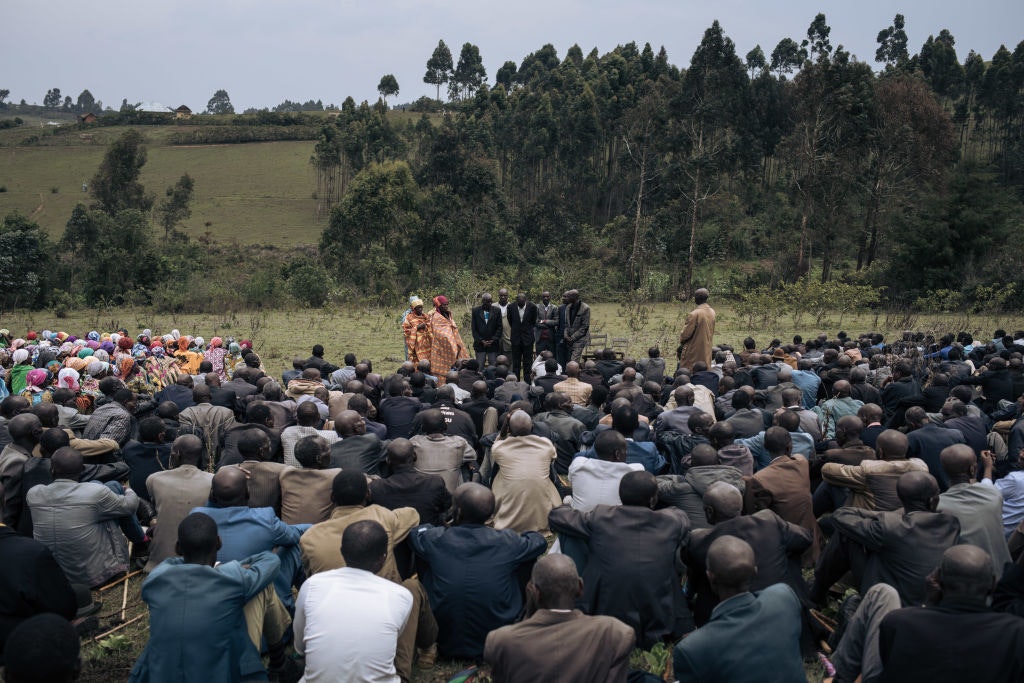
The Banyamulenge are a minority ethnic group in South Kivu, eastern Democratic Republic of Congo (DRC). In December 2022, the UN adviser on the prevention of genocide raised concerns about attacks against the community based on “ethnicity or perceived allegiance with neighbouring countries”. The Banyamulenge have long been viewed as not being Congolese. The government, however, has often dismissed claims that the community is facing targeted attacks as fiction. Delphin R Ntanyoma, who has extensively researched the Banyamulenge, explains why they are facing persecution.
Who are the Banyamulenge and how has their status changed over time?
The Banyamulenge live in eastern DRC in South Kivu province. They are mostly seen as affiliated to the Tutsi of the African Great Lakes region, and they speak a language close to Kirundi (Burundi) and Kinyarwanda (Rwanda). The Banyamulenge settled in South Kivu between the 16th and 18th centuries, having come from what are today Burundi, Rwanda, Tanzania and Uganda. They are largely cattle keepers.
They mostly occupy the southern part of South Kivu province: the Fizi, Mwenga and Uvira territories. In the 1960s and 1970s, some Banyamulenge moved to Katanga in the DRC’s southern region. The region has rich pastures for cattle herding and is close to the large cities of Lubumbashi and Mbujimayi, providing business opportunities. However, in 1998, nearly 20,000 Banyamulenge were forced to flee Katanga after they were attacked for being “foreigners”.
Since 1984, the DRC has not organised a general census. The historian Joseph Mutambo estimated the group had around 400,000 people in 1997. There are no clear estimates today, but it’s safe to assume that they have grown in number.
Colonial history in the Great Lakes region has categorised local communities into “native” and “immigrants”. Farmers are seen as native, while cattle herders are largely perceived as immigrants, foreigners and invaders.
Read more: Why history matters in understanding conflict in the eastern Democratic Republic of Congo
Based on these assumptions, the Banyamulenge have been viewed as foreigners and were denied citizenship in the 1980s. A decade later, the Congolese state sought to expel them after a parliamentary resolution to send back all Rwandan and Burundian descendants.
This added to the perception that the Banyamulenge were “invaders”. I have researched the drivers of violence in South and North Kivu for six years, with a focus on the Banyamulenge situation. It’s clear that much of the violence targeting them revolves around the misconception that they are strangers in their own country.
Who’s who on the list of their political adversaries?
The Banyamulenge’s political adversaries range from local politicians to armed groups and militias. Most of the politicians who rally their constituents against the Banyamulenge are from neighbouring ethnic communities. These include the Babembe, Bafuliro, Banyindu and Bavira. Members of these ethnic communities consider themselves “native”. Political figures outside South Kivu have also spread the idea that the Banyamulenge are outsiders.
Those who take issue with the Banyamulenge claim to be protecting their country from “invaders”. This has led to armed mobilisations and the use of local militias, like the MaiMai and Biloze-Bishambuke. These militias have vowed to expel the Banyamulenge or eliminate them.
Read more: How conflicts intertwined over time and destabilised the DRC – and the region
Since 2017, Burundian rebel groups like Red-Tabara and Forces Nationales de Liberation have joined local militias in attacks against the Banyamulenge. The Red-Tabara’s involvement raised questions about Rwanda’s role after UN reports claimed that the country had supported the rebel group with logistical and training skills.
How are the Banyamulenge targeted?
The Banyamulenge have been targeted by Congolese security services and local militias in major attacks in 1996, 1998 and 2004.
A new wave of violence against the group began in 2017, and has since led to the deaths of thousands of civilians and the destruction of hundreds of villages. That year was marked by intensifying conflict in the DRC over election delays.
The looting of Banyamulenge-owned cattle has been a constant occurrence since the 1960s. Cattle constitute a major source of income and livelihood, and looting has worked as a strategy to impoverish the community and jeopardise their future.
Read more: Burundi’s Gatumba massacre offers a window into the past and future of the DRC conflict
Due to the widespread destruction of villages, the remaining Banyamulenge in South Kivu live in small localities like Minembwe, Murambya/Bijombo, Mikenge and Bibokoboko. They continue to face regular and coordinated attacks, which have prevented the community from accessing pastures and farmland beyond a two-kilometre radius.
Armed militias in South Kivu have prevented and constrained humanitarian organisations from getting aid into Banyamulenge settlements.
Hate speech has played a major role in fuelling violence against the community. Twitter, Facebook, YouTube and other social media platforms have thousands of posts and videos that claim the Banyamulenge are not Congolese citizens and shouldn’t be in the country.
Such dehumanising and hateful speech feeds the minds and hearts of young people, mainly men, who consider attacks against the Banyamulenge a “noble” cause. Researchers and activists have called for greater attention to be paid to these attacks.
Who’s behind the attacks?
The Banyamulenge are targeted because they are viewed as “foreigners”. For decades, local armed groups and militias have mobilised to get rid of those perceived as invaders. This ideology is transmitted across generations.
In addition, the Congolese national army has played a role in enabling attacks against the Banyamulenge by providing ammunition to militias or opening breaches when rebels attack civilians. Huge destruction has taken place in areas where the Congolese army is present but didn’t intervene.
There are three possible reasons for the army’s general inaction. First, some military commanders and soldiers may believe the narrative that the Banyamulenge are not Congolese. Second, some military commanders create chaos and conflict pocket zones to serve one or more protagonists in the Great Lakes region. Third, violence allows military commanders to access operational funds – and looted cattle can be turned into money.


