The Battle of Christiana, 1851
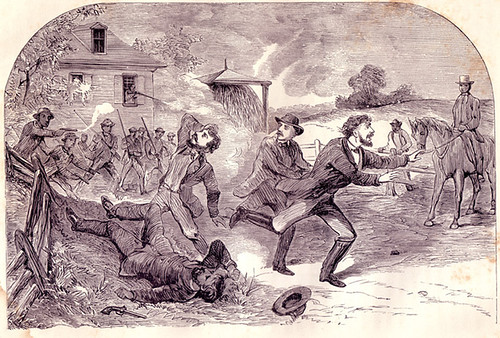
Image by elycefeliz
Christiana is a borough in Lancaster County, Pennsylvania, United States. In 1851 it was the site of the Battle of Christiana (also called the Christiana riot).
On September 11, 1851, Christiana was the site of the Battle of Christiana in which the local residents defended with firearms a fugitive slave, killing the slaveowner. Southerners demanded the hanging of those responsible, who were accused of treason and making war on the United States, but after the first defendant, a Quaker, was acquitted, the government dropped the case. The trial was the first nationally-covered challenge to the Fugitive Slave Law of 1850.
The Christiana Incident
Pennsylvania abolished slavery in 1780, although in a slow manner. The existing 6,000 slaves in Pennsylvania remained slaves, and the registered children of those slaves were slaves until their 28th birthday. The last slave child registered in Pennsylvania was Haley, born in 1811, and a freedman no later than 1839. Thus Pennsylvania was legally a free state when the Fugitive Slave Law of 1850 was passed as part of the Compromise of 1850. Being immediately north of the Mason-Dixon line, Lancaster County was an important stop on the Underground Railway.
Edward Gorsuch, a slaveowner, did not beat his slaves, and as a wealthy Maryland wheat farmer, he could afford to manumit slaves in their 20s. He allowed his slaves to work for cash elsewhere during the slow season. There was wheat missing, though, sold to a local farmer by his slaves, and he thought a former slave was responsible for this dishonesty. As he had a bad temper, slaves Noah Buley, Nelson Ford, George Ford, and Joshua Hammond became afraid, and fled to the farm of William Parker, a mulatto who lived in Christiana, Pennsylvania. Parker, 29, was a member of the Lancaster Black Self-Protection Society, and known to use violence to defend himself and the slaves who sought refuge in the area.
Gorsuch obtained four warrants, and organized four parties which set out separately to recover his property. He died in the attempt, though, and others were wounded. Although Gorsuch was legally entitled to recover his slaves, it is not clear who precipitated the violence. The incident was variously called the "Christiana Riot", "Christiana Resistance", the "Christiana Outrage", and the "Christiana Tragedy".
In September, 1851, the grand jury returned a "true bill" (indictment) against 38 individuals who were then held in Moyamensing Prison in Philadelphia to await trial. The only one who was ever tried was Castner Hanway. It is not clear that Castner Hanway was responsible in any way for what happened. He was a white man, one of the first on the scene. Hanway and his horse provided cover for Joshua Gorsuch and Dr. Pearce, who were wounded. Hanway was tried in federal court in Philadelphia on November 15, 1851 for liberating slaves taken into custody by U.S. Marshal Kline, for resisting arrest, for conspiracy, and for treason. The jury returned a Not Guilty verdict in 15 minutes. Among the five defense lawyers was congressman Thaddeus Stevens.
On September 11, 1851, Maryland planter Edward Gorsuch was killed by African Americans in Christiana, Pennsylvania, as he tried to take possession of three young men who had escaped from his ownership two years earlier.
The Christiana " Riot" or "Tragedy," as it became known, ignited a nation increasingly divided over the issue of slavery. Many in the South viewed the failure of the Pennsylvania courts to convict any of the dozens of men who had participated in the riot that resulted in Gorsuch’s murder an egregious, willful violation of federal law; a violation that threatened the property rights of Southerners and the stability of the Union. Northern abolitionists, however, viewed it as a victory of liberty against the vile institution of slavery and despicable slave hunters.
On the morning of November 7, 1849, Edward Gorsuch awoke to discover that four male slaves had fled from his farm in rural Baltimore County, Maryland, the night before. Gorsuch was shocked, for he believed that he had treated the four well and that they respected him. Influenced by Quakers and the Methodist Episcopal Church, and his decision to grow wheat rather than tobacco, he had already made arrangements to free his slaves once they reached the age of twenty-eight. Just south of the Mason Dixon Line, Maryland was a slave state, but it also was home to the nation’s largest population of free African Americans.
Despite Gorsuch’s promise of manumission, Noah Buley, Nelson Ford, George Hammond, and Joshua Hammond fled in 1849. Nearly a year after their escape, the federal government passed a new law, assisting slave owners like Gorsuch in their search and in the capture of their fugitive slaves. The Fugitive Slave Act of 1850 made aiding fugitive slaves illegal, punishable by a potential six-month jail sentence and a ,000 fine. Refusing to help or impeding the capture of a fugitive slave also became a federal offense. The law also denied fugitive slaves the right to a trial by jury. Soon, slave catchers were aggressively pursuing fugitives throughout the North, sometimes kidnapping free African Americans to sell them into slavery in the South.
n August 28, 1851, Gorsuch received the news he had spent two years awaiting: a letter from an informant placed at least three of his slaves in Lancaster County, Pennsylvania. Some 3,000 free African Americans and fugitive slaves lived in Lancaster County, one of the easiest places in the nation for slaves to cross from slavery to freedom. Lancaster had a highly organized underground railroad, with some fifty permanent "stations" scattered across its countryside. There, two of Gorsuch’s escaped slaves were living with a black farmer, William Parker, near Christiana. Parker, too, had run away from Maryland, in 1839, and ran a self-defense group to protect the local community of free blacks from slave catchers.
After obtaining warrants in Philadelphia on September 9, Gorsuch, his son Dickinson, Deputy Marshal Henry H. Kline, and several other men rode west for Christiana. Word of their arrival, however, preceded them, for the Philadelphia Vigilance Committee, run by William Still, sent Samuel Williams, a black man active in the Underground Railroad, to warn Parker and the fugitives of their imminent arrival. Early on September 11, 1851, Gorsuch and his party arrived at the home of William Parker.
What transpired over the next hours is impossible to know with certainty. What is known is that after Parker’s wife Eliza blew a horn out the window of their home to notify the neighbors and members of the self-defense group of the emergence some fifty to one hundred African Americans, armed with guns, pitchforks, and other weapons, ran to the house. Among the first to arrive was Castner Hanway, a white miller and Parker’s closest neighbor, who attempted to calm the mob and warned Gorsuch and Kline to leave before things turned violent.
Gorsuch refused to retreat without his property, the fugitives refused to surrender, and when gunfire broke out Gorsuch fell, mortally wounded, to the ground. As Dickinson ran to help his father, Parker’s brother-in-law shot him. Kline and the other members of Gorsuch’s party fled, the mob following in hot pursuit. Dickinson would recover from his wounds, but Edward Gorsuch died at Christiana.
In the days that followed, several groups of vigilantes terrorized African Americans living in Lancaster County in search of participants in the riot. The men of Parker’s household, however, had already scattered. Parker and his brother-in-law fled for Canada, traveling through Rochester, New York, where Frederick Douglass helped them obtain passage on a steamer to Toronto.
The law was swift in its response. A grand jury in Lancaster County indicted thirty-eight men on 117 counts of treason–the largest number of Americans ever charged with treason in the history of the United States–including Castner Hanway, whom Deputy Marshal Kline accused of leading the mob and refusing to aid, as required by federal law, in the recapture of escaped slaves. The ensuing trials attracted national attention. Lucretia Mott and other abolitionists raised money for Hanway’s defense, which was led by Pennsylvania Congressman Thaddeus Stevens. Hanway’s eighteen-day trial, which began on November 24, 1851, was standing room only, the courtroom crowded with reporters, and members of the Society of Friends. Conflicting testimony resulted in the jury finding Hanway not guilty of treason.
In its aftermath, however, tensions and violence escalated along the Pennsylvania and Maryland border. Now fueled by the lust for retribution, slave hunters continued their raids and kidnappings. In Maryland, a white man traveling to Baltimore from Lancaster County to petition for the freedom of a free black woman stolen from his farm was killed, allegedly in revenge for the death of Gorsuch.
The Christiana riot and trial also strengthened the convictions of northern abolitionists and inspired others to join the struggle. Castner Hanway became an abolitionist following his trial. Southerners and Northerners in favor of slavery and the rule of law were outraged at the court’s failure to win a single conviction.
THE FREEDMAN’S STORY, by William Parker
This Free State South Africa image was automatically curated and published with WP Robot plugin – CLICK HERE to learn more about WP Robot for WordPress – a massive time and money saver.
Visit the MyPE YouTube Channel.


