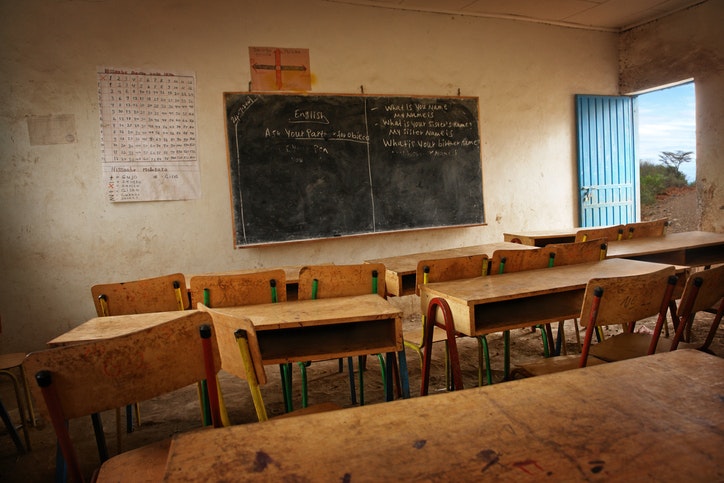
The COVID-19 pandemic has disrupted schools and universities across the world. UNESCO figures state that the worldwide average time lost due to COVID-19 related school closures has been two thirds of an academic year.
This situation has been the most acute in Latin America and the Caribbean, where five months have been lost and three out of five children lost an entire school year. In Africa there have also been long school closures. In Uganda, for example, schools have been kept closed for almost two years.
There were different scenarios at work when schools closed: some went digital, many students didn’t learn because they lacked access to the necessary technology, examinations were run virtually if not cancelled altogether. Learning was lost because, quite simply, home environments are often not designed to support learning the way that schools are.
I’ve done research on international education and I also have direct experience, as a Head of School, into understanding how disruptions affect learners. I know how important it is to keep the rhythm of learning apace, and I’m concerned that students have not been able to ensure progress and consolidate their learning due to the gaps that COVID has caused. These gaps will linger.
Almost a century ago, the Swiss psychologist Jean Piaget explained what happens when gaps appear in learning: the way we learn is by assimilating new information to old information. When information is lost, or is incorrect, it creates fossilised errors or gaps, and students try to bolt new knowledge on to that. It’s like a house being built without foundations.
In addition, school closures have immediate and long-term effects on students, both emotionally and economically. They also have a ripple effect on a country and on income inequality.
Costs of this education deficit
One of the greatest costs to a person who misses out on an education is economic. It is well established that there is a positive correlation between education and economic growth, not just in terms of degree eligibility for employment but also in terms of the intrinsic worth of cognitive growth as a predictor of social renewal and economic health.
In line with this, there will be a material cost caused by several months out of school. The exact economic cost of gaps in education is not easy to calculate, as it is based on projections and conjecture, but forecasts are bleak. A 2020 paper by the Organisation for Economic Co-operation and Development (OECD) states that:
students in grades 1 to 12 affected by the closures might expect some 3% lower income over their entire lifetimes. For nations, the lower long-term growth related to such losses might yield an average of 1.5% lower annual GDP for the remainder of the century.
Other studies argue that school closures related to COVID-19 are likely to lead to a 0.8% drop in global economic growth. This is because a loss of learning makes future job candidates less competitive, reducing future earnings.
Read more: Counting the cost of lost schooling in South Africa
Psychological effects
But economic fallout is not the only consequence of COVID-19.
The psychological effects of school closure are significant. Research from the UK shows that behavioural incidents (for example antisocial conduct, hyperactivity, expressions of negative emotions) spiked after pandemic-related school closures. This behaviour can be explained by the lack of access young people had to age-like peers and the effects of stay-at-home claustrophobia.
Studies run by universities in the US also showed evidence of psychological effects. There was a palpable worsening of mental health in children due to school lockdowns and closures, due to numerous intertwined factors including social isolation, increase of abuse at home, anxiety and disorientation.
Hence, we are reminded that the role of school is not just education in the narrow sense of information transmission and skills development. It holds society together by giving young people a space to socialise, to feel a sense of belonging and to connect with other human beings.
Read more: How the pandemic is hurting university students’ mental health
Increased inequality
School closures will also increase inequality, within a country and across borders.
Not surprisingly, studies show that the children who have been affected the most by school closures have been those from socioeconomically deprived backgrounds.
As is so often the case in education and, as I’ve pointed out in my study Education and Elitism, a cruel and unfair reality is that household wealth predicts academic success or lack thereof. When deficits occur, it is the poorest who pay the heaviest price. This means that they have fallen – and may continue to fall – even further behind.
Read more: COVID-19 exposes the underbelly of South Africa’s education system
Alongside this, a small elite in well-equipped schools with access to powerful technologies and high performing, innovative pedagogies, are propelled further even more, racing into the position of future leaders.
Future prospects
However, while COVID has created educational deficits, it has unearthed a number of salient questions about learning, and many of these might well be keys to the future of learning organisations and how to keep children learning.
Accelerated use of technology for learning has morphed the educational landscape considerably, making blended and hybrid learning approaches mainstream. One simple way that this can improve learning is by increasing access, since students are able to attend lessons remotely. At my school, an online philosophy course I run is open, for free, to any student in the world. If they attend and pass a course assessment, they receive high school credit.
Another example, at university level, is the University of the People, an online university that is opening access to higher education to tens of thousands of students from across the world.
As such, the cost of COVID is heavy, but there are also opportunities to advance learning in new and innovative ways that will increase access and reduce inequity.
The collapse of examination systems has brought increased attention to alternative assessments, celebrating student achievement in a more holistic manner than high stakes testing. An example of an alternative testing system that can address educational deficits is the Learner Passport, a system we are developing at the International School of Geneva with a strong team of counsellors and instructors. The passport is designed to recognise many forms of student achievement, such as sports, arts or work affecting the community positively.
Read more: Delivering education online: coronavirus underscores what’s missing in Africa
The cost of closing schools is major, for the individual, for the group and for society at large. Ultimately, the cost of COVID will best be measured in the way humans pick themselves up from the pandemic to build a new tomorrow, perhaps no longer looking at education in terms of material investment, financial prospects and economic growth (or loss), but the development of more ecological, humane and creative approaches to the major challenges facing the planet.


