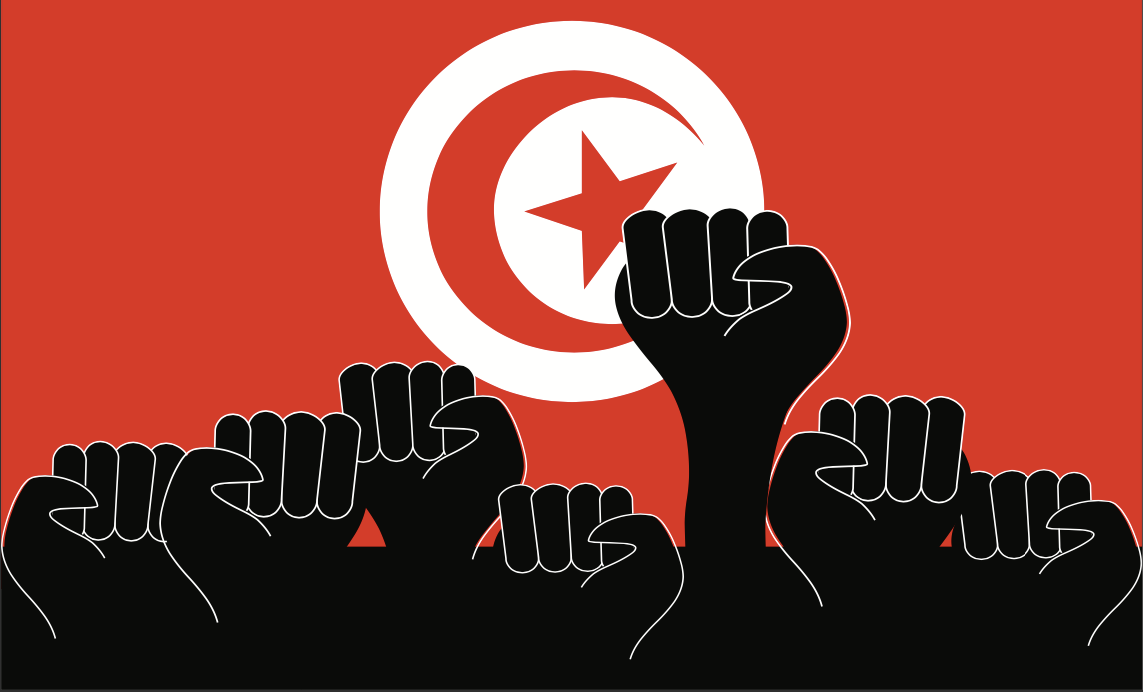
Music genres such as rap have become the primary artistic means for expressing the discontent and aspirations of a new generation of activists in Tunisia. But the heritage of protest songs from decades before is still held in the collective memory of young leftists.
From the mid-1970s and throughout the 1980s, during the regime of Habib Bourguiba, the protest song in Tunisia developed as a countercultural music scene. This is a period characterised by economic instability and waves of protest and political contestation.
The protest song was the product of the cultural work of Tunisian leftist parties and organisations, which were particularly active in the student movement and influential among grassroot unionists.
Why was such a popular art form important for the cultural work of the Tunisian left? In my research I argue that leftist activists found in popular culture – and in songs in particular – a powerful tool. It could raise awareness among young people, galvanise activists and spread socialist revolutionary ideas. These songs become a link in the longer chain of resistant cultural practices in the country.
Art and politics
In Tunisia, the protest song is called al-ughniya al-multazima in Arabic, or chanson engagée in French. Both literally mean “committed song” and put an emphasis on the political and social aim of this genre. Art, in this case music and poetry, was a vehicle to convey a message.
In the 1970s and 1980s protest song groups formed and artists were increasingly visible. Among the pioneers of this genre there were the songwriter Hédi Guella and the group Imazighen. They performed on university campuses and at unionist venues, animating political gatherings and events. They exhibited in cultural centres and some participated in important cultural festivals. Their songs were rarely broadcast on TV or radio, but tape recordings circulated widely among activists and students.
The songs were mostly typical of the Arabic musical tradition, created on instruments such as the oud, the nay and the darbuka.
Their political and cultural framework distinguishes these songs from previous popular chants of protest (for example against colonialism) as well as from patriotic songs (praising the nationalist regime).
A new popular culture
The 1970s and 1980s protest songs were expression of a counterculture that was at odds with the ideology propagated by the regime of Bourguiba, who died in 1987.
Bourguiba had come to power in 1956 as the leader of the nationalist movement against French colonialism. Educated, middle-class and rather Western-oriented, he promoted a modernist and reformist ideology. In the last two decades of his regime, he was losing consensus among the population at large and among the new cultural and intellectual elite.
The Tunisian radical left was increasingly influenced by Maoism and Arab Nationalism. They recognised that a connection with the working class would be impossible without an appreciation of the Arab-Muslim identity of the Tunisian people.
The left engaged in cultural work for the creation of a new national-popular culture. This needed to be rooted in the people’s culture but also be an expression of a progressive and socialist ideology. Marxist theorists such as Antonio Gramsci had become influential. His ideas on cultural work, hegemony (the dominance of one group over another) and common sense had penetrated the Arab intellectual world.
Songs were one of the most efficient tools for implementing this project. They were easy to propagate with the new and cheap technology of audio cassette. Concerts were organised on a small budget, attracting hundreds of people.
The oasis and the mine
Among the many interpreters of the protest song in Tunisia, two popular singing groups stand out.
Al-Bahth al-Musiqi (The Musical Research Group) hailed from the southern Mediterranean city of Gabes, which lies beside an oasis and has, since the 1970s, hosted a massive chemical industry complex. Awlad al-Manajim (The Children of the Mines) were from Moulares, a village near Gafsa, situated in a phosphate mining basin.
Both groups, still active in Tunisia today, were born from places where industrialisation and the exploitation of natural resources deeply transformed the once rural environment. This industry would ultimately impoverish and harm the resident population.
The members of al-Bahth al-Musiqi were university students active in the student movement. The members of Awlad al-Manajim were workers who supported the workers’ struggles in their hometown.
Both groups were cherished by leftist activists and unionists for their performances and for the strong revolutionary message of their songs.
Both groups created a popular yet revolutionary cultural product. To do so they drew from modern Arabic poetry, for example singing poems by Mahmoud Darwish supporting the Palestinian people. But in particular they drew on themes and styles typical of Tunisian folklore and vernacular poetry. They responded in an original manner to the need to create a new, popular, socialist culture for the masses.
They took inspiration from other Arab experiences. Composer and singer Marcel Khalife (Lebanon), experimental musical group Nass el-Ghiwane (Morocco) and especially the duo of musician Sheikh Imam and vernacular poet Ahmed Fouad Negm (Egypt). This musical production represented a new, revolutionary and genuinely popular culture.
Hence, al-Bahth al-Musiqi produced songs like Hela Hela Ya Matar (Come Down O Rain), Nekhlat Wad el-Bey (The Palm Tree of Wad El Bey) or Bsisa (a traditional southern dish). These juxtapose rural imagery with national symbolism and revolutionary slogans.
Similarly, Awlad al-Manajim’s repertoire includes local songs about the harshness of life in the mining region, like Ya Damus (The Tunnel), and songs calling for workers’ solidarity and Arab unity against imperialism, like Nashid el-Sha’b (The Hymn of the People).
A heritage of resistance
The popular protest song scene in Tunisia declined with the rise of the Ben Ali dictatorship in the 1990s. But it never disappeared. After the 2011 revolution forced Ben Ali from power, some of the old singing groups reunited and claimed their space in the newly democratised cultural scene.
In Tunisia today, protest music takes many forms, from rap to electro. However, the old protest songs are still chanted at political gatherings, commemorations and festivals.
Despite being scarcely documented and studied, the Tunisian protest song of the 1970s and 1980s is an integral part of a resistant collective memory. It is loaded with emotional and political meaning for a generation of political activists and unionists.
The study of this experience may offer a new perspective on Tunisia’s cultural and political life under authoritarianism. It sheds light on the continuing and constant presence of dissent and revolutionary culture in the country – one that paved the way for the events that, in 2011, eventually overthrew dictatorship.


