The term Siddi refers to Afro-Indians – Africans who mixed with Indians through marriage and relationships. Africans crossed the Indian Ocean and arrived in India during the 1200s, 1300s and 1400s. They were transported by Islamic invaders and Portuguese colonisers as enslaved people, palace guards, army chiefs, harem keepers, spiritual leaders, Sufi singers, dancers and treasurers.
Today, the majority of Siddis are found in the west and south-west of India, in Gujarat, Maharashtra, Karnataka and Telangana states. As they settled, they preserved and practised their African ancestral sociocultural traditions – and also adopted local Indian traditions.
This interweaving of African and Indian cultural values gave birth to various creolised (mixed) food, music and spiritual practices.
As a diversity studies scholar, I have been researching Siddi culture for some time. Working within this community in Gujarat and Karnataka, I found that their creolised cultural practices emerged as a resistance to colonisation, racialisation and victimisation in postcolonial India.
My most recent research – which can also be seen in a new documentary – has focused on the music and dance performances of the Siddi community in Gujarat, called Dhamaals.
The story of Dhamaal performance traditions reveals the rich and complex mixing of cultures in a world shaped by human movement and history.
What are Dhamaals?
Dhamaal is a mix of Sufi and African (mostly East African) musical and dance traditions. It refers particularly to the spiritual practices of the Siddis of Gujarat.
The Siddis begin almost every Dhamaal song by blowing into a conch shell. This is often followed by the slow playing of East African percussion instruments like the musindo and the slow thumping of feet that marks the onset of the singing and dancing Dhamaals. The ritual of foot thumping is a crucial part of spiritual East African dance and musical traditions.
The Siddis are followers of Islam and arrived in India from Muslim communities in East and Central Africa. Dhamaals are performed in memory of their spiritual leaders, among them Bava Gor, Mai Misra, Baba Habash and Sidi Nabi Sultan. According to Siddi folklore they arrived from Ethiopia through the Nubian Valley, Syria and the Indian Ocean to the coast of Kuda in the Bhavnagar district of Gujarat.
Usually, Dhamaal songs and dances are performed to celebrate the anniversary of the birth and death of spiritual leaders. They are performed in two ways – Dance Dhamaal and Baithaaki Dhamaal. The Baithaaki Dhamaal is performed in the sitting position and the Dance Dhamaal is performed in both sitting and dance positions.
During the performance of Baithaaki Dhamaal the focus is more on the lyrics and less on the musical instruments. During Dance Dhamaal the focus is more on the sounds of the instruments. These are often played in a frenzied manner and accompanied by frenzied dance movements. The spiritual songs that are sung during the Dhamaals are known as zikrs.
A mixing of cultures
The creole cultural aspects of Dhamaals are broadly reflected through the Swahili Creole language used to sing the zikrs, the Indian and African musical instruments used to perform them and the Afro-Indian body movements of Dance Dhamaals.
Historically, the Swahili Creole language in India emerged among the Siddis through the mixing of Kiswahili from East Africa with Gujarati, Hindi and Urdu languages from India. As an example, these are the lyrics of one zikr:
Ya bolo sabaya hua wey
Ya bolo sabaya hua wey
Hu sabaya
Salwale Nabi Sultan
This zikr is sung in the praise of Siddi spiritual leader Nabi Sultan, believed to have arrived in Gujarat from the Nubian Valley. The Swahili words that have been used are “hu” (a common expression of consent) and “sabaya” (meaning that everything is alright). The zikr means that with the blessings of Nabi Sultan no evil can befall the Siddis of Gujarat.
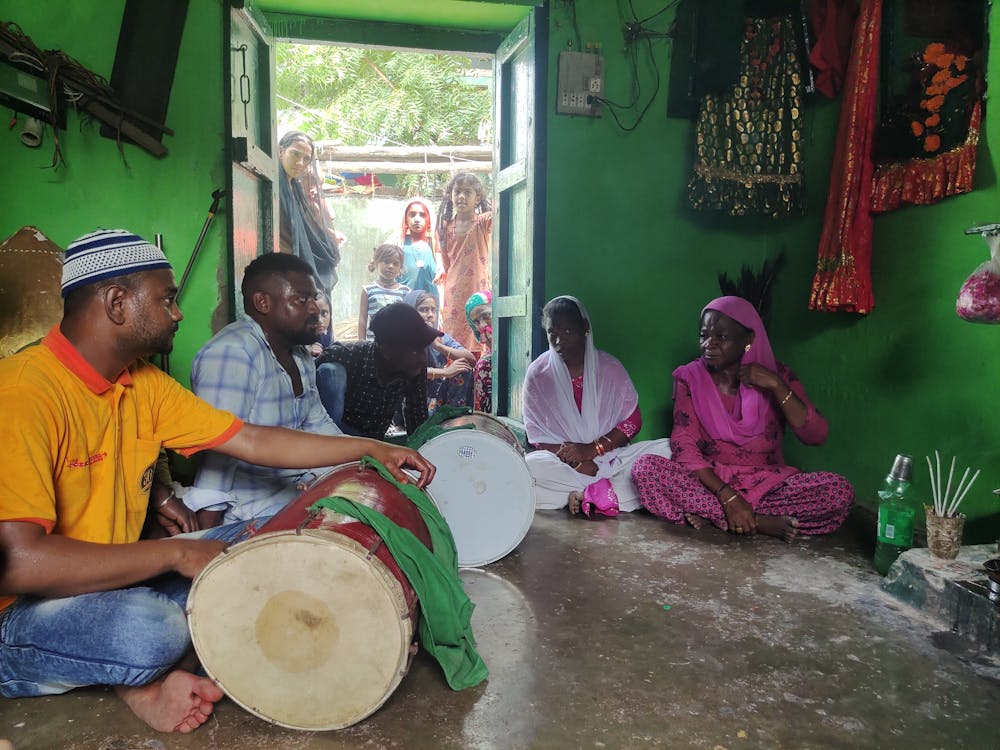
The musical instruments used to perform the zikrs are East African percussion instruments. The musindo, for example, is a cylinder-shaped, two-sided drum from Kenya. The misr kanga is a small, funnel-shaped instrument from Ethiopia, containing small stones. The mugarman is a large, cylinder-shaped, one-sided drum from Tanzania. These are played along with traditional Indian musical instruments. These include the harmonium (a keyboard instrument) and the dholak (a two-headed hand drum). The intermingling of Indian and African musical instruments generates creole rhythmscapes which are traditionally African and Indian at the same time.
During the Dance Dhamaal, the hand and the body movements of the Dhamaal dancers in Gujarat are very similar to the Ngoma dancers of East Africa. The Ngoma dancers thump their feet and swing their arms sideways to the rhythm of drums. The Dhamaal dancers also swing their arms sideways, but the thumping of feet depends on the context of their dance. During religious occasions, for example, the foot thumping is slow. This is because the Siddis follow many spiritual aspects of the Sufi tradition. For Sufis, heavy and frenzied feet thumping is prohibited when worshipping spiritual leaders.
Transoceanic roots
These creolised musical and dance performances allow the Siddis in Gujarat to maintain their African ancestral practices. They do so in collaboration with Indian practices so that they do not forget their historical roots yet can respect local traditions at the same time.
These creole practices have allowed the community to build a transoceanic identity (one which crosses the oceans). This is done in a collaborative, reciprocal and diverse way.
The Dhamaal tradition of the Siddis has socially, culturally and economically empowered the community as well. Several community members, through the assistance of government and private organisations, travel across India and the world to perform at cultural festivals. This encourages the Siddis to share their creolised cultural values across the globe.
This in turn invites audiences to consider history through an interracial and intercultural lens.


