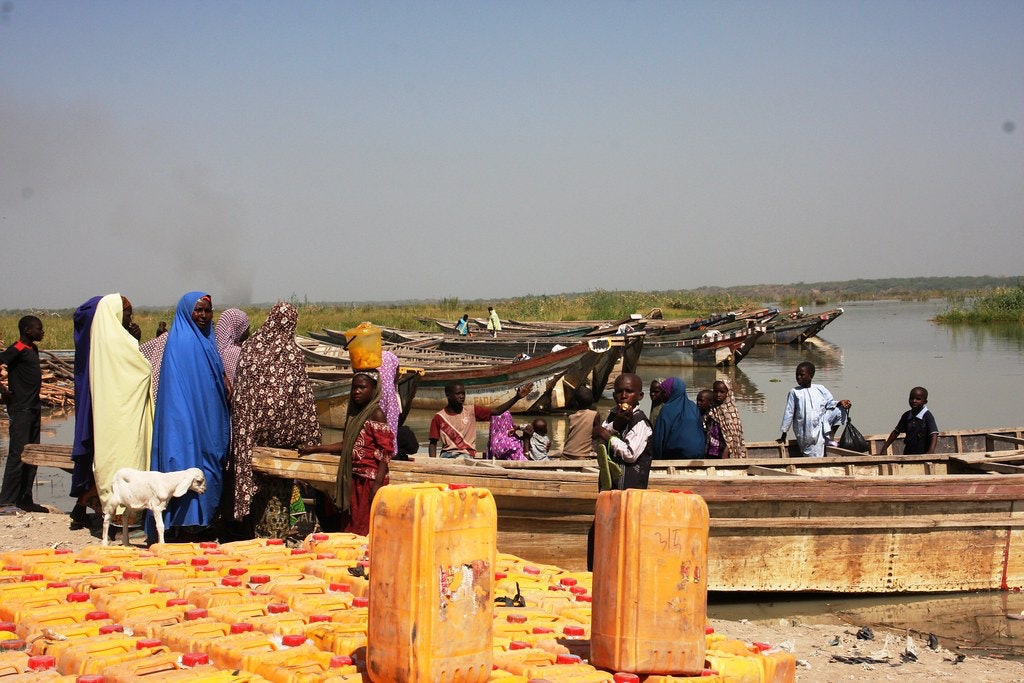
It is now 14 years since Boko Haram and other armed groups began to operate in the Lake Chad Basin. The region, which includes Niger, Nigeria, Chad and Cameroon, has become unstable and the people who live there are in dire need of humanitarian assistance.
Out of the 30 million people in the Lake Chad region, 11.3 million have been displaced by the conflict and over 11 million urgently need aid.
Drought and flooding are adding to the problem. Lake Chad, the primary source of water in the region, has shrunk significantly due to drought since the 1960s. In 2022, the region was hit by a severe flood. More than 600,000 people and large areas of agricultural land were affected. These climate-related disasters pose a serious challenge to food security. Over 5 million people in the region are struggling to get enough food to survive and half a million children are suffering from acute malnutrition.
The Lake Chad Basin conflict affects everyone who lives there. But evidence suggests that young people experience the greatest impact. The majority of the people who join Boko Haram are young men. Poverty, absence of basic services like education and healthcare, and loss of livelihoods push young men to join Boko Haram.
With the region’s population expected to double in the next two decades, the insecurity has serious implications for development and people’s well-being.
Five focus areas for Lake Chad
For many years, the governments of the affected countries have worked together with the international community to find solutions. Several high level conferences have been organised to raise funds and discuss the crisis. In 2018, the affected countries adopted a five-year regional strategy to address the root causes of Boko Haram’s emergence and its consequences. But the crisis has continued, largely due to limited collaboration and underfunding.
In January 2023, as researchers and practitioners working in the fields of stabilisation and displacement we visited Niamey, the capital of Niger, for the 3rd High Level Conference on the Lake Chad Basin Region.
The aim of the conference was to take stock of the progress made in addressing the crisis and to forge pathways for a more coherent and collaborative response. A diverse range of voices was represented, from government officials to international agencies, researchers and civil society groups.
The importance of local ownership, social inclusion, civilian protection and climate action are key points that emerged from the conference.
Regional and national ownership
International partners, donors and other actors involved in stabilisation, peace, development and humanitarian aid agreed to work with the local communities, national governments and regional institutions to foster regional and national ownership of intervention programmes. This idea isn’t new: it was mooted in 2021 at the third governors’ forum. Yet progress has been slow.
The idea is that the local communities who suffer the impact of the crisis and who know the context must participate actively in finding and implementing solutions, rather than having external solutions imposed. Solutions that are shaped by the culture and values of the affected populations are more likely to be relevant to them. This will help to build trust and sustain peace and development.
Including young people, women and girls
Young men face higher risk of joining Boko Haram. Women and girls face the risk of sexual violation and gender-based violence, including rape and forced marriage at the hands of extremist groups. The key message of this high-level conference was “leave no one behind”. Participants emphasised the need to create employment opportunities for young people to restore their hope and build shared prosperity. This can be achieved through entrepreneurship programmes, skills training and engaging youths in productive agriculture. Victims of sexual violations should receive mental health and psychosocial support.
However, research has shown that youth interventions can reinforce inequality if elites or youth representatives “capture” the programmes and less powerful youth groups are excluded. This must be avoided.
Managing mass exit from Boko Haram
Some programmes have been implemented to facilitate the voluntary exit of Boko Haram recruits and reintegrate them into the society. Nigeria’s Operation Safe Corridor is one.
But if exits from violent groups are not handled well, social cohesion and community security could be undermined. Critics point out that Operation Safe Corridor does not provide enough screening, training, support and reparations for Boko Haram members before reintegrating them into the community.
Transitional justice mechanisms will be needed to address the legacy of the conflict (including human rights violations and abuses) and ensure accountability, justice and reconciliation. The root causes of the conflict, such as poverty and lack of economic opportunities, must also be addressed so that those who return home can live dignified and better lives.
Consultation with the wider community is necessary to improve acceptance and to ensure peaceful reintegration. Prioritising the needs of former Boko Haram members over those of the victims is unfair.
Protection of civilians
Many civilians continue to face violent attacks not just from Boko Haram but also from military officials. In recent years, civilians‘ access to humanitarian assistance has decreased. In part, this is due to immigration obstacles and increasing attacks on humanitarian workers. Civilians could be better protected through training more military officers on human rights and by supporting communities to build their own coping mechanisms.
Climate action
Conference participants explained that more work is needed to address the link between climate change, violence and displacement in response planning. Drought and flooding are increasing competition for land, water and food. This has led to conflict and displacement, as seen in Nigeria and Cameroon.
An important first step will be to amend the Regional Stabilisation Strategy to respond to this link. More funds will also be required to manage the harmful consequences of climate change. Yet funding continues to shrink. In 2022, the International Organization for Migration reported an 87% funding gap in addressing the drivers and longer term impacts of crises and displacement in the region, including climate change.
Achieving a peaceful future in the Lake Chad Basin requires more collaboration and financial commitment. Time, however, is running short.
This article was co-authored with Dr. Chika Charles Aniekwe. He is the Senior Advisor and Head of Stabilisation for the UNDP/Lake Chad Basin Stabilisation Strategy


