The private sector, agriculture and climate change. Connecting the dots:
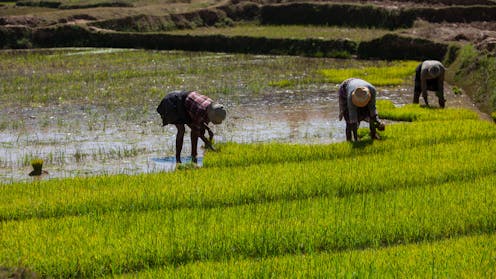
Agriculture plays a key role in food security in Africa. It is also crucial to the economic sector, accounting for between 40%-65% of jobs. Farming is expected to remain an important livelihood for decades to come.
At the same time, agriculture in sub-Saharan Africa is very vulnerable to climate change. Agriculture was a priority under the commitments made by sub-Saharan countries to the Paris Agreement.
The widely held view is that the public sector alone can’t meet the cost of the continent’s commitments. Already there’s a mismatch between the investment needs for adaptation and the finance available. As a result, there is increasing interest in bringing in capacity and resources from the private sector to achieve countries’ climate change commitments.
Against this background, our recent research examined the role of private-sector players in helping agriculture in sub-Saharan Africa adapt to a changing climate. This work is part of wider research that looked at ways to give the private sector incentives to help countries in the region achieve their Paris Agreement goals.
Our work shows that these projects for agriculture vary widely. Some use public finance to raise awareness of climate risks and adaptation opportunities. Their aim is to stimulate future private investment. Others channel public finance through private players which are hired to provide goods and services.
Our analysis suggests that the public sector could do more to engage the private sector. Enabling and encouraging private investment, particularly in infrastructure, is expected to have high pay-offs.
Some examples
We found that private actors – smallholder farmers as well as small and medium-sized private businesses – are beginning to play a role in a wide variety of key adaptation strategies. Their actions include:
-
Introducing irrigation and water management systems
-
Improving weather and seasonal forecasting systems – and ensuring that farmers can use them
-
Introducing drought- and heat-resistant crop varieties,
-
Adopting new “climate-smart” farming techniques, and
-
Expanding finance insurance options for farmers.
In Namibia, a project is showing how small-scale farmers can pay for agricultural index-based insurance. The aim is to develop a viable business model. The insurance policy uses a parameter (or index), such as rainfall estimates or vegetation cover, to determine when a payment should happen to cover the loss after an extreme event, like drought.
In Mozambique, a project is strengthening hydrological and meteorological information services to deliver climate information at the local level. Services include hydro-meteorological information for farmers; flood forecasting and early-warning systems, and weather service alerts in coastal areas. Television, radio and telephone companies are crucial as they deliver the forecasts and warnings. And, as the users, commercial farms and maritime transport companies are part of the design and implementation of new hydro-met services.
In Madagascar, a project is increasing climate resilience in the rice sector. Through public-private partnerships, it promotes the use of modified fertilisation practices and drought and pest-resistant varieties of seeds.
These examples suggest that the private sector is getting involved in agricultural adaptation to climate change in sub-Saharan Africa.
But there are still two important barriers to overcome.
First, developing countries can find it difficult to attract private investment to meet their most urgent needs. Second, low awareness of climate risk is also a barrier for private involvement in adaptation. But business opportunities do exist, and a growing number of adaptation projects are now demonstrating their potential.
Getting the private sector involved
There are five ways in which policymakers could make it more attractive for private actors to engage in agriculture adaptation in sub-Saharan Africa.
Provide more clarity. Policymakers should be clear in stating which private actors – and in which capacity – they want involved in their agriculture adaptation projects and programmes. This would help accelerate and scale up private investment. The private sector is, obviously, diverse. Different actors respond to different incentives. Without clarity, projects may struggle to identify opportunities for private-sector involvement.
Involve private actors at the design stage. By identifying ways to involve private actors already at the design stage, project developers can create stronger partnership and more effective ways to promote investment.
Look for opportunities along the value chain. Increasing agricultural productivity is not the only possible target. Improvements in the harvest and commercialisation stages also offer potential for involving private sector actors.
Demonstrate potential. Demonstrating the commercial viability of adaptation strategies is vital. Public funding should therefore be focused on feasibility assessments or arranging pilot projects.
Scrutinise results. Monitoring and evaluation of adaptation projects should include ways to assess private-sector involvement – when it works and when it fails. Transparency in this kind of information can help identify future opportunities.
Private actors already play a role in agriculture adaptation projects in sub-Saharan Africa. But more work is needed to identify effective policies to increase their involvement, and remove existing barriers.
Nella Canales, a research fellow at the Stockholm Environment Institute was a co-author on this article.

Richard J.T. Klein leads the project PRINDCISSA, which is funded by the Swedish Energy Agency.
Source: The Conversation – Articles (AFRICA)
Read more on The Conversation.
Join the fun: Add Your event | Submit a Press Release | Add your listing.


