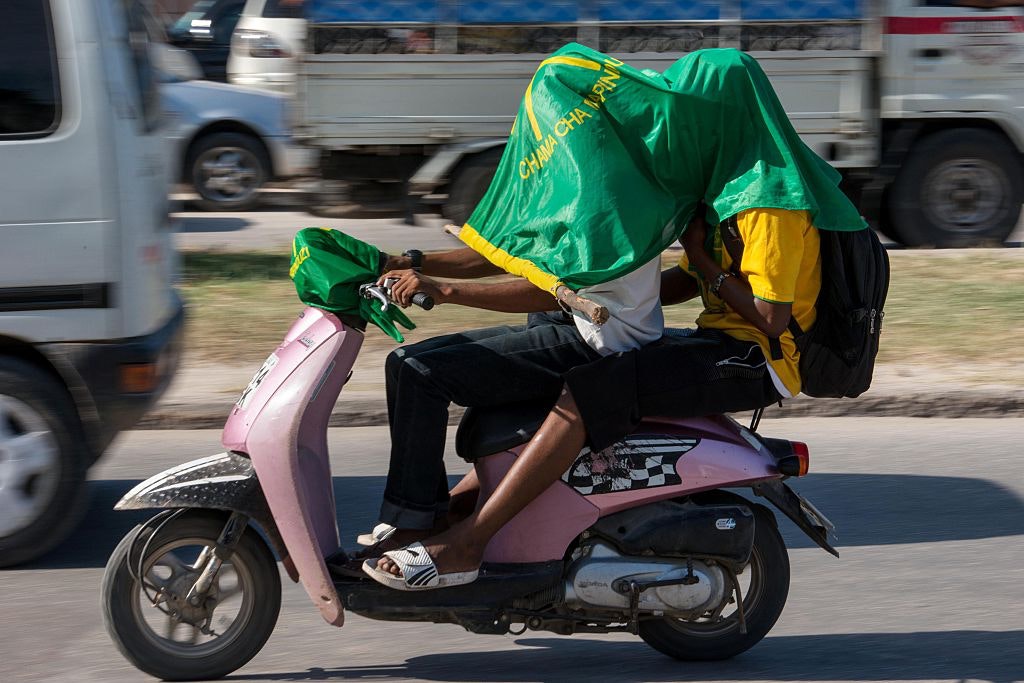
Nobody was surprised that President John Magufuli won a second term in Tanzania’s 2020 general elections. The ruling Chama Cha Mapinduzi has been in power since independence in 1961, and has never come close to losing power nationally.
What was surprising was the huge size of the victory, the oppressive strategies used to bring it about, and the continued closing of political space even after the votes were tallied.
Many blamed this authoritarian turn on Magufuli himself. But in our new journal article “Tanzania: The Roots of Repression” we argue that this is a mistake.
Magufuli’s tenure did not take the ruling party, Chama Cha Mapinduzi, off a democratising path. It was never on one. It is also unlikely that a different leader would have given Tanzania a free and fair election.
Put simply, Chama Cha Mapinduzi’s rule has always had coercive elements.
This assertion has two important implications for understanding Tanzanian politics. First, it leads to a more accurate framing of Magufuli’s life and legacy following his untimely death in March 2021. Second, it suggests that there may be significant limitations to the political reform that will be realised by his successor, President Samia Suluhu Hassan.
How to control an election
The 2020 general elections were not free, fair or credible.
Following a decade of putative democratisation, the election campaign laid bare the crude authoritarian logic of the ruling party. As the Africa Center for Strategic Studies notes,
violence has become deeply embedded in Chama Cha Mapinduzi’s current calculus of control.
A particularly chilling instance of political violence was the September 2017 attempt on the life of Tundu Lissu, the leader of Chadema, the main opposition party.
The intimidation of the opposition and its supporters continued throughout the election, backed by censorship and efforts to disqualify hundreds of opposition legislative and local government candidates –- in some cases with the clear aim of giving Chama Cha Mapinduzi a better chance of winning the seat.
Meanwhile, a new law gave the state power to oversee, and even suspend, civil society groups. This further limited freedoms of association and information.
These strategies continued even after Chama Cha Mapinduzi had officially won 84% of the presidential vote and 97% of legislative seats, when a number of senior opposition party members were arrested.
The disturbing side of Nyerere’s legacy
It is easy to see why many people associated the country’s “authoritarian turn” with Magufuli’s rise to power. Had not Tanzania been on a democratising arc? If so, surely it was Magufuli’s idiosyncratic leadership that wrenched it off track.
But the authoritarian strategies used to produce the lopsided 2020 results are familiar Chama Cha Mapinduzi tactics. Repression, censorship, indoctrination, and the misuse of state resources for partisan ends have always been the methods that CCM presidents deploy to retain control.
Tanzania’s first president, Julius Nyerere, was an anticolonial activist and intellectual. He is often rightly revered for securing his country’s independence and keeping it politically united.
But this reverence has obscured the fact that he consistently used repression to maintain control.
One-party rule
In 1965, Nyerere introduced a single-party system which outlawed political opposition and made it easier to manage the ruling party. The lack of an opposition left dissatisfied ruling-party factions with no alternative political vehicle to defect to. It was thus easier to keep them in line.
But this was not all. Anyone held to be a threat to state security could be detained at presidential discretion. By 1977, Amnesty International estimated that there were up to 2,000 such detainees in Tanzania.
Mass incarceration was buttressed by the abuse of state power for partisan ends. Party cadres were involved in dishing out patronage, buying votes, and intimidating political foes.
The barrage of authoritarian laws that Nyerere used were the basis for the “lawfare” that Magufuli waged.
Securing hearts and minds
Nyerere gained credit by voluntarily leaving office in 1985, one of the first African leaders to do so. Yet he left a legacy of censorship and ideological indoctrination that helped to cover up some of the abuses of his regime and continues to underpin state repression today.
The Newspaper Act of 1976 and associated laws allowed the president to ban publications – domestic and imported alike. It was the precursor to the Media Services Act (2016), which was used to crack down on the press under Magufuli.
Beyond this, Chama Cha Mapinduzi pushed an official state ideology, particularly through education. Constant pressure to teach obedience and loyalty to the ruling party meant that over time teachers “internalised” authoritarian values.
Multipartyism and democratic backsliding
Chama Cha Mapinduzi does not repress and censor in constant measure, however. Instead, it knows how to let up and bear down.
Thus democratic backsliding under Magufuli also reflected the growing strength of the opposition.
In the 1990s, Chama Cha Mapinduzi won elections on the mainland with ease, so civil society groups and opposition parties were allowed to operate with relative freedom. This changed around 2010, when Chama Cha Mapinduzi’s vote-share drop started to alarm the regime.
It was after Chadema began to make significant inroads that Chama Cha Mapinduzi started to move against civil society. Significantly for our argument, some of this repression occurred before Magufuli became president.
Prospects for democratisation
We were just finishing our article when news broke that Magufuli had passed away. His successor, former vice-president Samia Suluhu Hassan, sparked hopes of a process of democratic reform when it appeared that she had lifted “a ban on all media”, and committed her government to transparency and accountability.
These efforts should of course be welcomed and supported, but our analysis suggests that – just as with the early days of the Magufuli presidency – it is important not to celebrate the emergence of a reformist leader too soon.
Real change would mean revising and removing repressive legislation and structures so that they cannot be employed in future. Repressive media laws remain on the books. And while the president noted that “we should not ban the media by force”, she added “we should ensure they follow the rules”. Just hours after her celebrated statement on media liberalisation, the government rolled it back, “clarifying” that it was only online television that was being unbanned.
New leaders can claim the reformer’s mantle, but giving them too much credence before serious structural reforms have taken place sells democracy short and increases the risk of authoritarian relapse when political opposition begins to rise.
Real and sustained democratic progress in Tanzania will require not just a new leader, but the emergence of supportive pro-reform factions in the ruling party to support their ideas. President Samia Suluhu Hassan may be able to engineer this over time, but Chama Cha Mapinduzi’s history tells us that doing so will be a long and difficult struggle.


