The story of the enigmatic man who founded southern Africa’s largest church:

Every Easter weekend, several millions of Zion Christian Church (ZCC) faithful from across southern Africa descend on “Moria city”, the church’s capital in the north of the country, for their annual pilgrimage.
The church, founded by Engenas Lekganyane in 1925, is “the largest indigenous religious movement in southern Africa.” An estimated one in ten South Africans is a member, according to University Allan Anderson, Professor of Theology at University of Birmingham.
There are two branches of the church. The main one is led by the founder’s grandson, Bishop Barnabas Lekganyane (b. 1955) The breakaway St. Engenas ZCC is headed by his namesake and great-grandson.
Both of these competing branches are headquartered at Moria, two kilometres apart on the same farm on which Engenas died and was buried. They hold separate pilgrimages and other events.
The regular members of the main branch are expected to wear Star badges at all times. For their part the St Engenas members sport Dove badges. Both organisations are similar in theology – a fusion of Christianity and traditional African beliefs. They prohibit drinking, smoking and eating pork, among other practices. The Star section has a distinctive men’s organisation.
The unrelenting growth of the ZCC has essentially sidelined the traditional Protestant churches that introduced Christianity to southern Africa. In addition to their vast membership base across the region, they also control extensive business empires in areas such as transport, agribusiness and insurance.
But, even though Lekganyane was central to the redefinition of Christianity in southern Africa, his life story has been extremely difficult to track down. Few written records have survived. In addition, the ZCC has always been secretive. Members are forbidden from discussing the church with outsiders.
Church writings are restricted to members and still cannot be found in public libraries. Researchers, from the 1940s onwards, were also stifled as the church sought to maintain tight control over its message and practices.
My new book, Engenas Lekganyane and the Early ZCC: An Unauthorized History sheds light on the enigmatic figure and foundations of his church. The full biography became possible after a substantial cache of new documentation emerged about Engenas and the ZCC in the last few years.
Who was Engenas Lekganyane?
The Lekganyanes were ordinary members of a small Pedi chieftaincy living in the hills east of Polokwane. They lived on land owned by German missionaries, and Engenas grew up as a Lutheran before a political disagreement erupted over a land dispute between the mission and the tribe.
In the late 1890s the young Engenas was educated by Xhosa Presbyterian missionaries brought in to replace the Lutherans. So Engenas had a very orthodox Protestant background and education.
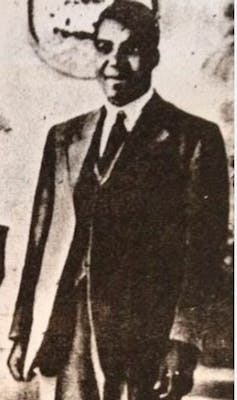
Lekganyane’s education and life were completely disrupted following the outbreak of the South African War between the British and the Boers in 1899. He eventually became a migrant worker, leaving home to work in nearby Tzaneen and faraway Boksburg on municipal construction projects.
During these years he first joined Pentecostal or Zionist churches. But he was expelled from Tzaneen by the Protestant chief. Returning home in 1915 at the age of 30 he began his own church with 14 members. Within 10 years he had 926 followers and began the ZCC following a vision he had at the top of Mt Thabakgone, a now sacred hill adjacent to his village.
After a legal dispute involving the stillbirth of his illegitimate child, Lekganyane was expelled by his chief in 1930. He lived on private land thereafter, carefully maintaining his autonomy and privacy.
Making of the ZCC
Lekganyane was initially inspired by an Australian faith healer named John Alexander Dowie. He took most of his theology from the then white-led Apostolic Faith Mission a Pentecostal group he belonged to from 1910 to 1916.
He incorporated many syncretic practices taken from African tradition. The most important of these was to incorporate ancestral worship into his church, a practice that he adopted from an early Zionist named Daniel Nkonyane.
ZCC members were expected to make cash offerings to their ancestors, which they gave to Lekganyane so that he could intercede on their behalf. He also reputedly protected his members against witchcraft, crime and disease. Over time, he usurped the roles of the chiefs as the claimed major rainmaker in the region.
By 1948, his church had grown to about 50 000 members. His legend within the ZCC community has grown substantially ever since. Even though he left no writing texts behind, the ZCC has made him the focus of its sacred narrative. The story of his religious calling, and also his various claimed miracles and prophesies, are well known by all members.
One of the reasons he managed to turn the ZCC into a religious juggernaut was his financial astuteness. He acquired property and carefully used donations for expansion. Additionally, he catered primarily to migrant workers, the largest growing segment of the African population.
Engenas Lekganyane (c. 1885-1948) died 71 years ago on his private farm east of Polokwane.
During his lifetime, Lekganyane was never mentioned in print. Nor did anyone write his obituary following his rapid burial. He lived, to the end, a secretive and enigmatic existence.

Research Fellow, Department of History, UNISA
Source: The Conversation – Articles (AFRICA)
Read more on The Conversation.
Join the fun: Add Your event | Submit a Press Release | Add your listing.


