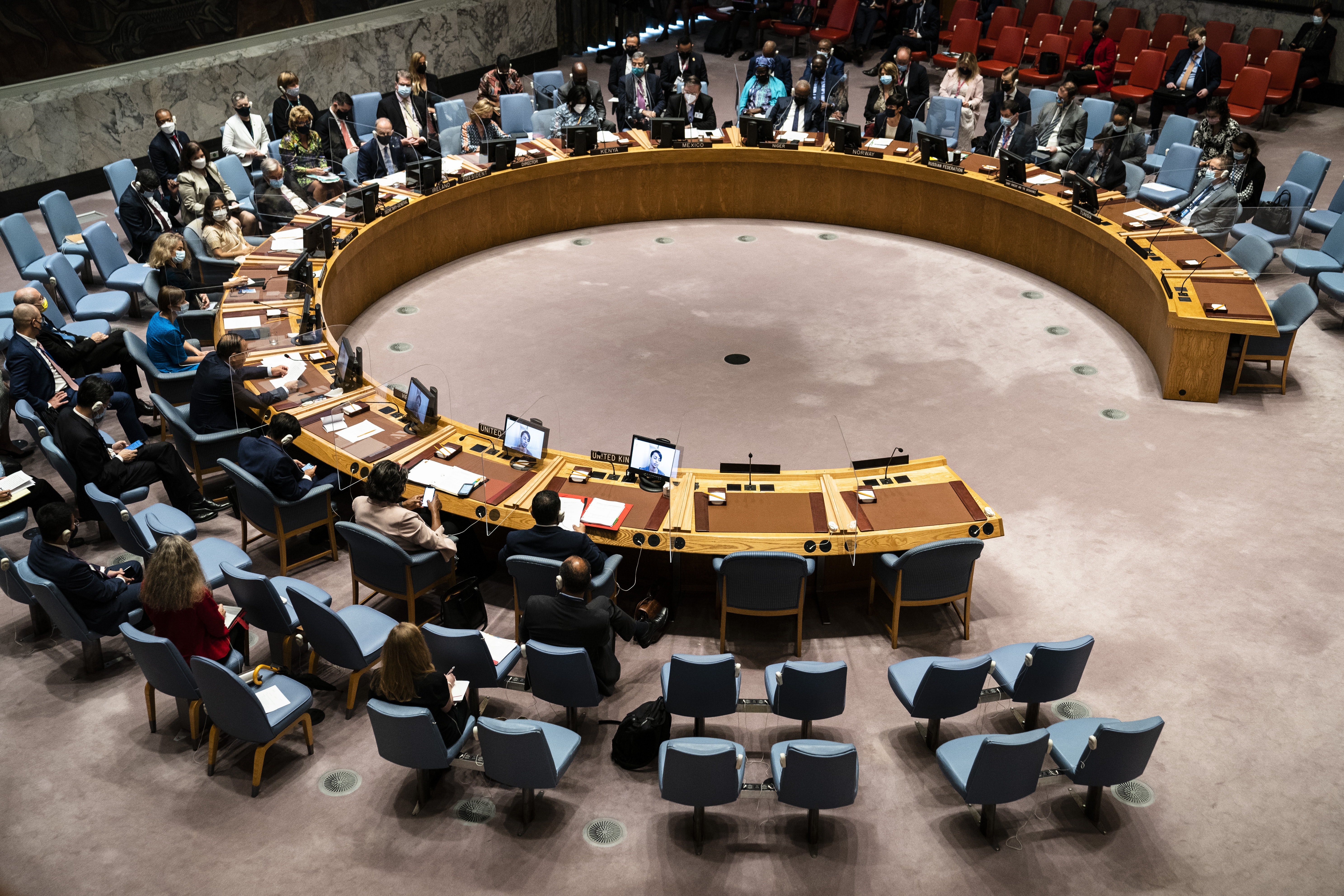
There are growing demands for the UN Security Council to act on the war in Tigray. The Security Council has held 11 sessions on the war that started in Tigray a year ago. But each session ended without even a single official statement. Russia and China —- shielding themselves behind the position of the three African members of the Council Kenya, Niger and Tunisia —- defined the Tigray problem as an Ethiopian internal problem.
There is no place in the world where the global asymmetry of power plays out as vividly as in the Security Council. Whether or not the rest of the members of the Security Council agree, there can be no resolution if any one of the permanent five members objects to it. This has so far left the Security Council in the default position of leaving the matter to the government of Ethiopia.
The balance of power in the conflict has changed in favour of the Tigray Defence Forces. This new development might create a renewed appetite for the council to adopt a resolution. In such a case the council should learn from previous mistakes and particularly from its resolution 2216 on Yemen and its consequences. The resolution was taken in 2015.
A Security Council resolution can be an instrument for peace – but it can also be an obstacle to it.
UN resolution 2216
By the time the Security Council convened and adopted Resolution 2216 and recognised the regime of Abd Rabbu Mensour Hadi – who had been appointed on interim basis – as the only legitimate entity to rule and demanded the Houthis to disarm and withdraw to their pre-2014 positions, the civil war in Yemen had escalated. Despite the good intention of the decision, some articles of the resolution ended up being a millstone around the UN’s neck.
The three key mistakes of the resolution are:
-
its complete and unconditional legitimisation of the interim government of Mansour Hadi
-
its call for the complete and unconditional disarmament of the Houthis
-
its demand for the withdrawal of the Houthi forces to their pre-2014 positions.
Simply put, a resolution the UN Security Council adopted to address the Yemeni crisis ended up constraining its efforts to bring peace to Yemen.
There are some parallels with the situation in Tigray. These include the contested nature of the legitimacy of the central government; a regional force being the lead belligerent to the central government; and the shift of power balance towards the regional force.
Avoiding the same mistakes
The original cause of the war in Tigray is rooted in the Federal Government replacing the Federal Constitution with a unitary regime run from the centre.
One year on the war in Tigray is now at its climax with reports that the Tigray Defence Force has taken back lost ground, and that it’s expanded into the Amhara.
Whatever happens next, the Tigray Defence Force has shown that a complete military triumph for federal forces is out of the question.
Ethiopia therefore stands on the brink of escalating civil war and state failure. This is the moment to prepare for concerted international action to prevent further drift and complete collapse for this nation of more than 114 million people.
Read more: Why the African Union’s mediation effort in Tigray is a non-starter
The Security Council must take care not to make Yemen-like mistakes in its deliberations and decisions. Three key issues need to be handled with care: legitimisation of the parties involved; redeployment of forces; and disarmament and arms control.
Legitimisation: By definition, in a civil war, each party is contesting the legitimacy of the other. The Security Council naturally inclines towards respecting the authority of the government of the day, but it is unwise to award that government unconditional legitimacy. What’s needed is an all-inclusive national dialogue for charting the future of a peaceful and prosperous Ethiopia. The Ethiopian government is not competent to organise and lead such an experiment. The design, organisation and leadership for such a forum should be part of the negotiation for political settlement.
Redeployment of forces: The US government and the European Union have demanded a cessation of hostilities and the redeployment of forces to their pre-November 2020 positions. So has the African Union.
The problem with such a proposition is its attempt to implicitly or explicitly link the provision of humanitarian assistance to Tigray with a ceasefire. But the obligation on the belligerent parties to respect international humanitarian law should not be conditional on a ceasefire.
Disarmament and arms control: The war thus far has ended up creating two conventional armies. The Tigray Defence Forces has captured large amounts of arms in the course of the war. These include includes tanks, howitzers, and armoured vehicles but also missile systems. It did not exist prior to this war: it was created in response to it.
This army is now fighting for the full realisation of the right of the people of Tigray for self-determination. This includes secession. It is therefore impossible to talk about disarmament at this time. All that can be on the table is arms control and management.
Political settlement
To secure peace, the Security Council could keep in its sites a three-phased peace process that, in my view, has the potential to secure a political settlement.
Phase one could include the immediate suspension of hostilities for the limited purpose of unimpeded humanitarian access; restoration of essential services; and withdrawal of Eritrean forces and Amhara militia from Tigray.
Along with these there would need to be an end to hostile propaganda and incitement of violence.
Finally, the release of political prisoners as an essential pre-condition for negotiations.
Phase two would entail direct negotiations towards a permanent ceasefire done directly between the federal government and the regional administration of Tigray. The parties would negotiate key principles, key actions, time lines and so on, for a complete political settlement.
This would lead to phase three, in which an all-inclusive national political dialogue would begin. This would hopefully end in a complete and national level political settlement.
By following this route the Security Council would ensure that it didn’t repeat the mistakes in made in Yemen.


