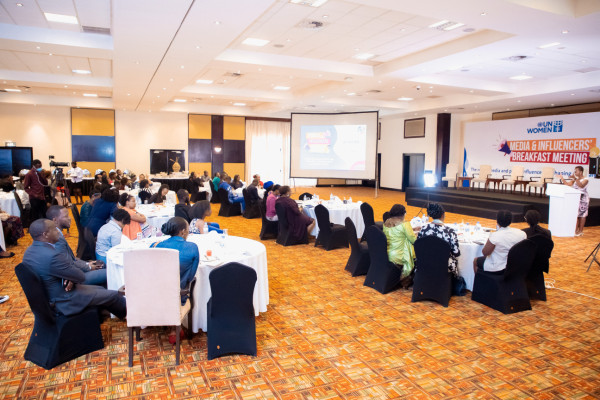
Through an interactive dialogue, the breakfast meeting was an opportunity to reflect on the role of the media, CSOs and other influencers in shaping and transforming negative social norms and stereotypes which exacerbate gender inequality, tolerate gender-based violence and impede effective enjoyment by women of their human rights agreed to in national policies and laws.
Rwanda has recorded significant gains in promoting gender equality and women’s empowerment in the country. Reports show that there has been unprecedented progress in gender equality on social-economic transformation and transformational governance. However, there are still prevailing challenges in achieving full gender equality and empowerment of women, rooted in negative social norms and gender stereotypes which, if not properly addressed, will continue to perpetrate inequalities and gender-based violence.
Social and gender norms being standards and rules that most members of societies agree upon, media plays a key role in reshaping norms positively using their power and influence. Through a breakfast meeting themed “The Role of Media in Shaping Social and Gender Norms”, UN Women Rwanda brought together reporters and journalists from different media houses, social media influencers, members of the civil society organizations, UN agencies, members of Parliament and representatives of different Government institutions to discuss existing negative social norms that hinder gender equality promotion and define strategies to address them.
As Guest of Honor at the event, Prof. Jeannette Bayisenge, Minister of Gender and Family Promotion applauded UN Women for bringing together media, CSOs and influencers on this important subject, noting the critical role these actors play in information dissemination at a wider scale, in advocacy and in shaping how people think, behave, socialize, and act. She urged the media to make full use of its powerful role in promoting gender equality, family cohesion and the well-being of Rwandans. “Addressing social norms and gender stereotypes embedded in our cultural beliefs and patriarchal society cannot be done overnight. It's rather a process that requires a mindset shift and concerted efforts by different stakeholders” she noted.
Welcoming the participants, UN Women Country Representative Ms. Jennet Kem commended the Government of Rwanda for advancing gender equality. “As we work towards dismantling patriarchal negative norms, it is important to reshape society to embrace and promote positive social norms that contribute to gender equality. Today’s meeting is a crucial moment for us to build on gender gains in Rwanda, reflect on innovative ways and strategies to address persistent negative social norms and gender stereotypes, and commit to sustainably addressing them.” Ms. Kem noted calling upon the media and other partners to join efforts in this light.
Opening the event on behalf of the One UN Country Team, Mr. Ozonnia, the UN resident Coordinator in Rwanda, stressed: “The Media has the power to challenge negative social norms, gender stereotypes, harmful practices, and negative cultural beliefs which continue to condone gender inequalities that increase gender-based violence,” said Mr. Ozonnia Ojielo, UN Resident Coordinator in Rwanda while officiating the event. He also reiterated that gender equality and women’s empowerment are among the One UN’s top priorities and recommitted to working closely with the Government of Rwanda, UN Women, and different partners, including the media, CSOs, and other key players to deliver on gender equality and women’s empowerment agenda, and in particular, on this journey to challenge the social norms, negative cultural beliefs, patriarchal attitudes, gender stereotypes, and GBV.
A panel of seasoned experts in the field of gender equality, comprising Mr. Silas Ngayaboshya, Director General of Gender Promotion and Women Empowerment from the Ministry of Gender and Family Promotion (MIGEPROF), Mr. Fidele Rutayisire, Executive Director of RWAMREC, Ms. Gaudence Mushimiyimana, Executive Director of UNABU drove the discussions on the role of the media in shaping social and gender norms.
According to a survey conducted by RWAMREC, 56% of men fear that they would not be needed at home if their wives were financially independent. Mr. Fidele Rutayisire, Executive Director of RWAMREC said that “This is one of many negative social norms that hinder our efforts to empower women economically.” Another example shared during the discussions is the higher number of women holding positions of Vice Mayors in charge of social affairs in Districts. “It is an achievement to have women in leadership positions. However, it is still believed that they perform better than men in dealing with social affairs than in economic or other technical affairs.” DG Ngayaboshya sharing the experiences they face in the efforts to change mindsets on gender equality, emphasized that men and women should not choose careers based on their gender, rather on their capacities.
Speaking at the media panel, Ms. Gaudence Uwamariya, Executive Secretary of UNABU, a local NGO that represents women with disabilities brought into perspective the negative social norms on people living with disabilities, in particular women, and invited media and public influencers to be keen in disability inclusion in their advocacy. She said that media should not contribute to victimizing people with disabilities, especially women and girls. “Women with disabilities face discrimination because men think they are not able to perform their roles in their homes, such as cooking, taking care of kids, and working in the fields, among other chores,” Ms. Uwamariya noted. She encouraged media to contribute to mindset shift and attitudes towards people living with disabilities through sensitization to remove barriers for girls and boys and allow them to enjoy their full rights as human beings,”
Furthermore, Ms. Murebwayire Shafiga, Rwanda Investigation Division Manager of the gender-based violence crime division, presented the state of violence against women in the country, which indicated a rise in GBV incidents however, there was also an increasing trend in reporting. She said that the media is doing well in communication and advocacy, especially around, GBV but the choice of words should be thoughtful to avoid the re-victimization of victims. “Media should be mindful of what information should be in public to avoid distorting evidence and protect victims.”
Considering the high expectations from the media as expressed during the meeting, Edmond Kagire, a seasoned journalist, and social media influencer acknowledged that the media plays a role in fueling negative norms in both news coverage, profiling the subjects and in the choice of words either on microphone or on paper. “There is a strong need of media training and gender-sensitive reporting guidelines to help us take the right path on this journey,” Kagire said. He also expressed commitment on behalf of his fellow media practitioners to challenge the status quo. “We acknowledge our important role in reshaping the social and gender norms, and from what was discussed here, I believe those who attended today’s meeting will become agents of change in our newsrooms and on our social media platforms in collaboration with UN Women guidance,” Kagire noted.
Through open dialogues, panelists and participants exchanged personal experiences to highlight the impact of negative social norms and gender stereotypes both in their areas of work as well as their everyday life. They also proposed a range of recommendations on how to address them and bring positive change in society.
In her closing remarks, Ms. Jennet Kem, UN Women Rwanda Representative reiterated that not all social norms are bad and that ending negative social norms is not a fight between men and women. “This is an issue that both genders need to work on together. Let us create accountability mechanisms for gender-sensitive reporting,” she concluded.
Among many others, Ms. Juliet Karitanyi, a communication expert who attended the breakfast meeting, proposed the creation of an online document that will help to list the negative social norms that condone gender inequalities, adding that this will help in addressing them properly.
The breakfast meeting ended on a high note of engagement and commitment from all partners, media and influencers.
Distributed by APO Group on behalf of UN Women – Africa.


