The World Bank is finding new ways to understand South Africa’s issues:
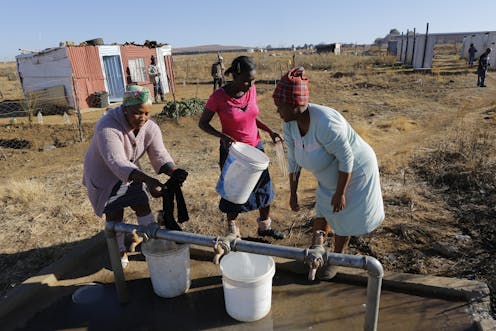
The latest World Bank report on South Africa is not only remarkable for the collaborative method it employed, but also for some of the conclusions it reached on issues like land redistribution.
The report, which includes contributions from a long list of external consultants including myself, the National Planning Commission and Statistics South Africa, is the platform for further engagement between the World Bank and South Africa.
In the 1970s and 1980s, the World Bank earned a justifiably bad reputation for seeking to impose solutions cooked up in Washington DC. Now, the bank takes great care to work in partnership with the country to figure out solutions to economic challenges.
This approach seeks to identify the underlying systemic constraints and not just the symptoms such as unemployment. The bank set out to get to the root causes of what it calls the twin challenges of poverty and inequality which characterise South Africa as an “incomplete transition”.
Interestingly, the bank – hardly known for being radical – identifies the skewed distribution of land and productive assets as one of the five key constraints. The other four are skills, low competition and economic integration, limited or expensive spatial connectivity, and climate shocks. I spoke to Paul Noumba Um, the World Bank’s country director for South Africa, about the report.
Your views about land are interesting in coming when populist movements in South Africa are calling for radical solutions. What informed your view?
We have made a significant effort to understand South Africa’s history. Our report acknowledges that efforts to overcome the legacy of segregation and apartheid was bound to take a long time, even though much progress has been made.
The economic structure that was engineered during the apartheid era remains largely in place even though political power has been democratised. Land reform is part of addressing this legacy and the government has long stated the goal of redistributing 30% of land to the dispossessed communities.
Admittedly, it has been a relatively slow process but this is not surprising given that it can be legally and administratively challenging process, especially when restituting land to South Africans whose families were dispossessed a very long time ago. We do not think that a lack of funds was a major reason for slow progress.
That’s why we argue for strengthening the administrative capacity for land reform, including restitution, redistribution and tenure reform. Our understanding is that tenure reform in the former homelands is particularly important for reducing poverty. Many poor South Africans live in their former homelands where land is still communal.
There are concerns that the noises around the land issue will undermine property rights and investor confidence. What do you think?
Many countries have successfully implemented land reform, in some cases with support from the World Bank.
Whether land reform deters investment depends on the way it is implemented. In our understanding, the South African land reform process has thus far not deterred investment. But policy uncertainty around expropriation without compensation could change this, as it makes it riskier to invest in land.
Our report also draws attention to the property security of poor South Africans. Many poor South Africans are still trapped in informal settlements and there is a huge backlog in issuing title deeds to households who were denied ownership during the apartheid era. Tenure security in the former homelands needs to be addressed. Addressing these tenure issues will unlock economic value for many households as they can make effective use of their assets, be it land for more productive agriculture or their homes for backyard rentals or starting a small business.
The report brings climate shocks back into the mix. Are you concerned that in all the talk about radical economic transformation and rolling back “State Capture” climate change will be neglected?
Not at all. The emphasis on overcoming the legacy of exclusion and rolling back “State Capture” is important. We think that the South African government is strongly committed to tackling climate change and reducing carbon emissions. In fact, the government is a pioneer in the area, of progressing toward introducing a national carbon tax.
Drought in the southern part of the country has also been a stark reminder that South Africa is a highly water insecure country, particularly vulnerable to climate shocks. Strong efforts are underway, in some areas in partnership with the World Bank, to raise water and climate-resilience in South Africa.
Climate change is certainly an area that is not neglected. Recent developments around renewable energy is inspiring. These include the signing of 27 renewable energy independent power producer contracts. And there was the launch of round five of renewable energy independent power producer contracts.
Why is partnership with your host government important to you, and what exactly does that partnership entail?
The World Bank is made up of 189 member states, including South Africa. These member states gave the World Bank Group the mission to eliminate poverty by 2030 and boost shared prosperity. These twin goals cannot be achieved unilaterally. They require a strong partnership between the government, the World Bank and many other stakeholders.
The better we understand the challenges to the twin goals, the more constructive a partner we can be. That’s why we conduct these Systematic Country Diagnostics before preparing any new country strategies.
The five constraints we identified in our diagnostic have come out of broad consultations. What may surprise South Africans is what we consider to be root causes versus symptoms of poverty and inequality in South Africa. This is a discussion we seek with South Africans, but it is not up to us to decide how South Africa decides to accelerate progress on its National Development Plan.
But depending on where our partnership is sought, we stand ready to support South Africa in this progress through a variety of development solutions: evidence based analytical work, convening power around specific themes and financing.

Richard Calland is a Founding Partner of political analysis consultancy, The Paternoster Group, a member of the Advisory Council of the Council for the Advancement of the South African Constitution, a member of the Board of Directors of the Open Democracy Advice Centre and an international associate of Michel International Relations and Services.
Source: The Conversation – Articles (AFRICA)
Read more on The Conversation.
Join the fun: Add Your event | Submit a Press Release | Add your listing.


