Threats to press freedom are taking on different forms across Africa:
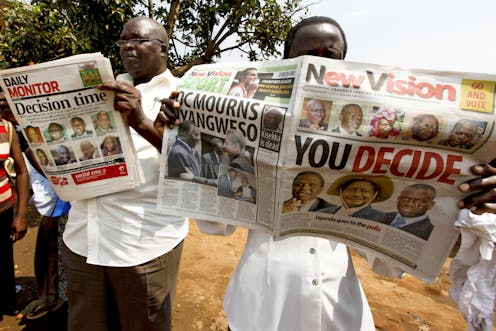
Africa buried two of its journalists in 2018. One was killed in Somalia and the other in the Central African Republic.
According to a report by the Committee to Protect Journalists, 54 journalists were killed around the world in that same year. And in January Ahmed Hussein-Suale Divela, a Ghanaian investigative reporter, became the first African journalist to lose his life in 2019. He was gunned down by two men on a motorcycle in the Ghanaian capital, Accra. Divela was part of a team of journalists – including the well-known undercover reporter Anas Aremeyaw Anas – who had made a powerful documentary on football corruption in West Africa.
Journalists across the continent face threats every day. Many are incarcerated or intimidated for covering sensitive stories. This is despite the fact that progressive laws have been passed in a number of countries. These are designed to protect the fundamental rights to free expression and access to information.
And yet governments like Kenya, Uganda, Zimbabwe, and others still show little respect for freedom of expression laws.
But traditional methods of undermining media freedom are being replaced with new ones. In an ever evolving political and technological landscape, we must also be alive to the new challenges that are threatening media freedom on the continent.
Governments are aware of the fact that old forms of media repression don’t necessarily work: they attract international attention, bad press, and can unsettle a regime. As a result, they are adopting subtler forms of media control to undermine press freedom. These can sometimes be even more insidious because they pass unnoticed.
Among the biggest threats to emerge over the past decade are the concentration of media ownership in the hands of a few, government use of advertising spend to starve independent media outlets of revenue, and significant attempts to legislate the online media environment.
Rolling back gains
The political changes in Africa in the 1990s saw many countries adopt multi-party politics. The changes allowed for the liberalisation of the media sector. Many countries relaxed their licensing regimes leading to a remarkable proliferation of media outlets. As a result there are thousands of radio and TV stations, as well as newspapers, across Africa.
But over the last decade, a number of governments have embarked on a process of recapturing the media landscape. Most are doing this by launching new media ventures using proxies, and through business people with ties to the political establishment. Licenses are generally awarded on the basis of proximity to or connection with the centre.
The result is that in countries such as South Africa, Kenya, Ghana and Tanzania, numerous media outlets are mainly owned by politicians and business associates of those who hold the levers of power. The arrangement enables governments to indirectly control various media outlets.
For the private press that has evaded such capture, governments have resorted to controlling advertising revenue. Media organisations in most African countries cannot survive without state advertising. In Rwanda, for example, nearly 90% of ad revenue comes from the public sector.
Against this background of political and economic vulnerability, new media forms were broadly seen to hold a great deal of promise for the public.
But this brave new world has also led to unintended consequences.
The promise of new media
Over the past 15 years new media such as social media and other digital platforms has been viewed as having the power to subvert state control. It also promised to provide important spaces for journalists and consumers to exercise some level of expressive freedoms that had become difficult to achieve in the mainstream media.
But this egalitarian promise hasn’t materialised. The main reasons for this have been the role played by governments as well as by big tech companies.
For their part governments have invaded these emergent new media spaces by employing digitally savvy state operatives and PR firms to neuter what are considered opposition or disruptive voices online. They have the resources to buy advertising, employ bots and to ensure that their agenda populates these spaces. This has been the case in various countries, particularly during elections. Kenya, Lesotho, Rwanda and Equitorial Guinea are just a few examples.
The state also has monopoly over legislation. Several governments have made various attempts to use new laws to control new media. These include Uganda, Zimbabwe, Gambia, Cameroon, Togo, Tanzania and Ethiopia. All have raised arguments relating to public security and order to defend draconian legislation that criminalises free speech online.
Meanwhile, tech companies such as Facebook and Twitter have made it possible for a new group of information brokers to emerge online. This, in turn, has undermined the democratic potential of social media platforms. This new corps of information brokers and social media influencers drives traffic, attract advertising and therefore enable tech companies to make money.
There is no incentive to unsettle what seems to be a highly profitable business model for them. Yet this development has significant consequences for media freedom and democracy.
It’s appropriate that governments face increased and continued pressure to end the killing, incarceration and intimidation of journalists. But it’s also time to start focusing on the emerging challenges undermining media freedom.

George Ogola does not work for, consult, own shares in or receive funding from any company or organization that would benefit from this article, and has disclosed no relevant affiliations beyond their academic appointment.
Source: The Conversation – Articles (AFRICA)
Read more on The Conversation.
Join the fun: Add Your event | Submit a Press Release | Add your listing.


