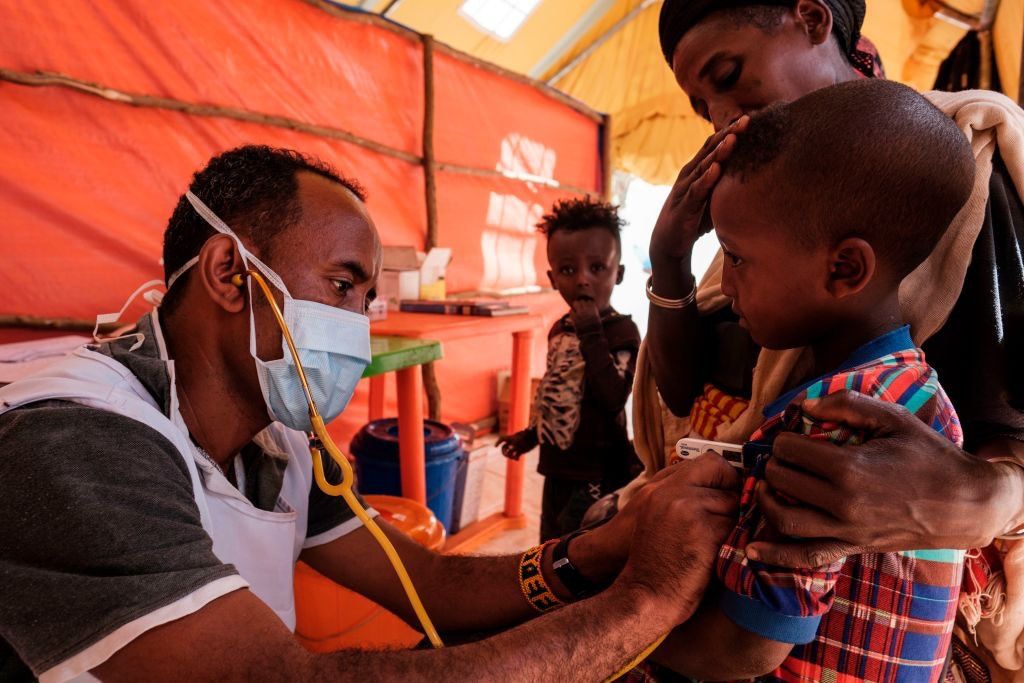
Tragic stories of suffering and death have emerged from Tigray since 2020, when civil war erupted between the central Ethiopian government and the regional Tigrayan government.
In just one example, a professor who headed Ayder Hospital’s oncology department in Mekelle, the capital city of Tigray, spoke of women’s malnutrition and resulting childbirth complications and deaths.
It’s not only the patients who are suffering. Despite being protected by international laws, healthcare workers and health facilities in the region are extremely vulnerable. Since the war broke out, healthcare workers have lost their jobs, been displaced, and been wounded, threatened or killed.
There have been reports of ambulances being obstructed and health workers being prevented from treating civilians.
There’s a lack of medical supplies. Patients and healthcare workers have resorted to unusual measures. At one hospital, healthcare workers were reusing gloves and asking patients to bring white clothes that could be repurposed as gauze.
Tigray’s healthcare systems were already under pressure before the war. The unfolding crisis will only worsen the situation. Action is crucial: the international community must recognise and acknowledge that accepted global norms related to healthcare workers’ safety are being violated. They must condemn the situation in the strongest terms. Tigray’s health sector needs support – both now and when the war ends.
Trying circumstances
Healthcare workers in Tigray were last paid in May 2021. In July 2021, 50% of the region’s roughly 20,000 healthcare workers did not report for normal duty. This figure includes all 741 health extension workers employed in posts across Tigray to provide primary healthcare services, including crucial maternal and child health services.
Read more: What people from war-torn Tigray told us about the state of their lives amid the war
The economic meltdown and the ongoing violence have prompted many healthcare workers to flee. Some have remained in the area, seeking refuge in camps for internally displaced people. Researchers found about 2,000 healthcare workers living in one such camp in Mekelle. Others have fled to neighbouring countries like Sudan.
During an interview with the BBC on 3 October 2021, the head of the Tigray region Health Bureau, Dr Hagos Godefay, reported that 22,000 health workers were displaced.
Those who have continued to work, along with international aid workers providing healthcare support, are extremely vulnerable. The regional Health Bureau reports that 37 healthcare workers have been killed and 78 wounded since the start of the war. The UN says 23 aid workers have died.
Fears for the future
Healthcare infrastructure has not been spared in this conflict. Seventy-eight percent of health posts (primary healthcare structures), 72% of health centres, and 80% of hospitals have been destroyed.
Educational facilities, including medical colleges, have also repeatedly come under attack. The resulting disruptions bode ill for the future – Tigray may experience a significant gap in the supply of skilled health professionals in the coming years.
Some students from the medical colleges have stepped up to provide services, despite not yet being qualified. This unfortunate situation imposes a responsibility beyond their capacity. It’s also likely to cause extreme stress in their lives and may drive them out of the profession after the war.
The extreme and blatant disregard of healthcare workers’ neutrality (which is guaranteed in numerous international agreements), the denial of access to basic services for civilians and wounded combatants, and the destruction of healthcare infrastructure in the Tigray war cannot be justified.
Looking ahead
It is a painful paradox. At a time when Tigray’s citizens need it most, they cannot access good, reliable, safe healthcare. We fear that the situation won’t improve.
We expect that Tigray’s post-conflict period will be characterised by poor health outcomes due to the limited availability of healthcare workers and complete collapse of its healthcare system. The brain drain of health workers and collapse of the healthcare system, and sustained negative health outcomes in the population after the conflict, have been seen in several conflict areas such as Sierra Leone and Yemen.
Here’s what’s needed to address the situation:
-
global advocacy and a show of solidarity from the international community
-
mobilisation and financial commitment to rebuild the health workforce
-
demanding accountability from those who have flagrantly violated international law and ignored global norms around protecting healthcare workers even in times of conflict.


