When large animals like elephants, giraffes and crocodiles roamed what is today South Africa’s Cape south coast hundreds of thousands of years ago, they were not alone. Far below their sight lines, tiny creatures like gerbils were forging their own paths across the landscape.
Like their larger counterparts, these small creatures left their marks. Their tracks were preserved in aeolianites – the cemented remains of dune surfaces – and cemented beach deposits.
In a recently published article in Quaternary Research we documented these minute gerbil tracks and traces. We also described an invertebrate trackway, which we attributed to a spider. This work is part of the Cape south coast ichnology project.
Since it started in 2008 our team has identified more than 300 vertebrate tracksites along a 350 km stretch of South Africa’s coastline. They date back to the Pleistocene epoch, ranging mostly from 140,000 to about 70,000 years in age. The spider trackway is the first belonging to an invertebrate that the team has described.
There is something near-miraculous in the concept of tiny creatures, weighing just grams, making tracks and traces so long ago, that are now evident in rock, and are recognisable and amenable to our interpretation.
Finding and describing them helps us to reconstruct an ancient environment. This can deepen our understanding of how the landscape has changed over time and how it might change in the coming years as the climate shifts.
A rare find
The sites we have documented as part of our project would have been situated at the margin of the vast Palaeo-Agulhas Plain, which was alternately exposed and inundated during Pleistocene sea-level oscillations. The fossil tracksites we study provide a census of which creatures trod on the area’s ancient dunes and beaches.
The stretch of coastal cliffs in which these sites were found contains a concentrated zone of tracksites. To date, 80 vertebrate track sites have been identified in this remote area alone.
Several of these have had important paleo-environmental implications – like revealing the previously undocumented presence of hatchling sea-turtles.
Read more: First fossil trails of baby sea turtles found in South Africa
It’s very unusual for small tracks to be preserved. Larger, heavier animals create larger, deeper tracks, which are easier to identify once Pleistocene palaeosurfaces are re-exposed. Dune and beach sands, being relatively coarse-grained, also do not provide ideal conditions for tracks to be registered and preserved. Good preservation is more likely in finer-grained silty sediments which are relatively rare in rocks along the Cape south coast.
Trackways of small mammals are extremely rare in the global fossil record, previously being known from only two Mesozoic sites (from the Jurassic Period in Patagonia about 165 million years ago) and three Cenozoic sites, from the Miocene Epoch about 15-20 million years ago in Colorado and Utah.
This makes our discovery of gerbil trackways especially exciting. The evidence for gerbils – probably the Cape gerbil, Gerbilliscus afra – included a trackway consisting of 12 pairs of tiny tracks in a typical bounding gait pattern (rather than a walking, running or hopping gait). We also found branching burrows and a characteristic structure resembling a debris mound that gerbils create at the entrance to their burrows and tunnels.
A tiny trail of tracks
Close by another site yielded a further unusual and exciting find: an arachnid trackway that extended for a distance of 25 cm. Extant spider groups in the region capable of making such traces include rain spiders and baboon spiders.
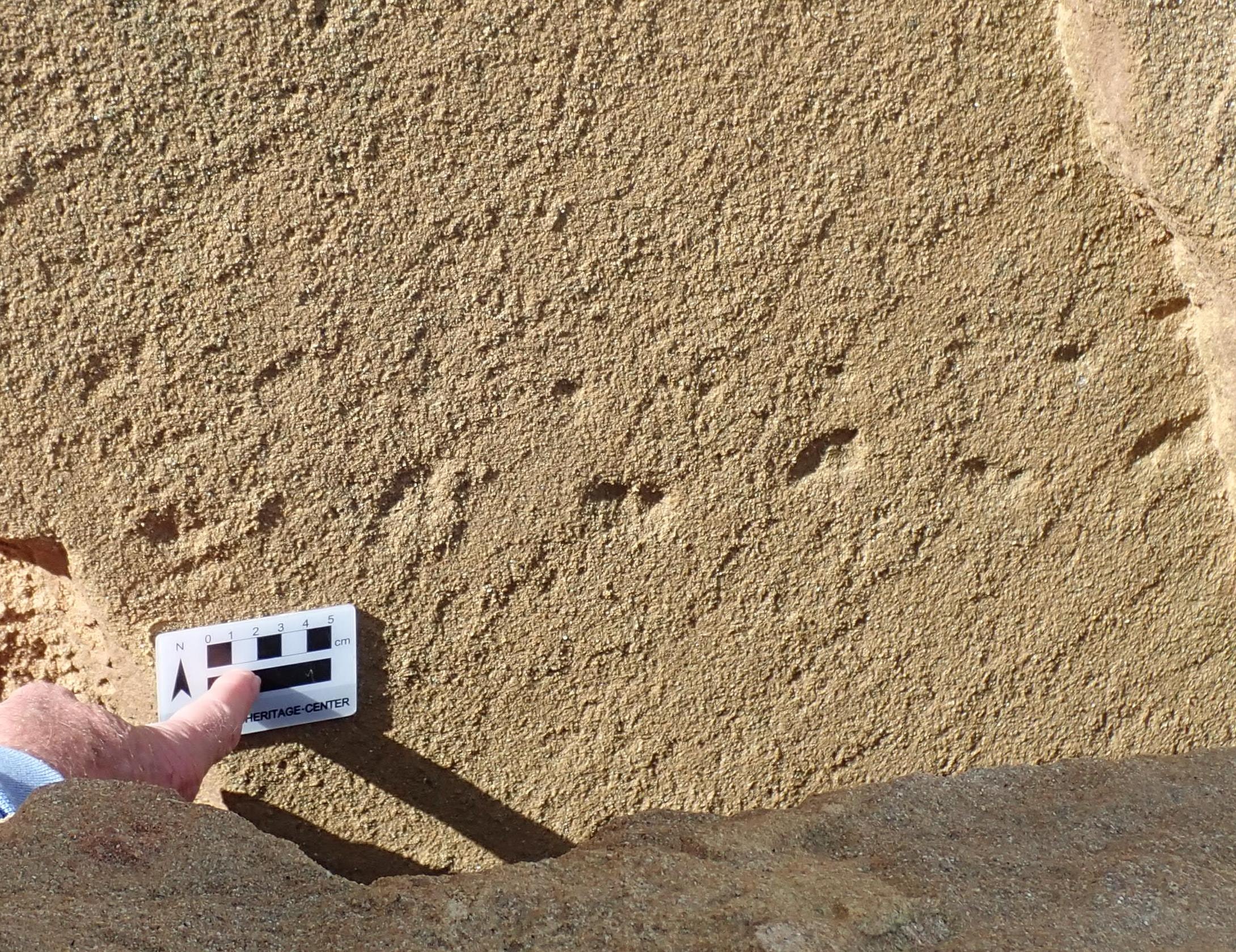
Invertebrate trace fossils are common on Cape south coast Pleistocene palaeosurfaces. But the science of analysing, describing and considering their paleoenvironmental significance is in its infancy. The arachnid trackway illustrates the potential of this field for future study.
Sadly, these sites are ephemeral. Within weeks of being identified the gerbil debris mound had disintegrated. Within a year the gerbil trackway had been severely eroded by wind and water and the rock containing the arachnid trackway had slumped into the ocean. This serves as a reminder of the need for frequent coastal surveys, in particular after rockfall events and storm surges.
Nonetheless, these discoveries show that under favourable circumstances Pleistocene palaeosurfaces on the Cape south coast have the capacity to preserve fine detail made by tiny trackmakers, visible under optimal lighting conditions.


