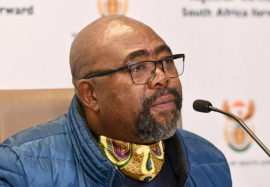
With transformation in South Africa’s labour market continuing to progress at a snail’s pace, government should consider reviewing legislation in an effort to achieve the desired outcomes, says Employment and Labour Minister Thulas Nxesi.
This comes in the wake of the Commission for Employment Equity (CEE) 21st report, which paints a bleak picture of the country’s labour force.
“It cannot be business as usual. I strongly believe that the time has come to re-strategise [and] adopt a different path to ensure that the Employment Equity Act achieves its intended objectives.
“It is evident that self-regulation has not worked and more aggressive strategies are required to reach the intended purpose, including reviewing of legislation,” he said.
The CEE document, released on Friday, states that in the past year, the CEE recorded a decrease of 492 (1.8%) in the number of reports received. In 2020, the Commission received 26 635 reports, compared to the 27 127 in 2019.
Of these, 43.8% were from Gauteng, followed by 20.8 % in Western Cape and 14.8% in KwaZulu-Natal.
With 18.3%, the manufacturing sector accounted for the most complaints. Wholesale and retails, repair of motor vehicles and motorcycles followed with 14.4%.
Agriculture, forestry and fishing account for 14.3% of the reports, while 9.4% came from construction.
Just over 2530 reports were received from the private sector covering 5 108 149 employees in 2020, which amounted to 95.1% of all the report received.
In a continuing trend, 64.7% of top management positions were occupied by Whites. This was in pale comparison to the 15.8%, 10.6%, 5.7% and 3.1% filled, respectively, by Africans, Indians, Coloureds and foreign nationals.
In this regard, males occupied 75.1% of these positions, while females 24.9% filled the remaining 24.9%.
Africans occupied 60.8% of the positions in national government while whites occupied 67.8% of the positions in the private sector.
CEE chairperson Tabea Kabinde said transformation in the country continued to be too slow, especially in the top and senior management.
Despite progression snags, in the past three years, significant increase of representation of the African population at senior management had improved.
“For the first time in three years, it’s sitting at an increase of 1.2 percentage points, which is very good. There’s still an insignificant increase of representivity of women at top and senior management. We know that in top management we get 0.5% while at senior management we had 0.4%.
“The situation in the professionally qualified occupational level much more palatable, with the African population at this level increasing by 3.5% in the past three years.”
Kabinde said the question remained as to why there is an increase of designated groups and a more or less better representation at middle management but this is just translating into an increase at senior and top management.
“Could it be true that there is a glass ceiling designated at middle management that owners and captains of industry do not trust black people enough to allow them to take the reins of the control of their organisations because real control begins at senior management so this picture is really telling us it’s still a story and it remains concerning for us,” she said.
With self-regulation having not yielded any positive results in transforming the labour workplace, the Employment Equity Amendment Act has been presented to Parliament in an attempt to fast track the desired results.
The amendments are expected to empower the Minister to put in place sector-specific targets – including compliance certificates – which the Commission believes will be a game-changer.
Nxesi expressed dismay at the dire statistics, saying the report should serve as a wakeup call.
“It is clear that we remain a very unequal society, particularly in the upper echelons of our economy. It’s clear that this is unacceptable, it is disconcerting to say that while you consolidate 27 years of democracy, 25 years of our constitution, and 23 years of the Employment Equity Act, we are still lamenting the snail’s pace of transformation of our labour market.
“We have economic power but there’s no economic power.”
He said the time has come for government to acknowledge that it had to address the imbalances of the past to uplift the most vulnerable groups.
“We should acknowledge where good progress has been made in relation to the representation of designated groups – blacks and women – in the economy.”
This much was evident in the progressively improving statistics in age and group in the middle tiers of the workforce, particularly middle management, the professionally qualified and junior management.
However, he said it was critical to seek answers as to why insignificant progress has been made in the key strategic occupational levels – top management and senior management. – SAnews.gov.za


