Trump’s comment about South Africa is a reminder that race still matters:
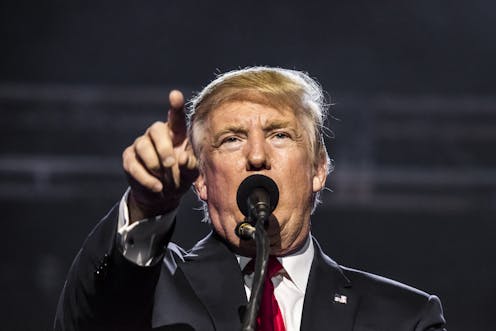
For a brief moment last week, US President Donald Trump served a useful purpose. He reminded us how important race is as an economic and political issue on much of the planet.
Trump chose last week to pronounce on land reform in South Africa. He asked his Secretary of State to study “land and farm seizures and expropriations and the large scale killing of farmers”. He made it clear why he was doing this by quoting right-wing commentator Tucker Carlson’s claim that the “South African Government is now seizing land from white farmers”.
Two aspects of Trump’s tweet tell us what lies behind it. First, his – and Carlson’s – interest in what they think is happening in South Africa is not the traditional conservative concern for property rights or the market. It’s that whites are, in their view, under attack from blacks.
Second, Trump and the right-wing commentators close to him are responding to the South African non-governmental organisation Afriforum. Two of its leaders went to the US to campaign on the land issue earlier this year, where they met Trump’s national security advisor, John Bolton.
Afriforum calls itself a “civil rights organisation” but is in reality a lobby group for white Afrikaans speakers who feel threatened by majority rule. It is rejected by most white Afrikaners who vote for the official opposition, the Democratic Alliance, not the Freedom Front Plus, whose view is close to Afriforum’s.
Why can a fringe South African lobby group gain the ear of Trump and his cheerleaders? Because they are talking about the issue which most worries him and those who vote for him: a sense that whites are under threat because others are sharing their spaces and challenging their control.
The power of identity
This is a European reality too. The British vote to leave the European Union was heavily influenced by fear of immigrants who, research has shown, were constantly portrayed by the media as threats. Claims that Europe is being “swamped” by immigrants is driving the growth of the populist right there.
Another key factor is fear of Muslims, which may also have helped India’s right-wing prime minister, Narendra Modi, win that country’s last election.
In much of the planet, then, the core political issue is identity – race, religion, gender – not the economy.
Some of this was boosted by the economic crisis of 2008: people who feel their dominance is threatened feel it far more sharply if their economic security is under threat. But the economy’s crisis fuelled something which was already there; it did not create it.
North America and Europe’s identity storm has been brewing for decades. People of African, Asian and Hispanic descent were once invisible there. Now they are not. It’s no accident that the US is the epicentre; whites will be a minority there in a few decades and research shows this is fuelling white fear.
Areas of life which whites monopolised are no longer all white. There are black and Asian professionals, corporate executives; even, as in the US and Ireland, the occasional head of government. This has created a sense of threat which emerged long before the 2008 crisis.
In India and Burma, two countries in which Muslims are the targets of violence, the economy cannot explain the enmity. In Africa, identity remains a core issue whatever the state of the economy.
In many societies, challenges by women to the power of men are also a huge identity issue. Violence against women seems strongest in societies where men feel their power is under threat. The economy is a side issue.
Overturning conventional theories
Marxists have often insisted that racial, religious and other identity divides are symptoms of economic inequality, not causes of conflict. Liberals have seen racial and religious division as primitive: for them, the good society is one in which the market decides, not tribal loyalties. Traditional American conservativism and centre-right thinkers in Europe share this view. The common thread is that the market place is primary, identity secondary.
But the opposite is now true – and may have been for longer than we think. Ashutosh Varshney, a US based scholar of Indian politics, argues that people who are on the wrong end of inequality usually act to change it only when they feel they are poor because of their identity. This is true of South Africa, where the trade union movement, which played a key role in defeating apartheid, was strong because its black worker members were also victims of racial injustice.
We need to stop seeing race, religion and other identities as side issues when we try to understand economies and politics. And, if we want to improve economies and societies, we need to tackle identity head-on rather than seeing it as a product of more important issues.
Race factor in South Africa
This is particularly so in South Africa where racial divisions were left to fester after 1994 because it was wrongly assumed that a new constitution meant they no longer mattered. These divisions explain poor economic performance better than any other issue.
There are many dimensions to this. But the root cause is that most economic debates are really about race. Since democracy arrived in 1994, the state has been controlled by black people, the economy mainly by white people. When people demand that the market decide, they want whites to decide and vice versa. This may not describe what always happens, but it is the way most people see the world.
The result is distrust between much of government and much of business, and attitudes and behaviours which make growth far less likely. The economy’s weakness is primarily about a failure to tackle race since 1994.
South Africa may be more like the rest of the world than it seems. If its economic debates are disguised ways of expressing identity, the same may be true of those in most other parts of the globe too.

Steven Friedman does not work for, consult, own shares in or receive funding from any company or organisation that would benefit from this article, and has disclosed no relevant affiliations beyond their academic appointment.
Source: The Conversation – Articles (AFRICA)
Read more on The Conversation.
Join the fun: Add Your event | Submit a Press Release | Add your listing.


