Tshisekedi has taken over the DRC’s Ebola response. How he can make a difference:
The most recent Ebola outbreak in the Democratic Republic of the Congo (DRC) rages on. There’s been a continued increase in the number of new cases for a year since the outbreak was first declared. This is despite the extensive use of an experimental vaccine, new treatments and more rapid response to the outbreak when compared to the West African outbreak.
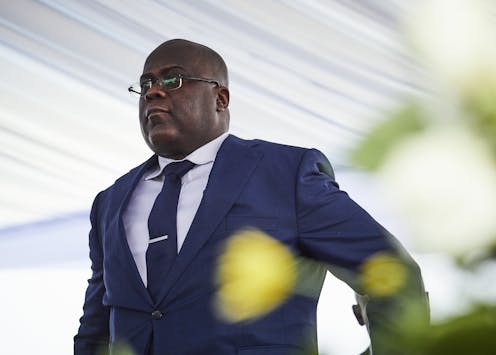
Until recently the Ebola response was coordinated by the minister of health. But in July, President Félix Tshisekedi announced that he would take over this function and appointed Ebola pioneer Dr Jean-Jacques Muyembe to lead the efforts. The announcement led to the resignation of health minister Oly Ilunga Kalenga.
But the decision was strategic and significant and is likely to galvanise national and international support. Ebola has now spread to Goma, a city of two million and a major international transit hub. By some estimates only half of the cases are accounted for.
The outbreak calls for a coordinated response across government ministries. This is because it has major social, cultural, political and economic implications.
There are four issues that, as head of state, Tshisekedi will be able to ensure are tackled. These are:
-
shifting from a single ministry leading the response to a multi-agency response with very high level of commitment from ministers,
-
raising awareness of the intensity of the threat to the highest international level and securing more robust international support,
-
forcing the different international state and non-state actors to coordinate their activities, and
-
sending a clear message that the disease is a national threat.
With the president coordinating the response, ministers will be expected to support the country’s efforts.
This is what happened in Liberia in 2014 when then President Ellen Johnson-Sirleaf took over the running of the country’s Ebola response. This provided government leadership that compelled local and global actors to coordinate their interventions and changed the course of a disease.
While this was true and easy in Liberia, we must admit the complexities of the DRC. Firstly, it is a much larger country. Secondly, there are parts of the country that don’t accept the central political leadership.
Lessons from Liberia
When the outbreak started in Liberia in 2014, the response coordination was passed from the ministry of health to internal affairs and then to loosely coordinated task forces headed by different leaders. But the change had little affect, the outbreak continued to spiral out of country.
At this stage the number of cases per month from July to August of 2014, increase from 249 to 1 048.
This changed when Johnson-Sirleaf took over the coordination of the response under the Presidential Advisory Committee on Ebola. She appointed the then assistant minister of health, Tolbert Nyenswah, to lead the incident management system. Key ministries and partners like the US Centres for Disease Control began to meet weekly with Nyenswah.
The coordinated leadership of the President was critical at this stage given the upward shift in the epidemic curve. The cases had increased by 2080 in September alone and 3077 in October of 2014. These increased number of cases would have threatened the peace and security of the country had the President not taken over the direct coordination of the response.
On top of this, Johnson-Sirleaf made a passionate plea to the US government and the international community, the military was deployed and massive resources were provided that led to the last push to end the outbreak. Under this new coordinating mechanism the Ebola cases started rapidly coming down by November of 2014.
In the early phases of the Ebola response in Liberia the lack of coordination was evident. This lack of coordination has also been cited as a major hindrance to efforts to contain Ebola in the DRC.
On top of this international partners may not be coordinating well due to the lack of clear political will about the direction of the DRC’s response.
But that can change now that Tshisekedi is in charge. He can ensure that all partners involved have a single coordinated plan. There will therefore be a much higher chance that strategies that he formulates will be carried out and supported by the partners.
What needs to be done
Tshisekedi’s direct involvement can help the DRC overcome some of the biggest obstacles to ending this outbreak.
First, as the president, he can rally citizens who have previously doubted the reality of the outbreak and mobilise provincial leaders to become active in the response.
Second, he can increase security. The epicentre of the current outbreak is North Kivu, a region marred by ongoing violent conflict. Ebola treatment centres have been destroyed and a doctor was killed in April this year.
Third, he can put fresh efforts into global response. Only 50% of financial support needed for the response has been provided. There has already been a shift in the international response since Tshisekedi took over the Ebola response. The World Bank committed $ 300 million just days after the announcement.
Tshisekedi can take advantage of the fact that the World Health Organisation recently declared the outbreak a public health emergency of international concern. This is a defining moment for the DRC and the president, he needs to take the response to the people, use his regional and international political capital to build security and mobilise resources to rapidly end the response.

Mosoka Fallah consults for MERCK/MSD as an expert from Africa on the process of the Ebola vaccine licensing.
Source: The Conversation – Articles (AFRICA)
Read more on The Conversation.
Join the fun: Add Your event | Submit a Press Release | Add your listing.


