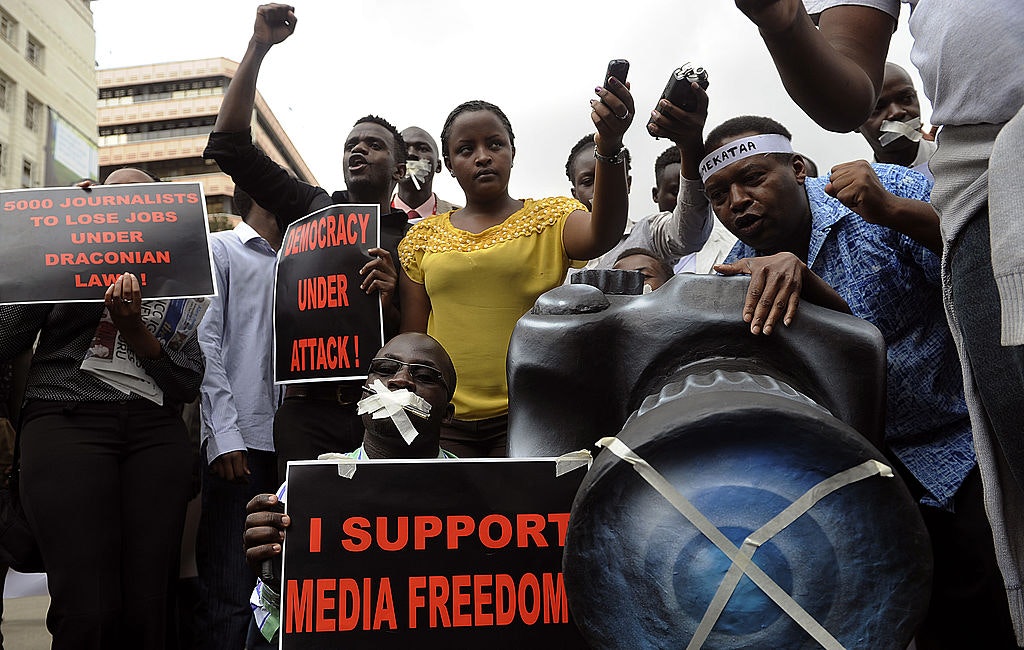
President Uhuru Kenyatta’s regime came into power in 2013. It was the first to implement most of the provisions of Kenya’s 2010 constitution. The media were eager to see how the government, led by Kenyatta and his deputy William Ruto, would adhere to article 34 of the constitution, which deals with the freedom of the press. The two politicians had promised to expand media freedoms once in power.
The relationship between the media and Kenyatta’s regime went through six stages that defined the president’s nine years in office between 2013 and 2022.
It shifted from “karibuni chai” (welcome to tea) to “nyinyi mzime hiyo mavitu yenu na muende” (all of you switch off your thingies (cameras) and leave).
1. Courting the media
Uhuru Kenyatta took over from Mwai Kibaki to become the fourth president of Kenya on 9 April 2013. His relationship with the media started off well. The president warmly welcomed journalists to State House before he and Ruto hosted a breakfast with top editors on 12 July 2013. It was the first time State House was hosting such an event.
Kenyatta called it an opportunity to build relations between the media and the state. Critics saw it as a way of arm-twisting the press to get it on the side of the government.
2. Rebranding the presidential press
The media breakfast was soon followed by another move touted as an effort to streamline the State House-media relationship. In July 2013, the Presidential Press Service, which mostly covered the head of state’s movements, was rebranded into the Presidential Strategic Communication Unit. Its mandate was expanded to communicating government policy and branding state events.
The rebrand implied that strategic communication – which is the purposeful use of communication to fulfil a set mission – would be prioritised. The presidential press unit would, therefore, be used to convey news from State House to journalists, and ensure the ruling party’s agenda was achieved.
3. Divorcing the media
The cordial start to the relationship between the media and Kenyatta’s regime didn’t last. Soon there were signs that the Jubilee government had taken a road it couldn’t walk comfortably.
Following the October 2013 terrorist attack at the Westgate mall, journalists were thrown out of parliament on allegations of misrepresenting facts. This followed media reports that soldiers had looted shops during the siege at the mall. In December, parliament passed a law that imposed heavy penalties on journalists and media houses found guilty of code of ethics violations. These violations were to be determined by a state agency.
Read more: How Kenyatta has gone about stifling the free press in Kenya
In 2015, when the media became critical of Kenyatta’s relationship with his deputy Ruto, the president dismissed these reports saying “gazeti ni ya kufunga nyama” (newspapers are for wrapping meat).
And at a police service conference in February 2018, Kenyatta told journalists to switch off their cameras and leave.
A month earlier, David Mugonyi, the then deputy president’s spokesman, threatened a journalist, Justus Wanga, with dismissal from his job. This was provoked by Wanga’s newspaper article carried under the title “Cabinet seats that split Uhuru, Ruto”.
4. Redirecting advertising revenue
To the chagrin of the media, the government withdrew advertising revenue from mainstream media in 2017.
The Kenyatta and Ruto regime established a state-run pullout and website, MyGov, which carried all advertising from government agencies. This was coordinated through a newly established body, the Government Advertising Agency.
Read more: How African governments use advertising as a weapon against media freedom
The government’s decision redirected about US$20 million in advertising that initially went directly to media houses annually. This accounted for an estimated 30% of total media advertising revenue. The formation of the agency coincided with rising tensions between the media and the government.
Though the move was initially criticised, it challenged media houses to think of other ways of generating income. This included tapping into reader revenue and exploiting technology to support daily operations. This, ideally, would have helped free media houses from the government’s use of advertising as a weapon to manipulate coverage.
5. Snubbing the 2017 presidential debate
The 2013 presidential debate was the first of its kind for Kenyan media. All presidential candidates were in attendance. It gave journalists an unprecedented opportunity to interrogate them on issues of national leadership.
However, in 2017, Kenyatta snubbed the presidential debate. This was replicated in 2022 when Raila Odinga, who contested the presidency under the Azimio coalition chaired by Kenyatta, disparaged the debate.
Read more: Political debates in Kenya: are they useful or empty media spectacles?
These decisions seemed to undermine the media’s relevance in Kenya. In my opinion, snubbing the debate was political indiscipline. It’s not just voters and the media who needed to hear from leaders, but all Kenyans.
6. Unable to hide
Despite the tense relationship he had with the media, Kenyatta still found it important to seek its help when he felt cornered. Twice, he sought out journalists to address his home turf, the important central Kenya voting bloc.
Two days to the 9 August 2022 elections, Kenyatta spoke with journalists from vernacular media platforms, urging people from central Kenya to vote for Odinga. Ruto allies protested the move. During this interview at State House, Kenyatta appealed for the region’s vote for his preferred successor, Odinga.
The relationship between Kenyatta and the media has been bitter-sweet. However, the media and state are not expected to be bedfellows. It is journalists’ responsibility to hold those in power accountable. That is why it’s a red flag whenever regimes purport to work with the media.


