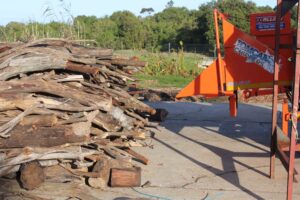
A new initiative to develop a strategic framework for an alien and invasive biomass economy in South Africa was launched in June and a stakeholder engagement process is now underway.
SCLI Environmental NPC, with support from the Department of Forestry, Fisheries and the Environment (DFFE) and its partners, will be facilitating a key stakeholder and affected party engagement process. SCLI invites all who work directly and indirectly with invasive alien plant/tree material to support the initiative and join a series of national dialogues that will be held during August and September.
The purpose of the initiative is to identify and unlock the opportunities of an invasive and alien biomass economy in South Africa that targets problematic alien and invasive woody biomass through ecosystem rehabilitation. It is estimated that invasive alien plants (IAPs) occupy close to 19 million hectares of the country and bush encroachment affects approximately 7,3 million hectares or 6% of South Africa’s total land area.
The clearing of alien and invasive woody biomass provides opportunities for developing green value chains that will support the restoration of ecosystems for climate change adaptation and mitigation, catalyse private sector financing and provide energy alternatives, amongst other uses. The development of a strategic framework for biomass use from invasive alien plants and bush encroachment species will further support the uptake of an economy around the biomass use with the aim to support the creation of jobs. Another aim of the initiative is to investigate the establishment of a National Biomass Industry Platform for the country.
A series of national dialogues with key stakeholders and desktop research will lead to the completion of a strategic framework and action plan that will include business cases for appropriate pilot landscape sites that will help accelerate the implementation of pilot projects.
The stakeholder engagement process will be based on a value chain approach, including: providers or sources of biomass, biomass harvesting, biomass processing, biomass value-addition, associated logistics channels and consumers and the consumption industries.
Says Cobus Meiring, chairperson of SCLI: “Every day, thousands of South Africans set out to the countryside, town and city perimeters to harvest significant amounts of invasive alien plant biomass to transform it to something useful which can be marketed and sold on any scale and format. But exactly how big is the industry dependent on invasive alien, as well as invasive but indigenous bush encroachment biomass in South Africa? How deep and valuable is the market for products derived from these plants and trees? How do we go about giving the alien and invasive biomass industry a voice and assist it in growing to be more sustainable and to make an even more meaningful contribution to the fast-emerging green, circular and climate-ready economy?”
“To get a better understanding of these questions, SCLI and its partners, will develop a strategic framework for the purpose of advancing the biomass industry in South Africa. The ultimate aim is to come up with a strategic framework and action plan, and, in addition, design a roadmap to the establishment of a National Biomass Industry Platform in the country.”
“Although mostly unchartered and, as yet, not formalised as a defined industry, all relevant stakeholders and interested and affected parties are invited to list their interests and concerns, make suggestions and make their voices heard,” says Meiring.
Stakeholders in the biomass economy value-chain include, among others, entities or individuals involved in related research, biomass-to-energy producers, timber manufacturers for the building and woodwork industries, companies producing charcoal from wattle and other types of invasive infestations and companies producing biochar of all grades for the local and overseas markets.
South African national, regional and local authorities, non-governmental organisations (NGOs), water boards, water catchment agencies, agricultural bodies, the forestry industry, those active in producing harvesting equipment and transport companies delivering services to the biomass industry, contractors rendering services to landowners and secondary producers, IAP specialists, land rehabilitation managers and all other relevant role-players in the biomass economy value chain are all encouraged to join in and provide critical input within the next few months, seeing that the baseline study will be concluded in October 2021.
More information on the topics or themes for virtual participation by interested and affected parties will be announced in due course and will be made available to all relevant stakeholders who are registered on the biomass economy strategic framework database.
To register as a stakeholder/participant, interested or affected party, please send an email with your full contact details to Louise Mare louisamare@gmail.com, or a WhatsApp message to 082 078 1629, during office hours.
For more information, please follow the link: https://www.scli.org.za/announcement-and-invitation-to-participate/
CLICK HERE to submit your press release to MyPR.co.za.


