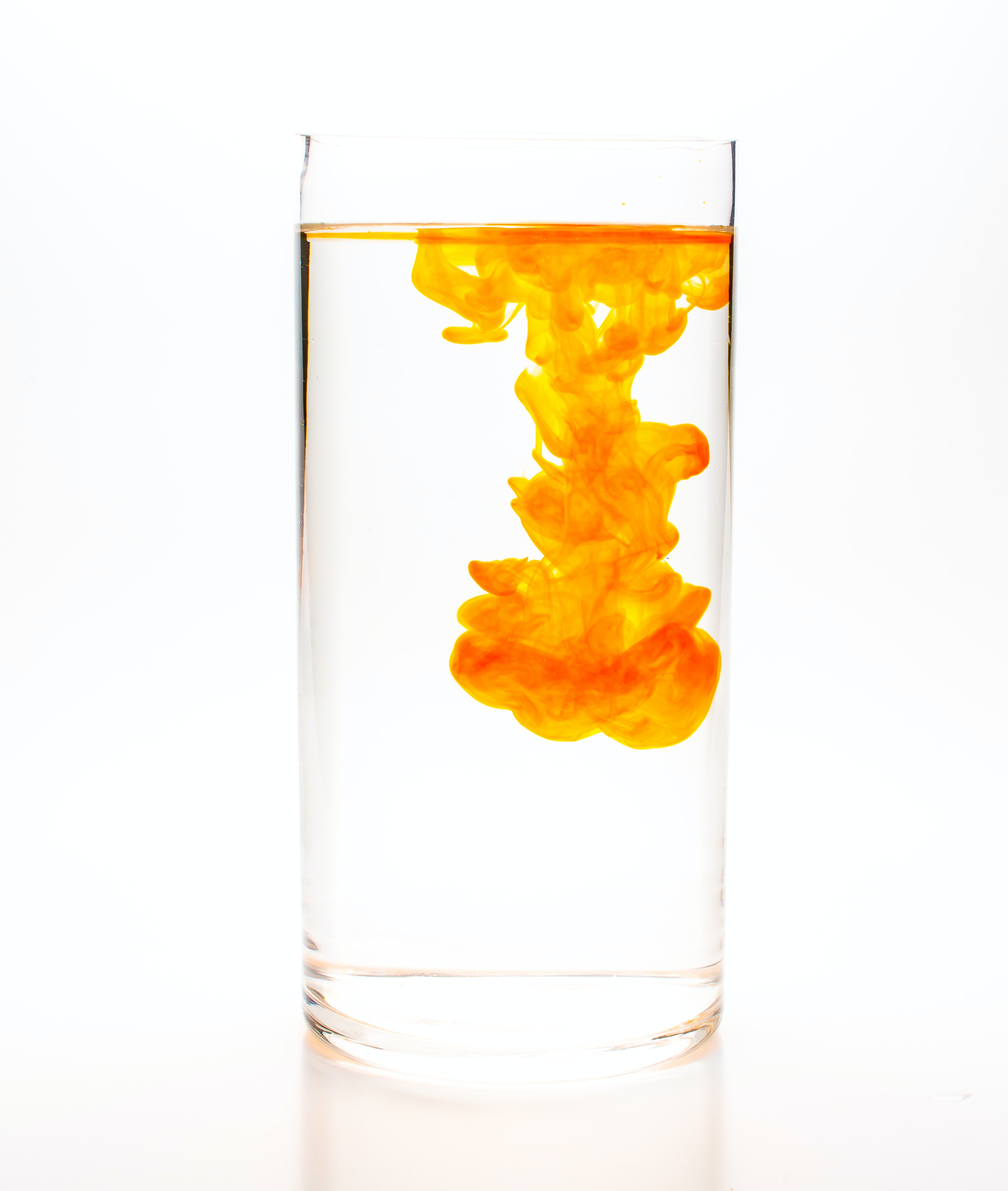
Why do processes in nature only work in one direction? For example, why can’t we heat up a cup of coffee in the fridge or prevent a drop of ink from spreading spontaneously in water?
It’s a question that’s puzzled many generations of physicists – and it stems from an incompatibility in the laws of physics, specifically between those that dictate the behaviour of macroscopic versus microscopic systems. Macroscopic systems can be seen with the naked eye; they consist of an extremely large number of atoms and molecules. Microscopic systems represent a different world: small enough that the behaviour of each individual atom or molecule can be described, but is not visible to our eyes.
Physicists can easily explain why the processes of macroscopic systems can’t reverse themselves spontaneously. It comes down to the second law of thermodynamics, which centres on the nature of the energy of a macroscopic system like a glass of water. This law provides a criterion that predicts the direction of spontaneous processes through the concept of entropy, a measure of order in matter. Liquids are less ordered than crystals, and gases are even less ordered. Hotter or more dispersed matter is higher in entropy. Simply put, entropy always increases; systems become more disordered as they progress spontaneously – and they cannot regress unless we supply energy.
A different set of physical laws exists when looking at the individual atoms and molecules that comprise a microscopic system. But these laws don’t explain what direction the processes in this system must take.
The matter and the processes are the same – but when they are studied from the macroscopic viewpoint the result may contradict that of the microscopic viewpoint. This is of course a problem.
In our new paper we argue that there’s a solution to this conundrum. The key is to distinguish between two types of reversibility: time-reversibility and thermodynamic reversibility. A smooth transition of the two types would pave the way to a unified theory that can describe all states of matter and all processes based on a single set of principles. This is what scientists are eagerly looking for.
Equilibrium and gradients
Consider a pendulum. It swings back and forth indefinitely in the absence of friction. If this motion is recorded and played backwards, there’s no difference; it would still look entirely natural. That’s a time-reversible process – the pendulum’s motion is symmetric with respect to time reversal.
But the heat that is dissipated from a cup of hot coffee never flows back. The heat inevitably flows from the hot coffee into the cooler air and the heat flow stops when the coffee and surrounding air have the same temperature. This final state is called equilibrium. Since it does not reverse like the pendulum the process is time-irreversible. A recording of it played backwards looks unnatural. This forward direction of processes in nature that stops at equilibrium is famously known as the arrow of time.
Then there’s thermodynamic reversibility. Heat dissipation is an example: it is driven by a heat gradient, going from warmer to cooler. In fact, all spontaneous processes are driven by some type of gradient – a temperature, concentration, or pressure difference. These processes proceed “downhill” along the gradient, from the higher to lower temperature, higher to lower concentration, or higher to lower pressure. This gradient provides the driving force of the process. Any process in the universe that is driven by some gradient is thermodynamically irreversible.
Gradients govern the course of events in small and large systems. The earth receives energy radiated from the hot surface of the sun and dissipates energy at a much lower temperature into the cold background of the universe. The processes of life (for plants, animals and humans, among other organisms) are also driven by gradients – their source of energy ultimately comes from the sun in the form of tiny light packets called photons.
All living organisms dissipate energy in the form of colder photons, which is eventually released into outer space.
Molecular memory
Time-reversibility doesn’t have anything to do with an entropy gradient. It’s about memory. A process is time-reversible if all the molecules can “remember” where they were and how fast they moved at every instance of time, so that every molecule’s motion can be reversed and the initial state restored. This can be simulated by modern computers if a system isn’t too large. As computer technology advances, increasingly larger and more complex systems can be described at the level of their individual atoms and molecules.
So, the apparent incompatibility between microscopic and macroscopic systems has nothing to do with the size of the system. It has to do with the type of process and whether that process wipes out the molecules’ “memory”.
In the case of heat, or of energy more generally, the same amount of energy that is used to synthesise a sugar molecule is set free when the molecule fuels a process in our body and decays back to its initial constituent molecules. This is the thermodynamic view; it neglects the aspect of time.
If it takes five minutes to synthesise the molecule it does not mean that the molecule also decays after exactly five minutes. We can’t predict the exact time that a molecule will decay because the process of decay is governed by a certain probability per unit time. And, importantly, probabilistic processes are never time-reversible because they contain no memory for the state in earlier times. A complete description of a probabilistic process requires one to take account of both the energetic and the timing aspects.
In this example both the synthesis of the sugar molecules and their decay are thermodynamically irreversible processes because a lot of energy must be added to reverse them. But this is completely different from time reversibility where memory is involved. So in this case, thermodynamic reversibility and time reversibility do not have the same origin.
This is the essence of the problem at hand. It is generally assumed that thermodynamic irreversibility and time irreversibility have the same probabilistic origin, which is often the truth but not always. Our paper argues that these two types of reversibility must be separated.


