Three African countries’ manufacturers have lost their tariff-free access to the US market this year. This follows the US decision in November last year to suspend Ethiopia, Mali and Guinea from the African Growth and Opportunity Act. The reason given for the decision was that it was in response to human rights violations and recent coups.
The African Growth and Opportunity Act (AGOA) is a trade programme designed to enhance sub-Saharan African countries’ access to US markets. The programme is an exception to World Trade Organisation (WTO) principles of reciprocity and non-discrimination. Nevertheless, it’s legally recognised by the Generalised System of Preferences adopted in 1968 and instituted in 1971 under the aegis of The United Nations Conference on Trade and Development.
Under the GSP regime, developed countries can grant non-reciprocal trade preference to the world’s poorest countries to increase economic growth and reduce poverty. Established by the Trade Act of 1974 (amended July 31, 2015), the US Generalised System of Preferences have allowed the US to import up to 5,000 types of products duty free from 119 designated beneficiary countries and territories. Linked to this, the US grants regional preference programs.
Nowadays the US administration grants countries in the Caribbean, in Latin America and in Africa non-reciprocal trade preferences. These trade arrangements are managed under the Caribbean Basin Initiative, the Andean Trade Preference Act and the African Growth and Opportunity Act.
For the sub-Saharan African region, the US administration passed the AGOA on May 18, 2000, as Title 1 of the Trade and Development Act of 2000. Qualifying nations are afforded several key benefits, most importantly preferential access to US markets with zero duties for more than 6,400 products.
The criteria and conditions for African countries to be eligible depend entirely on the US. Each year, Washington determines which nations qualify. And the US president grants or withdraws beneficiary status at discretion.
Critics view the African Growth and Opportunity Act as an economic instrument of American foreign policy in Africa.
In the past, several countries have lost their membership of the programme. Examples include Niger (2010), Madagascar (2010–2014), Democratic Republic of Congo (2011–2019), Central African Republic (2013–2015), Eswatini (2014–2016) and The Gambia (2015–2016). The reason in these different cases was mainly that “democratic progress was threatened by political turmoil” and human rights violations.
Mali and Guinea have been suspended from the programme before: Mali in 2012 and Guinea in 2010. Six other former beneficiary countries remain excluded or suspended: South Sudan (since 2014), Burundi (since 2015), Cameroon (since 2019), Zimbabwe (since 2019), Mauritania (since 2019) and Eritrea (since 2004).
Given the benefits of the African Growth and Opportunity Act, suspension may have important implications for the economy of country concerned. A recent study showed that this unilateral trade agreement has allowed growth in the average African beneficiary countries’ exports to US.
However, in my view, the suspension of Ethiopia, Guinea and Mali from the trade programme is not particularly harmful to them. The US market does not play an important role in their export growth.
Despite commercial preferences granted under the African Growth and Opportunity Act, it’s difficult for these countries to access the US market. Ethiopia, Guinea and Mali are among the poorest countries in the world, with a major shortage of infrastructure and logistics, and a low income and highly undiversified economy. These countries mainly export primary commodities with weak value added. In the American market, they face competition from the similar products from Latin America.
The aim of preferential treatment
The African Growth and Opportunity Act aims to boost trade relations between Africa and the US by:
-
reinforcing African reform efforts
-
providing improved access to US technical expertise, credit and markets
-
establishing a high-level dialogue on trade and investment with US firms.
Qualifying for the programme requires nations, as outlined in section 104, to improve their rule of law, defend human rights and respect international labour standards.
Currently, 39 of the 49 sub-Saharan African countries are beneficiaries excluding those temporarily suspended. Somalia and Sudan have never requested designation as a beneficiary country.
Equatorial Guinea (effective in 2011) and Seychelles (effective in 2017) are no longer eligible for trade benefits under the AGOA after having gained the high-income country status.
The numbers
The following two figures put in perspective the potential impact of suspension. Between 1996 and 2015, using data from the UN COMTRADE database, the first graph shows four, five-year averages of global exports of goods from each of the three suspended countries. The second reports the average share of exports to the US for every $100 of goods exported.
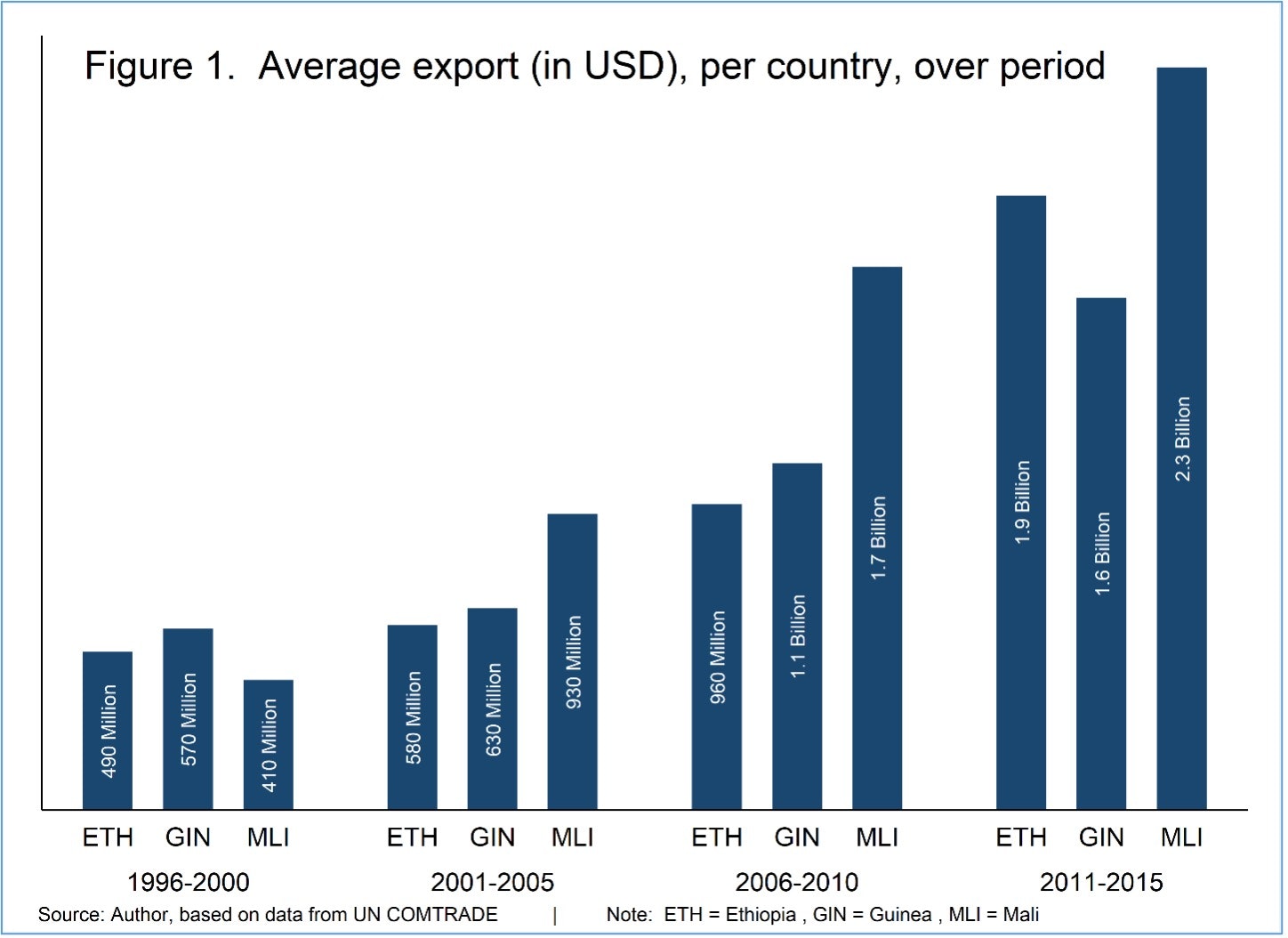
According to Figure 1, overall, the three countries experienced growth in global exports. Between the two, five-year periods 1996–2000 and 2001–2005, global exports from Guinea increased on average by 11% and from Ethiopia by 18%. Mali’s more than doubled over the two, five-year periods.
Subsequently, the three countries maintained the same growth trend. Global exports of each, over the period 2011–2015, represented more than double the average of exports during the period 2001–2005.
Despite preferential access granted under AGOA since 2000, countries have difficulty penetrating US markets.
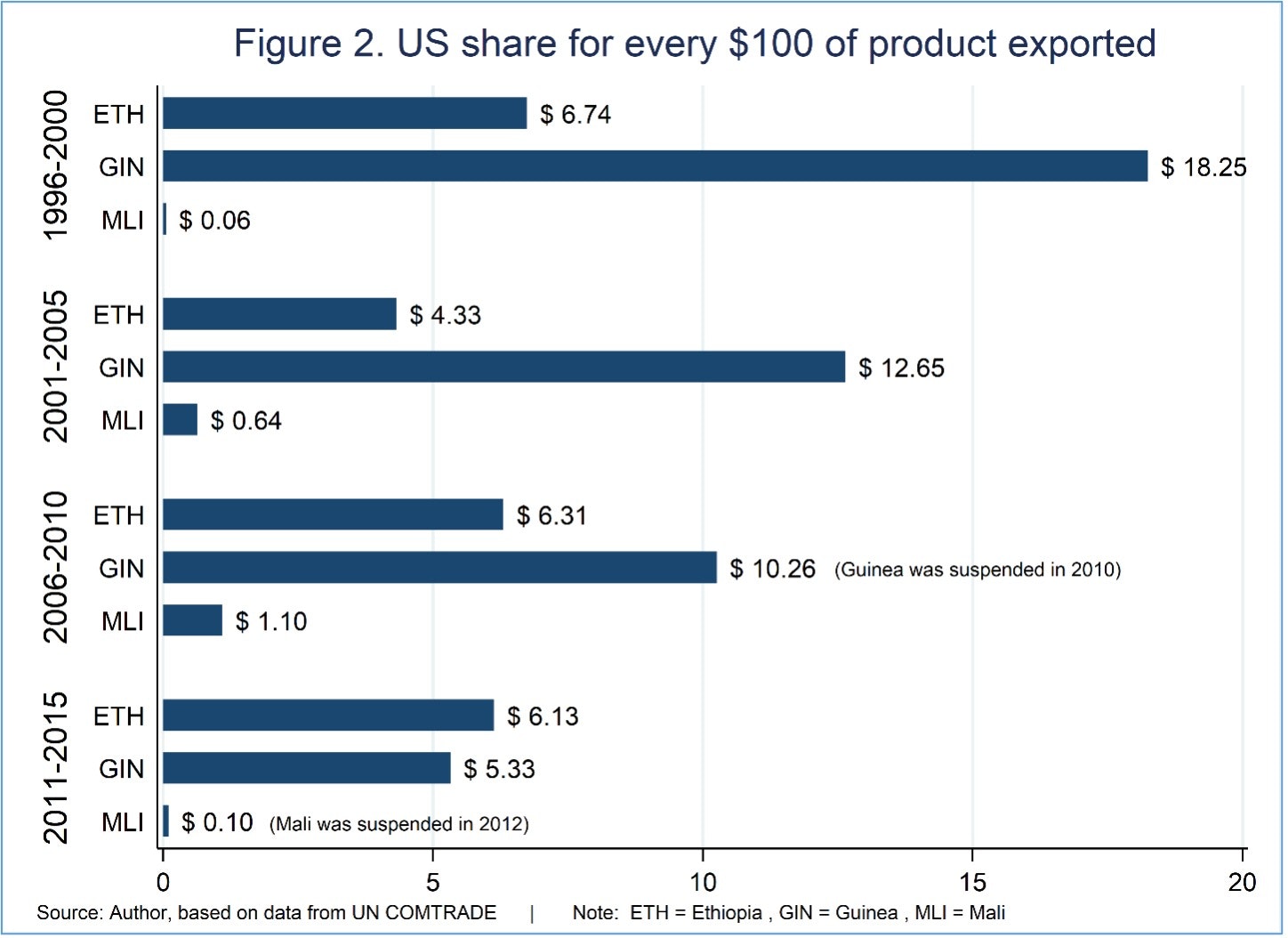
As shown in Figure 2, the share of Guinean exports to the US continues to decline. For $100 of global exports, the US market contributed an average of $18.25 (before 2000).
This share decreased to $12.65 on average over the five-year period following the AGOA (2001–2005). It decreased to $5.33 per $100 exported from 2011–2015.
Despite the AGOA program, the US market represents less than $1 per $100 of Malian global exports, except the period 2006–2010. Nor were Ethiopia’s exports to the US improved by AGOA ratification.
The average share of the US market in Ethiopian exports fell from $6.74 for every $100 exported (period before AGOA) to $4.33 (during 2001–2005), then to $6.31 (during 2006–2010) before falling to $6.13 over the period 2011–2015.
The figures show that, without taking into consideration likely deterioration of their diplomatic relations with the US, the suspension decision will have very little bearing on global export revenues of the suspended countries.


