Vast subsidies keeping the fossil fuel industry afloat should be put to better use:

Capitalism has often been identified as the underlying cause of the climate crisis. A leading voice on the subject is Naomi Klein, one of the climate movements most influential thinkers, whose seminal book on climate change was subtitled Capitalism vs. the Climate. She is one of many voices identifying capitalism as the cause of climate change.
Often central within the capitalism versus the climate framing is the idea that the heart of capitalist ideology – free market fundamentalism – has fuelled the climate crisis. But this line of argument often glosses over the fact that energy markets are not free from government intervention. In fact, the fossil fuel industry is deeply and increasingly reliant on government support to survive.
In a forthcoming book chapter, I detail case studies from the world’s worst climate polluting countries. I show that the fossil fuel industry depends on an egregious amount of government support, which makes the public foot the bill for a harmful – and increasingly uncompetitive – industry.
Polluters market
In my chapter, I show that governments the world over favour fossil fuel interests through public financing, financial subsidies, and bailouts. In addition, the fossil fuel industry is helped by corrupt governance systems. Together this forms what I call a system of fossil fuel welfare and protectionism.
To hide this reality, the fossil fuel industry has invested in a massive public relations scheme (read: propaganda campaign) to paint itself as the defender of the free market. In the US, the fossil fuel industry has even, quite successfully, duped Evangelicals into associating the fossil fuel industry with free markets, and free markets with God’s will. Thus, attacks on the fossil fuel industry become attacks on God’s will. But if God’s will was really aligned with the free market, then the fossil fuel industry would be doing the devil’s work.
Take South Africa, for example, the biggest carbon polluter on the African continent. It used to be home to the world’s fastest growing renewable energy sector, but government intervention to protect polluting coal interests set back these advances. Under President Cyril Ramaphosa the government is now taking steps to allow small amounts of new renewable energy into the market. But government actions continue to slow the immense potential South Africa has for a low-cost, renewable energy revolution.
A recent study reported that South Africa subsidises coal by R56,6 billion per year – propping up a polluting industry with taxpayer money. South Africa continues to subsidise coal despite studies showing that renewable energy was helping to prevent energy blackouts, was saving South Africa billions on energy and that a renewable energy future is the country’s lowest cost energy pathway.
On the other side of the Atlantic, a recent International Monetary Fund (IMF) study showed that the US, the world’s largest historic greenhouse gas emitter, gives ten times more to fossil fuel subsidies than it does to education. Without such subsidies half of future oil production in the US would be unprofitable.
As for coal, even the Wall Street Journal admits that US coal simply can’t compete on a level playing field, and is losing out despite its major subsidies. Studies reveal that without regulation to shield them from market forces, about half of the coal plants in the US would be going bankrupt.
The fossil fuel industry is increasingly relying on the heavy hand of the government to protect fossil fuels from competition. Subsidies and protective policies shield fossil fuels from the reality that renewable energy has become the cheapest energy source worldwide.
Redirecting subsidies
Global fossil fuel subsidies are so large, that if redirected, enough money would be available for investments in clean energy and energy efficiency needed to meet the Paris Climate Agreement targets.
The IMF estimates that eliminating fossil fuel subsidies could free up US$ 2.9 trillion in government revenue annually. That amount is more than double the annual investment of US$ 1.25 trillion the International Energy Agency estimates is needed by 2035 in clean energy and energy efficiency to stop the world from warming by 2°C.
To meet the much safer target of keeping warming to 1.5°C, would only require an additional $ 460 billion per year in clean energy and energy efficiency investments.
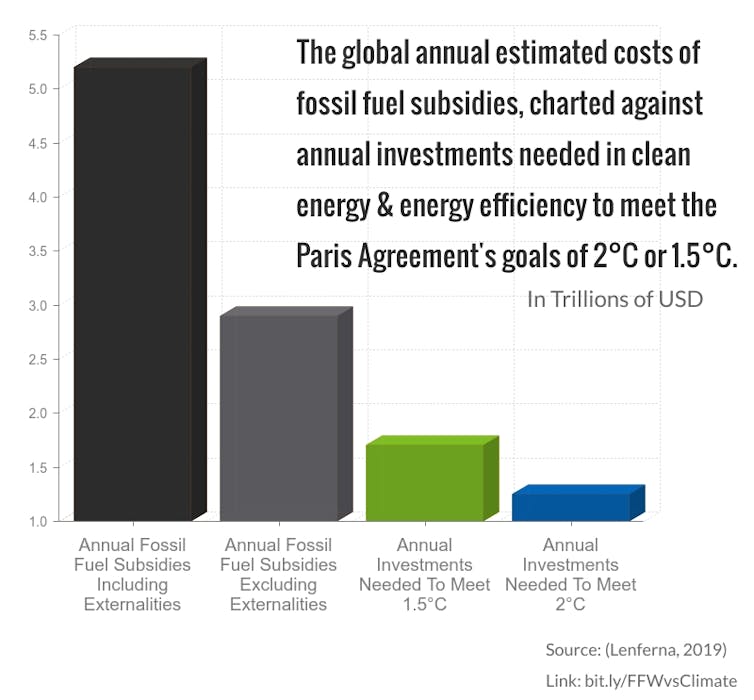
Far from climate action being too expensive, the polluting status quo is costing the world more than a clean energy future, even if we only look at the subsidies given to the fossil fuel industry and ignore the staggering amounts of harm fossil fuels cause.
Rebalancing a skewed system
It’s time we rid ourselves of the notion that what underpins the climate crisis is the operation of free markets. The markets that drive the climate crisis are far from free. Rather, the heavy hand of government is driving the world towards the brink of climate chaos and will also be needed to avert further climate destabilisation.
Instead of free market capitalism versus the climate, we have fossil fuel welfare versus the climate. And if we reinvested that fossil fuel welfare into social and ecological welfare, we could create a much more socially and ecologically prosperous future.

Alex Lenferna works as a climate justice campaigner for 350Africa.org
Source: The Conversation – Articles (AFRICA)
Read more on The Conversation.
Join the fun: Add Your event | Submit a Press Release | Add your listing.


