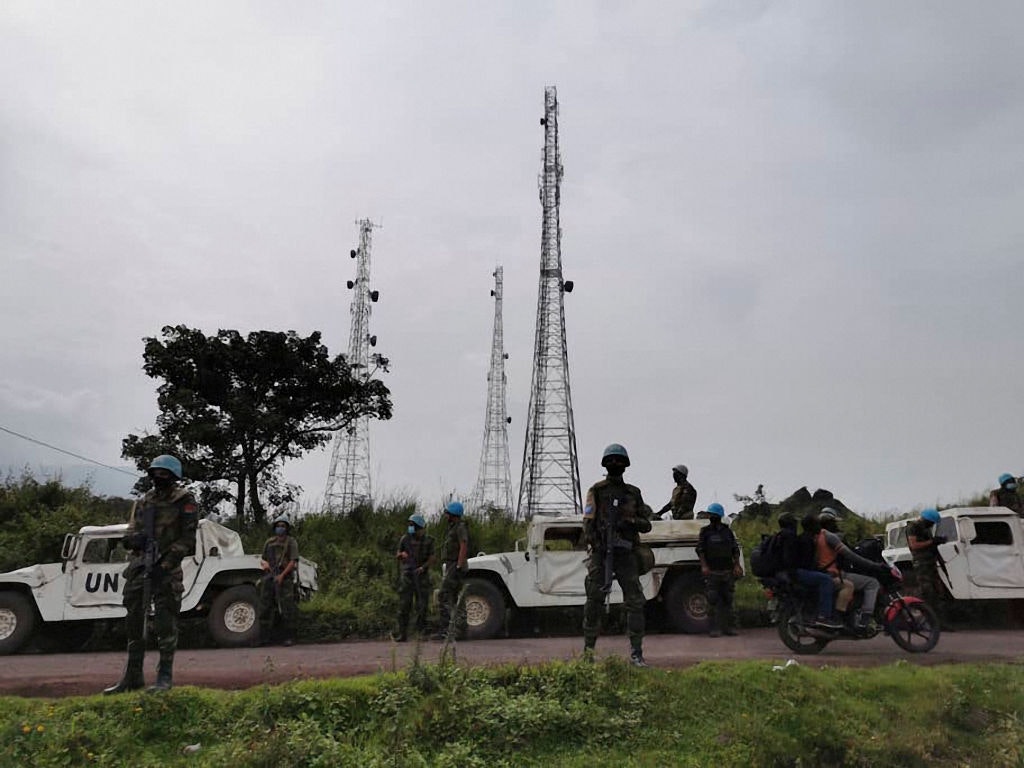
On February 23, the Italian ambassador to the Democratic Republic of Congo (DRC), Luca Attanasio, his bodyguard Vittorio Iacovacci and their driver Mustapha Milambo were killed in eastern Congo. They were part of a convoy that travelled from the World Food Programme’s compound in Goma, eastern Congo.
The convoy took a road that forms the eastern border of the Virunga Park – a national park famous for its wild mountain gorillas. The cars were stopped at gunpoint at a place called 3 Antennas near Kibumba, and Milambo was shot; the other six passengers were forced to leave the vehicles and walk into the bush. Here, a firefight took place with park rangers in which Attanasio and Iacovacci were hit.
Questions are being asked as to who did it and why. These quickly lead to a murky terrain. I’m a conflict researcher and an expert on the armed groups that operate within eastern DRC. This tragic event is only one instance in a widespread, and extremely complex, political economy of violence that affects the lives of millions in the country.
For nearly three decades, eastern Congo has been characterised by insecurity, with frequent outbreaks of violence between armed groups and attacks on civilians. Millions have been forced to flee this violence.
Since the 1990s armed groups have formed an essential part of the political economy of eastern Congo. Communities created self-defence militias in response to foreign-backed armed groups who are accused of using war to loot the country’s riches.
Over time, armed mobilisation turned into a goal in itself; to make money, to express political power, or simply for youth to cope with the chaos. Many of the initial groups mixed, split and metastatised into today’s complex tapestry of rebels. By the latest count, over 120 armed groups are present in eastern DRC.
My research over the past eight years has focused on how armed groups in the region work and fund themselves. This has given me insights into the political and security terrain, including explanations as to why the region is as violent as it is, and why insecurity persists.
Kidnappings
The recent event was immediately framed as a botched kidnapping. Given the context of eastern Congo, it wouldn’t be a surprise.
According to the Kivu Security Tracker, over the past few years, more than 5,000 civilians in the region have been victims of kidnappings and abductions. Kidnapping targets range from school children to women and businessmen. Rape and torture are common techniques of extortionists, and it often ends up deadly.
Ambushes are particularly concentrated in the area in which Milambo, Iacovacci and Attanasio lost their lives.
It is also a place where many different security actors hold sway, complicating attribution. The place of the incident is home to Congolese army checkpoints and a Virunga Park ranger station, and has had recent incursions by the Rwandan Armed Forces. It also straddles the zones of influence of three armed groups: a faction of the Democratic Forces for the Liberation of Rwanda (FDLR) – a Rwandese armed group holding out in the Virunga Park – a faction of the Congolese Hutu self-defence group, Nyatura, and the remnants of the March 23 Movement (M23), also known as the Congolese Revolutionary Army.
While some armed groups definitively do kidnappings, it appears that criminal networks – involving rogue army commanders – also use kidnapping as a way to make money. And in research for my forthcoming book, locals in Kiwanja and Goma told me that go-betweens from the local authorities or the army are often involved in setting up the exchange.
Kidnapping is just one of the things that make roads in this part of Congo so insecure. Nearly half of all violent incidents take place alongside the sparse roads that cut across eastern Congo.
As I’ve covered in my research, roads here are dangerous because everything of value has to pass along them. Armed actors can make a quick buck by targeting traffic along them through roadblocks and hold-ups.
Or lethal politics?
But there is another side to this tragedy that is equally important. It could be a political play. One of these issues could be the growing tensions between the Virunga National Park, politicians and local communities.
The Congolese government quickly blamed the Democratic Forces for the Liberation of Rwanda for the deaths. But the group is often used as a scapegoat because they’re partly composed of people involved in the 1994 genocide in Rwanda. Blaming a group hated by many people can place other issues out of view.
The Virunga Park is highly unpopular among large factions of the local population, some of whom profit from ties to armed groups, and who feel the park uses aggressive methods to keep them from surviving by exploiting the park’s natural resources.
Read more: Why rangers in the Congo’s Virunga national park are under attack
Political interests align with local grievances, because politicians covet popular votes as well as the oil deposits under the park. The park’s Belgian director, Emmanuel de Merode, already received a warning when the vehicle he was travelling in came under fire in 2014. Ever since, attacks on park rangers have been frequent. In 2018, very close to the site of this week’s attack, two British tourists were kidnapped for two days.
Seen in this light, recent events may well be part of a murkier political struggle for control over the park’s resources.
The death of the Italian ambassador highlights the insecurity in eastern Congo – and how kidnappings and politics drive this. It’s a stark reminder of the millions of Congolese people who are at the mercy of violent crime every day.


