Virtual images reveal secrets of an ancient fossil’s brain and inner ear:
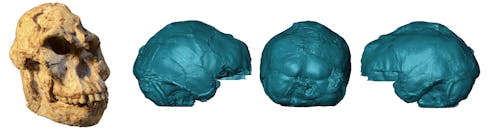
Little Foot is one of the oldest known hominins in southern Africa. This almost complete skeleton, belonging to the genus Australopithecus, dates back more than three million years. It was found in 1994 in the Sterkfontein Caves near Johannesburg in South Africa, which form part of the “Cradle of Humankind”.
We know quite a lot about the genus Australopithecus, thanks to hundreds of fossil remains found in Africa. We know that it consisted of several species, some of them possibly living at the same time, and that these species consumed a high diversity of food.
But unfortunately, because the fossils are often fragmented, we still don’t know exactly what Australopithecus’ brain looked like, how they walked or why they evolved in certain ways.
Now a combination of Little Foot’s relatively intact skull and a high-tech scanning technique called microtomography has helped us reveal some of the answers.
My colleagues and I used microtomography to virtually investigate Little Foot’s skull. This technique relies on the use of a scanner that allows us to access very fine details – a few micrometers at a time. We explored various anatomical structures of the skull and, more particularly, the brain imprints and the inner ear.
We then compared what we found to other Australopithecus specimens, and to fossil remains belonging to different groups: Paranthropus and early Homo. These are geologically younger, which allowed us to track evolution.
The brain and the inner ear are also interesting interfaces between fossil hominins and their physical and social environment. Through these studies, we can present and explore new scenarios about how our ancestors lived and evolved.
Studying brain imprints
The brain cannot fossilise. That means that any understanding of hominin brain evolution relies on analysing the imprints of the brain that are preserved on the inside of our skulls, also known as the endocast.
The endocast can deliver information about the size, shape and organisation of the brain, as well as the vascular system that feeds it. Despite the presence of some cracks and the fact that some parts of the skull are deformed, the Little Foot’s endocast is relatively complete and preserves clear imprints of the brain.
The imprints of the brain in Little Foot’s frontal lobes are similar to the geologically younger specimens of Australopithecus: they show an ape-like pattern that differs substantially from living humans. The visual cortex in the back region of Little Foot’s endocast, meanwhile, seems to be more expanded than in younger Australopithecus and in living humans, where it’s more reduced.
This information is critical because the reduction of the visual cortex in the hominin brain is related to the expansion of the parietal association cortex, which is involved in critical functions like memory, self-awareness, orientation, attention or tool use. This could mean that those functions were not as developed in Little Foot as compared to later hominins.
Our hypothesis is that environmental changes about 2.8 million years ago may have led to selective pressure on Australopithecus’ brain. An unpredictable environment might have changed the habitats and food resources of Australopithecus, and they had to adapt to survive. This would explain cerebral differences between Little Foot and younger Australopithecus.
And our study also suggests that the vascular system in the endocast of Australopithecus was more complex than previously thought, in particular in the middle meningeal vessels. This means that Little Foot might have been relatively close to us in terms of cerebral blood flow.
This trait might have played a pivotal role in the emergence of a large brain in the human lineage, since this part of the vascular system is probably involved in the brain’s cooling system.
Exploring the inner ear
In a second paper we also describe fascinating details about Little Foot’s inner ear. The inner ear contains the organs of balance – the vestibular system with its semicircular canals – and hearing, through the snail-shaped cochlea.
Traditionally, the inner ear in fossils could be described through the shape of the bony labyrinth embedded in the temporal bone. Our microtomographic analyses allowed us to virtually reconstruct Little Foot’s inner ear. We found that it combined human-like and ape-like features. It is most like another Australopithecus specimen found in Jacovec Cavern at Sterkfontein, which is of a similar age to Little Foot. Those two specimens may represent the ancestral morphology of Australopithecus‘ inner ear.
There is a close relationship between the vestibular system and locomotion – how we walk. In Little Foot and other Australopithecus, the vestibular system is different from humans and Paranthropus, but has similarities with apes.
This could be consistent with the long standing hypothesis that Australopithecus could have walked on two legs on the ground, but also spent some time in the trees. Paranthropus is also different from Homo: they were bipeds like us, but probably could not engage in specific activities such as running.
We gained further fascinating insights from the inner ear. These include the fact that Little Foot’s cochlea, which is found in the inner ear, is similar to geologically younger Australopithecus specimens, and to Paranthropus. But it differs substantially from that of fossil Homo specimens. This organ is related to sound perception and to ecological factors such as diet, habitat or communication.
So our findings suggest that Little Foot could have interacted with its surroundings differently than our more recent human ancestors.
This research offers a fascinating window into Little Foot’s brain and inner ear, and helps us understand more about how our ancestors’ brains and ears evolved millions of years ago.

Amélie Beaudet receives funding from the DST-NRF Center of Excellence in Palaeosciences and the Claude Leon Foundation.
Source: The Conversation – Articles (AFRICA)
Read more on The Conversation.
Join the fun: Add Your event | Submit a Press Release | Add your listing.


