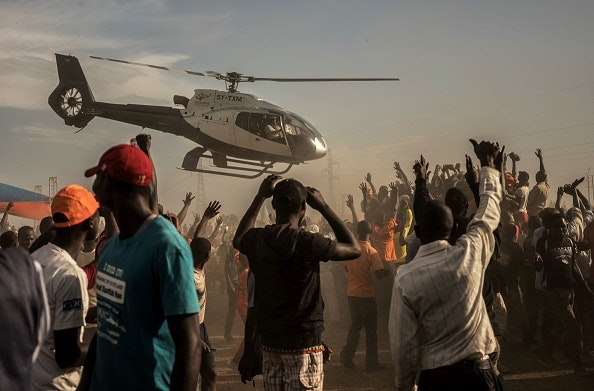
Kenya’s constitution provides for election of the president and 47 governors to head the executive organs at national and county levels, respectively. Also to be elected are legislators: 47 senators, 290 MPs and 1,450 members of county assemblies. There is fierce competition for these posts, not just between parties but between individuals within a party; and the more a candidate spends, the higher the chances of winning a seat. Karuti Kanyinga is a governance and development expert. We asked him how much it costs to run for office, and what the high cost signals for Kenya’s participatory democracy.
How much does it cost to win a legislative seat?
The Election Campaigns Financing Act recognises a number of campaign-related expenses that may arise, from party primaries to general elections. These include venue hiring, publicity material, advertising, campaign personnel and transportation. Candidates may also incur social costs, like contributing medical assistance and school fees to communities.
Our study – based on discussions and interviews with key informants from across the country – estimates that a candidate will this year spend about 39 million Kenya shillings (roughly US$390,000) on average to win a senate seat in the 9 August polls. The amount does not include support that a candidate may get from the sponsoring political party.
It took an average of US$350,000 to win a similar seat in the 2017. The 12.3% cost difference between 2017 and 2022 is attributed to the increasing cost of living, and inflation in general.
Kenya has 47 counties, implying successful senators will spend a total of 1.8 billion shillings (US$18 million) to win their seats.
To successfully run for the Woman Representative seat, an aspirant needs US$240,000 this year – 4.8% higher than the US$228,000 that a successful candidate spent five years ago. Kenya’s parliament has 47 such representatives, implying total spending in excess of US$11 million by the successful candidates.
An MP will require an average of US$222,000 to win in the August polls, up from $182,000 in 2017. The parliament has 290 elected MPs, implying a collective US$64.4 million (KSh6.4 billion) to fill the seats.
The least expensive political seat in Kenya is that of Member of County Assembly, at US$31,000 this year, or a total of US$45 million (KSh4.5bn) for the 1,450 electable seats.
Candidates interviewed for this study said voters generally viewed them as moneybags every time they organised meetings in their constituencies. The demands for money increased in tandem with approaching elections.
For Ghana, which returned to multiparty elections in 1992 – the same year as Kenya – the cost of election increased by 59% between 2012 and 2016. But the US$85,000 that a candidate required to win a parliamentary seat in the 2016 general election was only 46.7% of what a Kenyan counterpart would spend a year later, in 2017, to clinch a similar seat.
Within East Africa, a 2020 study in Uganda found that candidates spent between US$43,000 and US$143,000 to be elected to parliament in the 2016 general election.
What drives these costs?
The first driver is the allure of elective office. Kenya pays an MP a monthly package of at least US$10,000 – including basic allowances. Over 36% of Kenya’s population live below the poverty line, earning less than US$1.9 per day or US$57 monthly.
The second driver is patronage and connections, that have also been linked to theft of public resources. Upon winning election, a patron-client network chain ensues that connects the politician to higher levels of the state and senior politicians to the grassroots. This enables the politician to draw development resources and also provides an opportunity for self-enrichment through contracts with public institutions.
Third, pressure from voters demanding handouts also drives up the cost of politics in Kenya. In many of the interviews, respondents pointed out that voters openly demand money from candidates before agreeing to attend their meetings. Voters demand payment because some of those elected rarely engage with voters after elections.
Read more: Vote buying is a big problem in Kenya. How to curb it before the 2022 elections
The fourth driver of cost has to do with wrong perceptions of roles. In the past, voters judged elected leaders on the basis of the development projects initiated or number of people helped to access government jobs. The current constitution casts the roles of elected leaders as oversight of the executive; making laws; and representation of the people. But voters still demand the “development record” of aspiring MPs. To prove their worth, the aspirant is compelled to contribute to projects and assistance funds.
Fifth, some candidates are willing to outspend others during the primaries of dominant parties or coalitions in order to secure a ticket. Getting a ticket of dominant party reduces the chances of losing the election.
Lastly, there is limited oversight of election financing. The Election Campaign Financing Act restricts the sources of campaign funds but doesn’t place caps on them. Last year, MPs rejected an attempt by the Independent Electoral and Boundaries Commission to change the law and introduce spending caps.
What’s the impact of high costs?
Capable candidates who lack access to sizeable resources get excluded from politics. Our study shows Woman Representative candidates who won their race spent almost three times as much as those who were unsuccessful. Similarly, victorious senators spent more than double what losers spent. In the race for National Assembly, successful candidates spent 50% more than those who did not win.
High costs have also led to a non-functioning representative democracy. Political seats mostly go to those who lead in contributions to development projects, donations to groups, and raising funds for individuals in need. The transactional nature of politics reduces opportunities for debate and dialogue between elected officials and their constituents.
Once the heavy spenders win elections, they turn to the executive and to the public sector institutions for contracts and rent-seeking opportunities. The use of an electoral seat as a source of patronage in the constituency is linked to national level patronage networks, which in turn is the basis for corruption in the public sector. These networks help to entrench abuse of office, especially because political actors have to continue amassing resources for their support bases.
High costs also lead politicians to neglect their functions. Re-election bids begin almost immediately after elections as leaders, without seeking opinions of their constituents, initiate “development projects” aimed at boosting their visibility at campaign time.
A final impact of money politics is that elected officials do not always provide effective oversight of the use of resources by the executive at the national and county level. This would be an exercise in futility, given that some intend to access those resources for personal or political gain.


