We found high UV doses at high-altitude hiking trails in Reunion and Cape Town:
Ultraviolet (UV) radiation from the sun is important for life on earth and especially for humans.
In animals UV radiation is essential for biological functions like calcium metabolism. In vegetation it’s necessary for photosynthesis. And in humans, UV plays an important role in synthesis of vitamin D, which makes for strong bones, joints and muscles.
But too much UV radiation is also very dangerous for human health. Excessive exposure can cause skin ageing and sunburn and can induce skin cancer such as melanoma, cataracts, ocular melanoma, and immunodeficiency.
The sun is the main natural source of ultraviolet radiation. The risk for human health also depends on UV intensity. The UV level is affected by several atmospheric factors, such as ozone, aerosol, cloud cover or altitude. This is one reason why changes to the ozone layer as a result of global pollutant emissions make a difference to human health. The UV intensity is higher at high altitudes because there is less atmosphere to absorb it. Tropical regions also experience high UV exposure because the sun shines there a lot of the time.
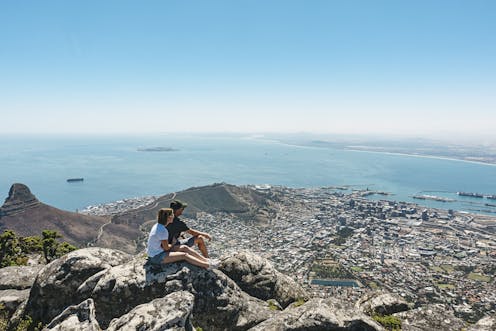
We tested the UV exposure in high-altitude sites in Cape Town and Reunion Island. We assessed human exposure for hiking activities at two popular high-altitude hiking trails on the Maïdo–Grand Bénare (Reunion) and Table Mountain (Cape Town) with a handheld radiometer. We recorded extreme exposure doses.
These high exposure doses highlight the importance of raising public awareness on the risk related to excess UVR exposure at tourist sites, especially those at high altitude. Our findings suggest a need for strong public awareness campaigns among visitors to sites like these to prevent skin diseases and cancers that could result from overexposure to UV radiation.
Our study
We chose our testing sites – Table Mountain (altitude of 1,035 metres) in Cape Town and Maïdo-Grand Bénare (2,898 metres) on Reunion Island – because they are popular tourist destinations for outdoor activities for most of the year. Yet their high risk for UV is not necessarily well known. Tourists, hikers and employees of the local national parks may be exposed to high UV levels. Every year, 1,000,000 people visit Table Mountain and 180,000 hike on Réunion Island mountain.
Two markers were used to quantify the UV exposure. One was the UV index, defined by the World Health Organisation (WHO) as a simple number for public awareness. UV index categories are low (1-2), moderate (3-5), high (6-7), very high (9-10), and extreme (11+).
The maximum UV index numbers recorded were 14 at Table Mountain and 20 at Maïdo-Grand Bénare, which is close to double the extreme UV index threshold defined by the WHO.
The study also measured cumulative standard erythemal dose (SED), a measure of UV exposure in terms of joules per square metre.
The field measurement indicated that people were exposed to 40 SED when hiking Table Mountain and 64 when hiking Maïdo-Grand Bénare. These doses correspond to 3 to 25 times the minimal dose required to elicit a sunburn response depending on skin type (lighter skin requires a smaller dose while darker skin requires a larger dose).
Information about the climate of the two sites shows that the total daily dose is extremely high during summer in Cape Town, and all year around in Reunion Island. Total daily dose is above the level where all skin types will experience sunburn, although people with deeply pigmented skin are less affected. These extreme exposures increase the risk of cataracts, immunodeficiency and melanoma – at least for people with white skin. The link between sunburn and these health risks is not known for people with dark skin.
Melanoma is a type of skin cancer. The mean melanoma rate worldwide in 2015 (male and female mixed) was five per 100,000. In South Africa, the melanoma rate for the total population, regardless of skin type, is five per 100,000 people for men and three per 100,000 for women. Among white South Africans, the melanoma rate is about 20 per 100,000 for men and 16 per 100,000 for women, which is similar to some of the rates recorded in Australia.
From 2006 to 2015, the male population of Reunion Island saw an increase in skin diseases from 2.7 to 7.1 cases per 100,000 people while cases in the female population surged from 3.0 to 6.1 per 100,000. These increasing rates may be due to an atmospheric change and a human behaviour change (such as the popularity of suntanning for aesthetic reasons).
Cover up
The results of our tests highlight the importance of public awareness and prevention of the risks related to UV, especially at exposed sites like Table Mountain and Maïdo-Grand Bénare. The WHO recommends that people avoid being outside in the middle of the day and wear long-sleeved shirts, hats, sunglasses and sunscreen.
This is particularly important in tropical regions, where there are several factors that can increase UV radiation: being relatively close to the Equator, low ozone, low aerosols, low solar zenith angle and clouds.

This research was funded jointly by the CNRS (Centre National de la Recherche Scientifique) and the NRF (National Research Foundation) in the framework of the International Research Project ARSAIO and by the South Africa – France PHC-Protea Program (project No 42470VA).
Caradee Yael Wright receives funding from the South African Medical Research Council and the National Research Foundation of South Africa.
This research was funded jointly by the CNRS (Centre National de la Recherche Scientifique) and the NRF (National Research Foundation) in the framework of the International Research Project ARSAIO and by the South Africa – France PHC-Protea Program (project No 42470VA)
Source: The Conversation – Articles (AFRICA)
Read more on The Conversation.
Join the fun: Add Your event | Submit a Press Release | Add your listing.


