We spent nine years tracking South Africa’s white sharks. What we learnt:
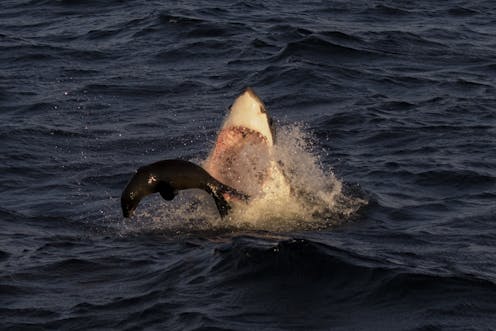
How big is South Africa’s white shark population? Nobody really knows: estimates range from 500 to more than 1200. This is an important question because the species is under enormous pressure. South Africa’s sharks come from two genetic lineages – one related to Australia and New Zealand, and one found only in waters around its coastline.
In places like KwaZulu-Natal, white sharks are culled in large numbers by shark nets and drumlines. They are accidentally caught in gill nets and longlines intended for other fish. They are also losing prey, as many of their favoured fish species are overfished and those species populations are declining.
White sharks are an important bellwether species. They are top predators that feed on a variety of squids, fish, seals, and other sharks; this means they’re able to influence what the ocean’s ecosystems look like and how they function.
By studying and monitoring white shark populations, scientists are able to provide accurate data for conservation purposes. For example, a finding that white sharks from South Africa are capable of swimming to Australia, motivated governments to support extra protection for the species by listing them on CITES which is an international agreement between governments which monitors trade of threatened species.
That’s why a team of researchers from the University of Cape Town, Rhodes University and an organisation called Shark Spotters spent nine years studying the white shark population at Seal Island. This is located in False Bay, on Cape Town’s coast, and is a popular haunt for sharks since seals are also among their favoured prey.
Apart from doing a “head count” of sharks, we noticed a fascinating trend. Seal Island is mostly used by juvenile and sub-adult sharks. But once the sharks – particularly females – reach maturity (around 33-years-old) they are rarely seen in the area again. This partly confirms what we already knew: Seal Island is an important habitat for one segment of the white shark population and needs to be conserved.
The mature white sharks, meanwhile, must be using other habitats to feed and reproduce. But we don’t know where those habitats are, and that’s a problem – without knowing what their chosen habitats are and what threats they might face in those areas, we can’t offer informed recommendations about conserving either the animals or their habitats. We can’t conserve what we don’t know.
In a different ocean, the Pacific, scientists have managed to crack the code of where the mature white sharks go. Through satellite tagging of adults they have identified a defined space in the middle of the ocean, halfway between Hawaii and Baja California, which they call the Shared Offshore Foraging Area. Similar technology is being used to figure out where South Africa’s white sharks go.
Where are the female sharks?
Our study, lasted from 2004 to 2012. During that period we spent 557 hours at sea. We attracted sharks to a research vessel and, on each trip, recorded how many there were, their size and sex. We also used photo-identification of individual sharks to examine their annual visitation patterns.
In total, we recorded 1105 shark sightings and used photo identification to identify 303 unique individuals. Most of the 303 were not sighted at Seal Island again. This suggests transient behaviour for a large proportion of the population.
The most surprising finding was that after visiting Seal Island consecutively for between two and three years, female sharks approaching sexual maturity were rarely seen again. Overall few mature females and no pregnant females were recorded at Seal Island. This suggests that Seal Island is a seasonal feeding ground for young white sharks rather than a nursery area or adult gathering site.
The same thing was true elsewhere in South African waters. We compared our findings to research from several other gathering sites and discovered that mature white sharks both male and female, but especially females, are rarely seen anywhere in the country’s waters. This indicates that they use other habitats to feed and breed.
But where do they go? Not knowing where mature sharks are is a major gap in our understanding of South African white shark ecology.
Satellite tracking has provided us with our first clue. The trackers suggest that the South West Indian Ocean islands and deep oceanic habitats off the continental shelf are areas where we can start looking. These are spaces ranging from a few hundred to a couple of thousand kilometres away from South Africa’s coast.

Alison Kock received funding from the Save Our Seas Foundation and the National Research Foundation. She works for South African National Parks and is a committee member of Shark Spotters.
Source: The Conversation – Articles (AFRICA)
Read more on The Conversation.
Join the fun: Add Your event | Submit a Press Release | Add your listing.


