What a constitutional clause reveals about Liberians’ ideas of citizenship:
In 1973 Liberia introduced its Aliens and Nationality Law. This, and the country’s 1986 Constitution, allow only people of “Negro descent” – those who are black – to obtain Liberian citizenship by birth, ancestry or naturalisation. The 1973 law also banned dual citizenship.
Many Liberians at home and abroad have questioned the citizenship regulations. But historical and contemporary developments explain why the laws are seen by some as “protectionary”. They are viewed as guarding Liberians against any kind of foreign domination.
What has become locally known as the “Negro clause” was driven by free blacks and manumitted slaves who fled 19th century racism and economic servitude in the US and the Caribbean. They established Liberia as a haven where they would be the sole owners of capital, land and the means of production.
Other countries – among them Chad, Malawi and Mali – historically restricted citizenship to people of “African origin” or “African race”. But those laws have been scrapped over time. Liberia is one of two countries in Africa that have maintained the “Negro clause”. Sierra Leone is the other. There, however, so-called non-“Negros” can naturalise. Liberia is also one of only eight countries on the continent that ban dual citizenship.
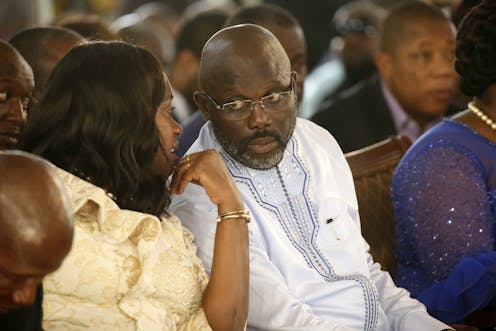
Liberian President George Manneh Weah has suggested it’s time to amend the laws. He believes the current citizenship regulations are unnecessarily “racist” and restrictive. He also argues that upholding them would hinder Liberia’s progress and prosperity, especially after its long, devastating armed conflicts.
My research on how Liberians view citizenship in general and dual citizenship in particular suggests that Weah won’t easily get his way.
Ideas about citizenship
My research involved interviewing more than 200 people who identified as Liberians by birth or ancestry, regardless of their citizenship status. They were based in cities in West Africa, Europe and North America.
The findings suggest that Liberians experience citizenship differently based on their class, gender and ethnicity. These factors greatly influence whether they reject or accept dual citizenship and the “Negro clause”.
For example, I found that poor Liberian-based Liberians were more opposed to abolishing the “Negro clause” and adopting dual citizenship than their better-off diaspora counterparts. They are worried that amendments to the citizenship laws would infringe upon their own already limited rights.
My findings echo the stance of Liberian delegates at a 2015 conference held in the country. They were invited by a committee set up in 2012 to review and make recommendations for amending the 1986 Constitution based on a series of national consultations with citizens. They vetoed the enactment of dual citizenship and removal of the “Negro clause”. Survey data from 2018 generated by Afrobarometer also shows that two-thirds of Liberians are pro-“Negro clause” and anti-dual citizenship.
Why is this the case?
My previous and ongoing research offer four key reasons. These are:
-
the fact that displacement and dispossession define the country’s past and its present;
-
land in Liberia, and by extension land ownership, is violently contested;
-
the country is extremely unequal; and,
-
current laws on citizenship are not properly enforced.
I will focus here on displacement and dispossession as well as the lack of enforcement of citizenship laws.
Historical concerns
Scholars like human rights law expert Bronwen Manby have illustrated how struggles over citizenship and belonging are most apparent in African countries that experienced widespread colonial-era migration of people. These migrants came from within the continent, as well as from countries in Asia and Europe.
Liberia was never formally colonised by Europe. However, during the 19th and 20th centuries, black migrants created citizenship tiers that barred some indigenous men and women from obtaining citizenship for almost a century. This has resulted in Liberians feeling very protective of their privileges as citizens in the 21st century.
I have argued previously that a divide between settlers and indigenes in the 19th century has been replaced by a rift in the 21st century between returnees and non-returnees. These differences pit those who fled the country’s protracted wars – and are now returning to demand citizenship rights – against those who never left and feel that they haven’t benefited sufficiently from the institution of citizenship.
Another factor contributing to the tension around citizenship is that regulations intended to protect Liberian citizens are unenforced and flagrantly disregarded, especially by political and economic elites. These regulations include the ban on dual citizenship and the prohibition on land ownership by non-citizens.
For instance, despite the current gridlock on dual citizenship, some Liberians – among them the country’s ambassador to the UK– allegedly break the law by carrying two passports.
Such stories leave many Liberians wondering if changes to the constitution would give the rich and powerful the licence to infringe on their already limited citizenship privileges through land grabs, voting in national elections or holding high public office.
There are a few things President Weah can do if he wants to tackle people’s resistance to adopting dual citizenship and abolishing the “Negro clause”. For one, he should make the rhetoric of his “pro-poor” agenda a reality. If he improves the material and living conditions of Liberians at home, people may stop viewing those abroad as a threat.
This article is based on one which originally appeared on Al-Jazeera English.

Robtel Neajai Pailey does not work for, consult, own shares in or receive funding from any company or organisation that would benefit from this article, and has disclosed no relevant affiliations beyond their academic appointment.
Source: The Conversation – Articles (AFRICA)
Read more on The Conversation.
Join the fun: Add Your event | Submit a Press Release | Add your listing.


