South Africa’s Karoo region is world famous for its wealth of fossil remains. Many of these are from long extinct land animals that lived between 280 and 200 million years ago. This was a time before the dinosaurs, when all the landmasses were joined into the supercontinent of Pangaea.
Most of the fossil skeletons that have been found in the Karoo belong to therapsids. These ancient reptilian precursors to mammals are often called “mammal-like reptiles”.
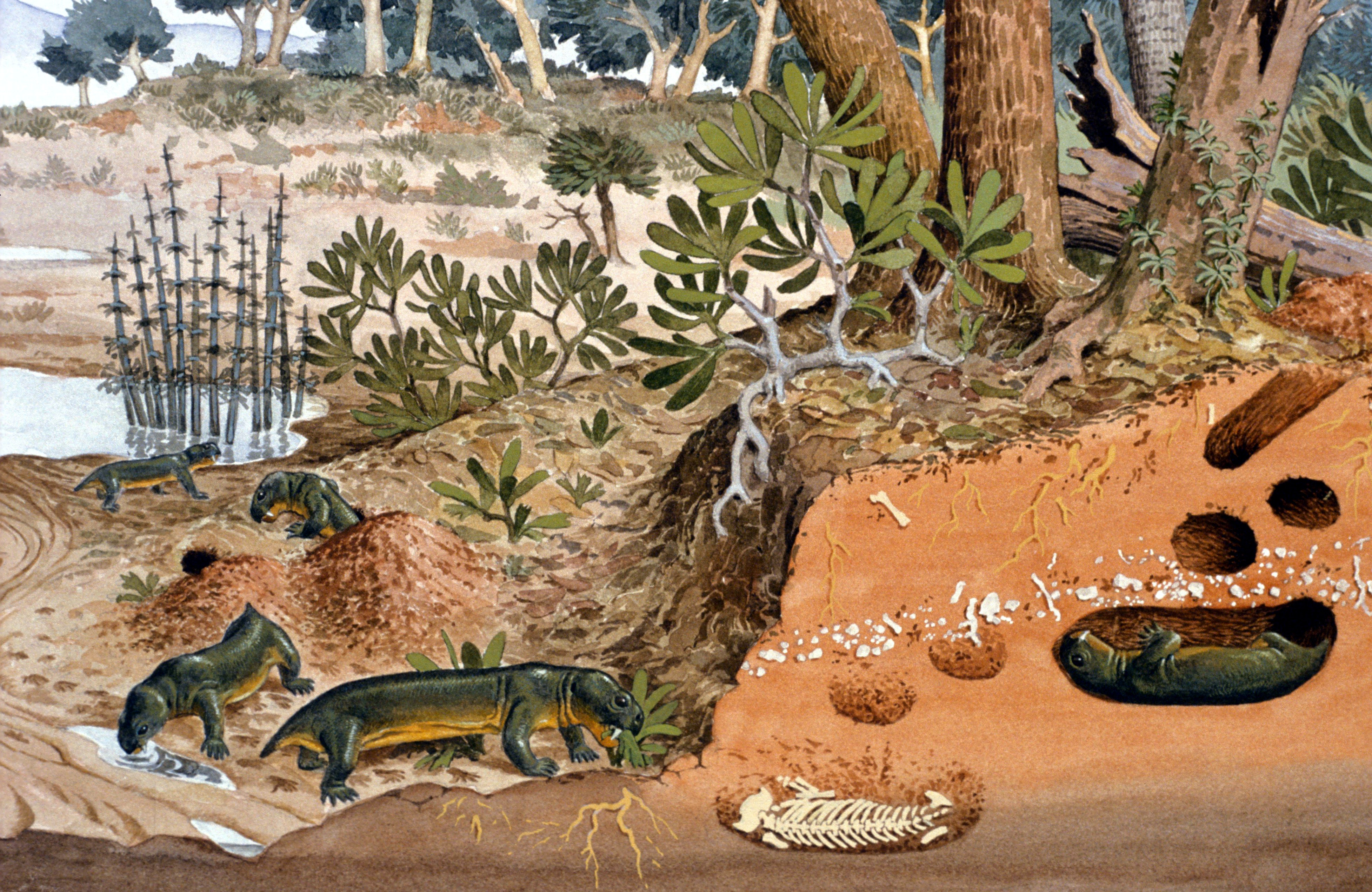
But it is very rare to find therapsid skeletons preserved in underground fossilised burrow casts. These are ancient burrows that were filled by sediments (during a flood for example), and were later deeply buried by time and the elements and turned into rock.
That’s why a find in the 1980s in the Namakwa district of South Africa’s Northern Cape province, near Fraserburg, was especially significant. Skeletons found in the terminal chamber of spiral-shaped burrow casts demonstrated that they were excavated by a small herbivorous mammal-like reptile called Diictodon.
It wasn’t clear why the animals might have gone underground but it was assumed to be mainly for body temperature regulation. Then, in 2014, some new burrow casts were found at the same site. These contained the scattered skeletons of adult and infant Diictodon. Now, after a few years of careful study, we have been able to establish that adult males were in the burrows, along with infants of the same species.
This supports the idea that Diictodon went underground to breed and also that adult males may have played a role in feeding and protecting their litter. This is a rare reproductive behaviour for most modern male mammalian species. These new finds indicate that Diictodon was burrowing and giving some parental care to its young. This was long thought to be unique to mammals. Now we have evidence that this behaviour also existed in their remote cousins, the mammal-like reptiles and it deepens the root of “mammalness” – the point in time when mammal-like behaviours first emerged – even further than previously thought.
Technology sheds light
Modern animals use burrows for a variety of reasons: avoiding predators, food hoarding, brooding, and avoiding extreme humidity and temperature fluctuations.
In the fossil record it is not always clear what ancient animals were using their burrows for. Luckily, modern technology means that scientists are increasingly able to answer such questions. Our team worked with the European Synchrotron Radiation Facility in Grenoble, France.
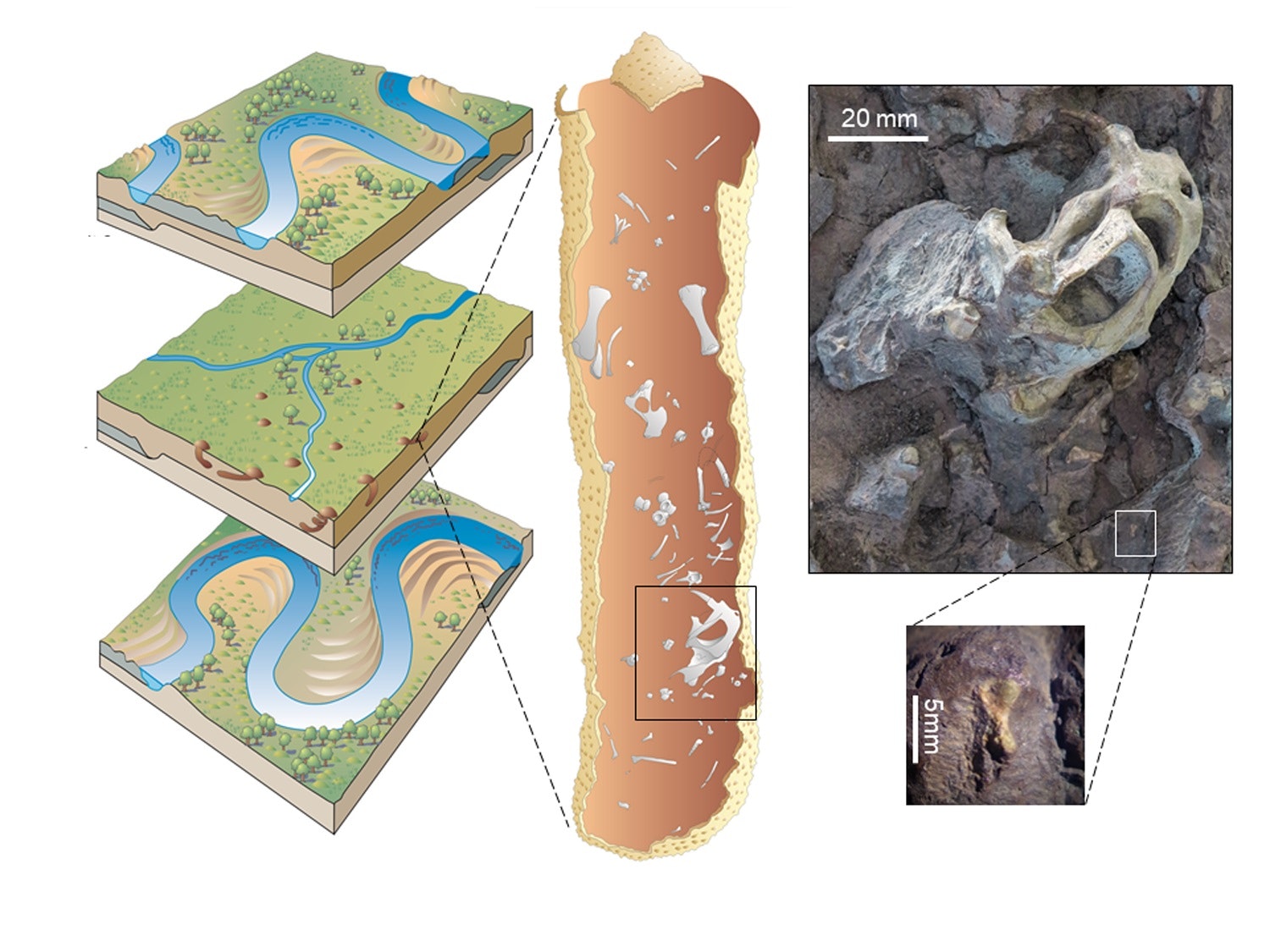
The X-ray beam generated in this synchrotron is 100 billion times brighter than the more common medical X-ray scanners, making it possible to create much sharper images. The technique we used is also much more sensitive to density variation: this is essential when trying to see fossilised bones surrounded by rock that can have very similar density. Using this powerful X-ray beam, we could digitally extract all the bones entombed in the burrow’s rock infill.
This meant we didn’t have to physically break the infill or damage the fossil. Even better, we discovered a second infant Diictodon that wasn’t visible from the surface. This reinforces the interpretation of the burrow as a brooding chamber, a conclusion that would have remained out of reach without the synchrotron.
In all, we identified the bones of an adult and two tiny infant skeletons all lying together in a confined space.
Meanwhile, the end chamber of another burrow cast found in 2014 was mechanically prepared at the Iziko South African Museum’s fossil laboratory. This revealed another adult Diictodon skeleton along with a tiny infant limb bone. Synchrotron imaging of the tusks and inner ear of the adult skulls indicated that they were both males.
Daddy takes care of the babies
This work has allowed us to demonstrate for the first time that burrows were used during breeding season as brood chambers. This is a clear case of parental care, which is a very mammalian behaviour. It shows that parental care of offspring may have predated the origin of mammals by almost 60 million years.
The fact that the two adult specimens are males, not females, suggests that some parental care may have been done by males, unlike in most modern mammals. We do not know the significance of this. But male parental care in modern mammals enables faster growth of the young and increases fecundity of the female, which can be advantageous in times of crisis.
Burrowing of this sort likely had benefits beyond parental care. The action may have saved mammals and their ancestors from mass extinction events countless times. For example, it enabled them to survive the “Great Dying” 252 million years ago, a biological crisis that wiped out 90% of all living creatures, and the fall of the notorious meteorite that killed off the dinosaurs 66 million years ago. Now we have evidence that this important, life-saving behaviour started 260 million years ago in South Africa.


