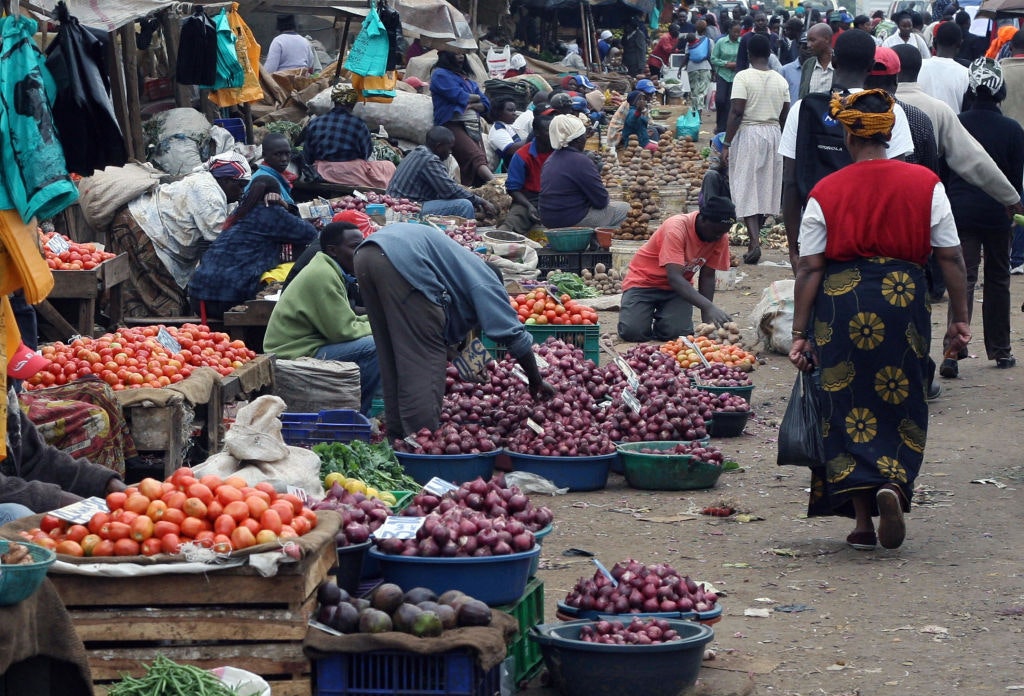
Kenyans are caught in the grip of higher food prices brought about by a combination of adverse weather, rising input costs – which have been worsened by the Ukraine war – as well as policy adjustments the government agreed to to access funding from the International Monetary Fund. The prices for the staple commodities in the food basket used to compute inflation by the Kenya National Bureau of Statistics, such as maize flour, wheat flour, irish potatoes, onions, tomatoes, cabbages, kales and cooking oil, rose by an average of 20% in January 2022 compared to the same period in 2021. By the end of February 2022, 3.1 million Kenyans out of a total population of 47 million were in need of food assistance. Timothy Njagi Njeru explains what’s driving prices up and what can be done.
What’s driving food price increases in Kenya?
One of the biggest drivers has been disruptions in global production and trade stemming from the COVID pandemic. The production and distribution of commodities were affected by public health measures such as lockdowns and curfews. Although demand for goods soon rebounded, production and distribution took time to get going leading to shortages – and price increase.
These disruptions also increased the costs of imports to Kenya which is a net importer of food. Cereal commodities such as wheat and rice are some of the largest food imports in terms of both volumes and value.
The Russian invasion of Ukraine is expected to add further pressure to food prices. Russia accounted for almost a third (32%) of wheat imports, making it the country’s lead supplier. Ukraine accounted for 94% of soya imports. It also contributed 2% to wheat and 3% to maize.
Another external factor is that input costs for food production have gone up.
Kenya imports most of the raw materials for animal feeds manufacturing. The raw materials include soya and sunflower, maize, wheat, rice and sorghum. Last year livestock farmers were hit by rising costs of animal feeds, attributed to shortages in raw materials such as soya in the global markets due to the COVID-19 pandemic.
The government announced a duty waiver for raw materials for animal feeds in December 2021. But rising global prices means that the expected effect in reducing local prices for animal feeds has not been realised. Prices for most of the raw materials have increased month on month. Soya which priced at 551 USD/ton in November 2021, was priced at 606 USD/ton in January 2022, while maize also rose from 248 USD/ton to 276 USD/ton over the same period.
Another input cost that’s gone up is the price of fertilisers. These have gone up by 70% compared with last year. The rise, which started in 2021, was mainly attributed to supply chain disruptions due to the pandemic. In recent weeks prices have been driven up even further by the Russian invasion of Ukraine.
Read more: Russia’s war with Ukraine risks fresh pressure on fertiliser prices
In 2020, Russia accounted for 17% of fertilizer imports to the country.
Lastly, the expected rise in the cost of fuel will also increase food production costs.
What are the domestic push factors?
The government increased excise duty on most commonly used household goods from 1 November 2021. This was after Kenya signed a deal to secure loans from the International Monetary Fund as part of the pandemic relief interventions.
In addition, production shocks due to adverse weather and rising costs of transport are seen as contributors to the food prices.
Northern Kenya is the leading producer of beef in the country. The drought there means a shortage in food supply in the country.
The increased transport costs means that adding cost to the distribution last mile – which in most cases is passed on to consumers.
What can the government do?
It’s the government’s responsibility to maintain the delicate balance between agricultural profitability and consumer price affordability. The government has sought to achieve this by supporting producers to lower the costs of production in a bid to keep prices down. When this is not sufficient, as was the case during the pandemic, the government provides welfare support to the most vulnerable households.
The current food price increases will likely increase the number of households requiring support. This is because most households are yet to recover from the economic effects of the pandemic. It’s also because the government failed to cushion producers from the global price shock that will lead to increased costs of production.
For instance, a one time duty waiver for fertiliser would have helped maintain prices within the reach of majority of farmers. This was considered but it is now too late in the production cycle.
Going forward, the government should consider a waiver on its total ban on genetically modified products. The ban means that Kenya will struggle to replace countries such as Russia or Ukraine in supply of wheat and soya as most of the leading producers in Asia, Europe, Latin America and North America produce GM products.
Such a step would also take the pressure off animal feeds.
This policy waiver should definitely be considered even as a short-term measure.
In addition, the government needs to tackle the problem of poor data on food availability. Credible data is the basis of useful policies.
The potential solutions for sustainably growing local production and ensuring stable and affordable food prices include investments in research, reviving the extension systems, providing incentives for increasing agricultural credit, climate proofing agriculture and building resilience for agricultural producers. Effort should also be made to increase public and private investments in agriculture.
The government has made efforts to implement some of these potential solutions such as climate smart programmes. But that won’t work work on its own as they have to be integrated with agricultural markets, and the scale of the programmes has been limited to specific areas.


