Many animals form groups. Living in a group can protect individuals from predators, reducing risk; it also helps them to find more food, increasing rewards. However, the presence of cities can alter these patterns of risk and reward. When wildlife enters urban space, there’s the potential that the way individuals behave in groups – their “collective behaviour” – can be drastically altered.
Until recently, scientists have known little about the collective behaviour of wild animals because it’s difficult to observe many individuals at once. Even less is known about wild animals’ collective behaviour in human-changed environments because the physical structure of urban spaces makes observations even harder.
In Cape Town, South Africa, wild chacma baboons regularly use urban spaces in search of high-energy human foods. This can result in negative interactions between humans and baboons, as well as high levels of baboon injury and mortality caused by electric fences, cars, dogs and shootings with pellet guns. The City of Cape Town contracts a private company which employs teams of “baboon rangers” to herd the baboons out of urban space in an effort to reduce these negative interactions.
We fitted GPS trackers to a troop of baboons living on the urban edge in Cape Town, to allow us to study their collective behaviour even when we cannot observe them directly. We aimed to understand if and how their collective behaviour changes in urban space, and what this means for managing them.
We found that baboons showed typical patterns of collective behaviour in natural space, but in urban space these patterns break down: individuals were further apart, the group was poorly coordinated and often split into subgroups in urban space.
We then examined leadership using an established method, which automatically detects leadership events over time, based on the relative positions and movements of all individuals. This uncovered that despite a breakdown in collective behaviour, high-ranking adults continued to have a large influence on others’ movement in both natural and urban spaces. These findings have implications for the management of the baboons.
How urban space influences collective behaviour
Chacma baboons typically live in stable mixed-sex groups with strong social bonds among individuals. When moving around their home range they tend to be very coordinated – their activities are often in sync. High-ranking baboons that have many strong social bonds also have a large influence on the group’s movement.
Urban spaces look very different from natural animal habitats. They have heightened risks and rewards, and tend to be “fragmented” – made up of houses, roads and other human structures that split up and create barriers in the landscape.
Using our GPS data recording at every second, we measured inter-baboon distances and variation in baboon speed and compass direction when the troop was in either urban or natural spaces.
This led to our first finding, that in urban spaces the baboons’ collective behaviour breaks down. But despite the emergence of subgroups, as well as individuals being further apart and activities being less coordinated, it was clear that the troop still followed high-ranking individuals more than other group members.
Because adult male baboons are larger, more visible, and elicit more complaints from the public, baboon management aims to deter baboons from urban space by focusing their efforts on adult males. Since our findings reveal that males are followed in both natural and urban spaces, this strategy successfully deters most of the group from urban space and reduces negative interactions between baboons and people.
However, it’s not that simple. In previous research we’ve shown that low-ranking females, which tend to have fewer social connections, break away from the main troop and use the urban space alone or in small groups. This will require additional or different management strategies.
The biology of leadership
The important roles of adult males in both natural and urban space is interesting from a biological perspective. In many species, individuals with many strong social bonds take on leadership roles. Sometimes, these individuals have particularly useful information. For example matriarchs or “grandmothers” in elephant and killer whale societies have the most knowledge about their environment and therefore tend to lead groups.
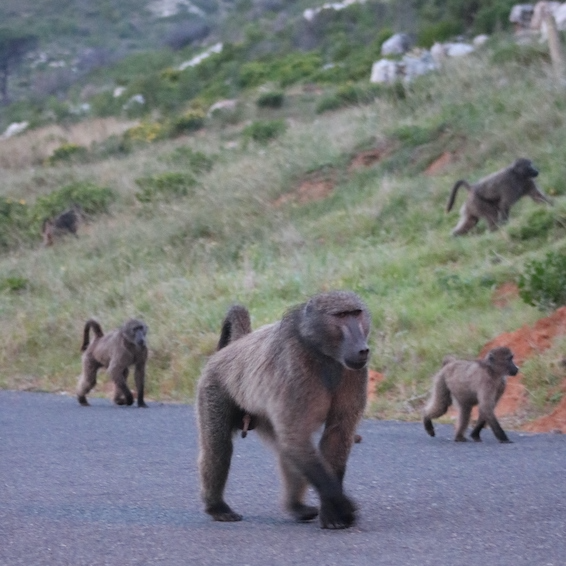
In other species, like chacma baboons, socially-connected high-ranked males act as leaders and are followed since they provide protection from predators and from other males that may commit infanticide.
Our finding that males continue to lead the troop in urban space despite other collective behaviours breaking down might suggest that leadership in animal societies may not be as flexible as other aspects of collective behaviour.
Why does it matter?
Our findings can be used to help city authorities understand how best to keep baboons out of urban space.
It is much easier to “herd” a baboon group away from urban space when it is whole, rather than made up of multiple small units. In the short-term, monitoring multiple groups requires more rangers and expense. Longer-term, if the subgroups become permanent (as has happened elsewhere on the Cape), this could be a real hindrance for effective management.
The next step is to understand exactly what factors cause the group to split up in the urban space: is it simply too difficult for them to stay in contact in urban space? Does the distribution of human food rewards cause them to split? What does management and herding mean for cohesion? Are there other factors?
Finding answers to such questions can help us understand how social species adapt – or do not – to human-changed environments, and provide insight into how to better manage the negative interactions that result.


