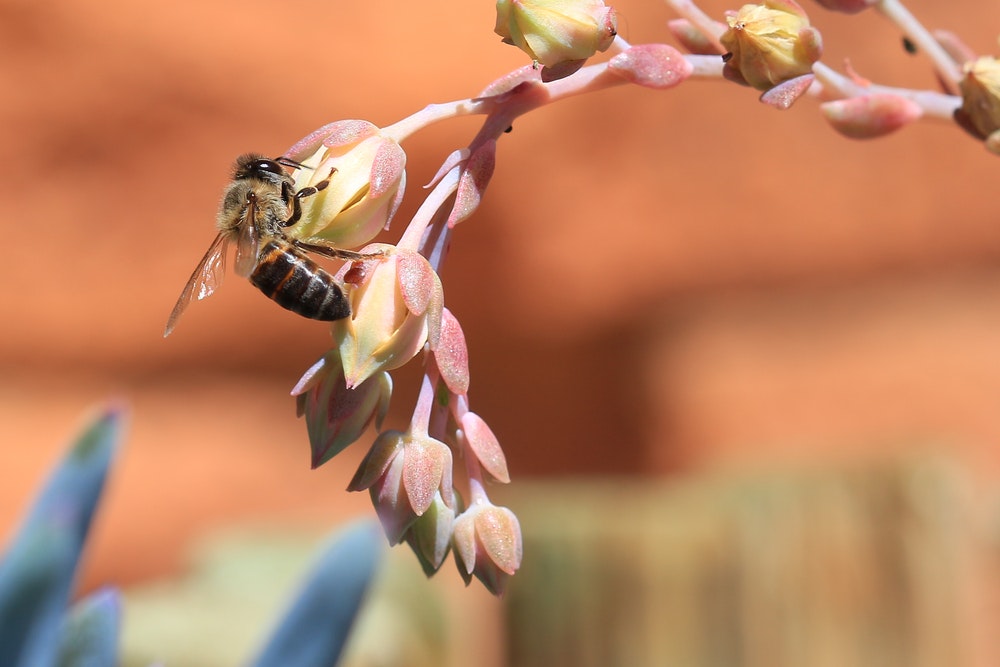
Honeybees are often in the news. Research constantly updates what’s known about their importance to the environment, biodiversity, economies and food security.
In South Africa, managed honeybees support livelihoods in various ways, such as honey production. In the last decade or so, pollination services to agriculture have also become a huge revenue area for beekeepers. It is estimated that honeybees pollinate over 50 crops in South Africa.
In just one province, the Western Cape, about 91,000 hives are currently required to serve the deciduous fruit industry. And this number is expected to increase to at least 100,000 in the next five years. In February 2020, the government’s beekeeper registration database recorded 77,088 managed hives for the province – more than 45% of the country’s total of 161,610. If these numbers are accurate, then there is already a shortfall of hives in the Western Cape.
In a book chapter I co-authored with my colleagues, we outlined the importance of the two honeybee subspecies, Apis mellifera capensis (Cape honeybee) and Apis mellifera scutellate (African honeybee). We explored their importance for pollinating agricultural crops and indigenous plants, helping to maintain various ecosystem functions. These honeybees require a diverse quality and quantity of good forage resources to survive and produce. But those resources are under threat and need to be better managed.
The bee forage challenge
Studies conducted by the South African National Biodiversity Institute, between 2011 and 2014, found that beekeepers manage a variety of forage resources important to honeybees. Some are indigenous; others are exotic – such as forestry plantations, agricultural crops, garden plants and tree lanes in cities.
These various resources all have preferred and complementary uses and are all important. They may be best for honey flow, colony build-up, or swarm trapping, or be available at different flowering times and accessible to different users.
Therefore, an overarching strategy for managing forage resources has to consider indigenous and exotic plants, as well as use, availability and accessibility.
We note with great concern that honeybee forage resources are under increasing pressure in South Africa. Threats to forage availability and accessibility directly affect beekeeper livelihoods and pollination services. They put both wild and managed honeybee populations at risk.
Here are some of the threats.
-
Changes in land use and landscape management. Changes and competing priorities resulting from land use and its management, including agricultural practices, have been shown to threaten bee populations through habitat loss.
-
Removal of invasive alien plant species that are important forage resources. Although invasive alien plants have a negative impact on biodiversity and ecosystem functions, some of these plants also serve as important forage for honeybees. Managing them must take trade-offs into account.
-
Accessibility to important and secure forage resources. Most beekeepers do not own the land where their hives are kept or where they can access forage. Permission to access good forage sites remains a challenge for beekeepers. This puts pressure on the foraging area and encourages overstocking, which may hinder hive productivity, increase competition with other pollinators and promote the transmission of diseases, pests and pathogens.
-
Crop chemical regimes that affect the viability of crops. Various crops serve as important forage for bees, especially at times when natural vegetation might be out of flower. However, these crops are often subjected to heavy pesticide application to manage pests, and this can kill bees. Beekeepers are then reluctant to place hives in agricultural areas.
-
Impacts of climate change. Extreme events associated with climate change, such as high frequency of fires and droughts, has an impact on forage and habitat for bees. Adverse changes in temperature also affect flowering, creating a mismatch in seasonal timing of when flowers produce adequate nectar and pollen for bees.
Planning and action
Taking into account the projected pollination demands for years to come, there’s an urgent need to plan for expansion and provision of forage resources for managed honeybees in South Africa.
In the Western Cape, a strategy for the industry was developed in 2017 with the assistance of the Western Cape Department of Agriculture. However, the plans are yet to take off, through lack of funding and, to some degree, political will to commit in the areas of demand. A public-private partnership is critical at this stage to plant and provide enough forage. Government needs to take leadership and responsibility, realising the importance of the beekeeping industry, and the services it provides to the agricultural sector – food production.
In our chapter, we put forward for consideration various management recommendations. A few are ready for action, while others still need to be developed further.
Raising awareness and building understanding. The public has to realise why the current situation needs to change. This process must be informed by facts and focus on the right target audience. It must also be monitored to ensure effectiveness.
Practices that protect existing forage resources. The goal is a viable and sustainable honeybee population. This must be a concerted effort among policy makers, agriculture and environmental sectors, researchers and the public at large.
Practices that promote planting of honeybee forage. The initiatives and practices around planting bee forage needs to happen on both public land and private land. There are successful campaigns to draw from internationally.
The pollination demands in agriculture are expected to keep rising. This means that more land and forage is required to feed the bees naturally. Hive theft and vandalism have increased tremendously in most areas across the country as hives are in demand for pollination. This adds to security costs for beekeepers. Beekeepers have started passing the cost of feeding and hive security to growers. They will no doubt pass these costs on to consumers.
Unlike some countries, South Africa is in no position to import any other species of bees for crop pollination. It’s up to us to keep them alive for the continuous provision of pollination services.


