What latest assessment on global warming means for southern Africa:
The release this week of the Intergovernmental Panel on Climate Change’s (IPCC) special report on global warming of 1.5℃ above pre-industrial levels marks a critical point in climate negotiations. Billed in the media as “life changing,” the report illustrates how crossing the ever-nearer threshold of 1.5℃ warming will affect the planet, and how difficult it will be to avoid overshooting this target.
The special report takes a worldwide look at the growing impacts of climate change. For climate change “hotspots” – hot, dry and water-stressed countries like Botswana and Namibia in southern Africa – local warming and drying will be greater than the global average.
The report underscores the urgent need for countries like Botswana and Namibia to prepare and adapt – and do so quickly. The Paris Agreement’s goal of limiting global warming to well below 2°C, ideally 1.5°C, by the turn of the century will be extremely challenging. To date, mitigation pledges by nations fall far short of what is needed, with global temperatures on track for a warming of 3.2°C by 2100. Under an increasing emissions trajectory, the 1.5°C threshold could be breached as early as the next decade, and the 2°C mark the decade after.
Our analysis of the effect in Botswana and Namibia of 1.5°C, 2.0°C and higher levels of global warming shows that they’re likely to get hotter, drier and more water-stressed. The sooner southern African countries prepare and implement adaptation strategies the better.
Impact
Botswana and Namibia already know the challenges of droughts and floods. A few years ago, Botswana’s capital city Gaborone was on the brink of running out of water as the country battled its worst drought in 30 years. Neighbouring Namibia has battled with recurrent and devastating droughts and floods in recent years, especially in its northern regions, where most of the population live.
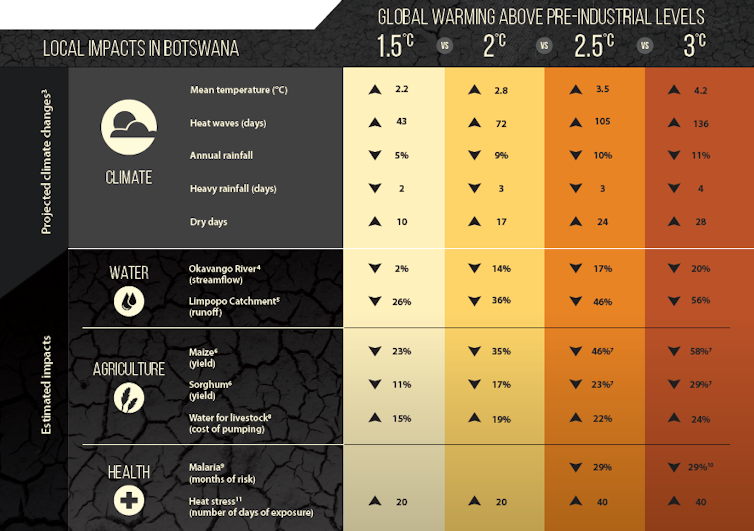
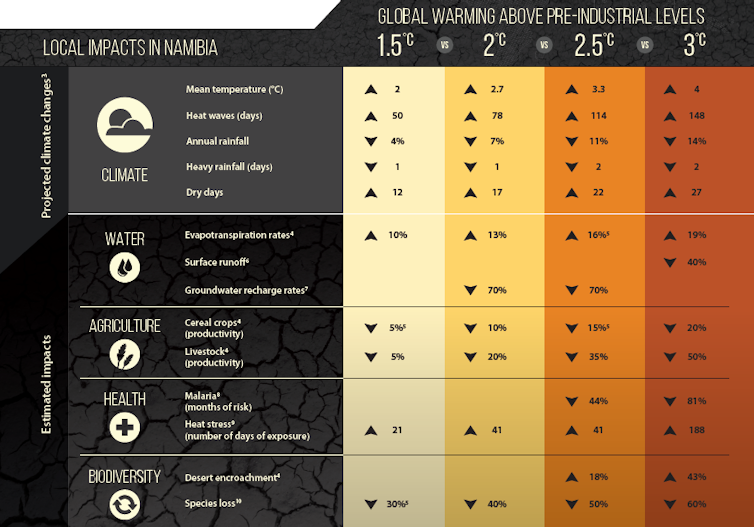
Global warming of 1.5°C would lead to an average temperature rise above the pre-industrial baseline in Botswana of 2.2°C and Namibia 2.0°C. At 2.0°C global warming, Botswana would experience warming of 2.8°C. Namibia would warm by 2.7°C.
Changes in rainfall are also projected to shift. At 1.5°C of global warming, Botswana would receive 5% less annual rainfall, and Namibia 4% less. At 2.0°C global warming, annual rainfall in Botswana would drop by 9%, with annual rainfall in Namibia dropping by 7%.
Both countries would also see an increase in dry days. At global warming of 1.5°C, projections show Botswana having 10 more dry days per year. That number rises to 17 extra dry days at 2.0°C global warming. For Namibia, dry days increase by 12 at global warming of 1.5°C, and by 17 at 2.0°C.
The impact of global warming on extreme events is also evident. Both countries can expect roughly 50 more days of heatwaves at 1.5°C global warming, and about 75 more heatwave days at 2.0°C global warming.
Tables show the projected impact of hotter temperatures.
Vulnerable sectors
The effects of higher global and local temperatures will be felt in various sectors key to the prosperity of people and economies in both countries.
Understanding what this will mean for sectors like agriculture, health and water, is crucial for adaptation planning and thinking about what must be done, and by when.
In a hotter, drier future there will be less domestic water available. Runoff in Botswana’s Limpopo catchment is projected to decline by 26% at 1.5℃ global warming, and by 36% at 2.0℃. In Namibia, evapotranspiration rates increase by 10% at 1.5℃ global warming and by 13% at 2.0℃, leading to reduced river flows and drier soils.
Agriculture is particularly vulnerable, with potential drops in crop yields and increased livestock losses. In Botswana, at 1.5℃ global warming maize yields could drop by over 20%. At 2.0℃ warming, yields could slump by 35%. Rain-fed agriculture is already marginal across much of the country, and anticipated climate change may well make current agricultural practices unviable at 1.5℃ and above. In Namibia, productivity of cereal crops is expected to drop by 5% at 1.5℃ and by 10% at 2.0℃
The impacts of global warming on human health are also essential to consider. Heat stress is projected to become an increasingly greater threat. At 1.5℃ of global warming, Namibia and Botswana can expect roughly 20 more days of heat stress exposure in a year. At 2.0℃, in Namibia this doubles to around 40 more days of heat stress exposure.
All of these factors become even more severe should the 2.0℃ threshold be overshot.
Urgent action is needed
The progressively serious climate impacts at 1.5 and 2.0℃ in these countries demands concerted action, both locally and internationally. Leaders from countries such as Botswana and Namibia cannot let-up on the global stage in pushing for nation states to make good on, and further improve, their pledges to cut greenhouse gas emissions in line with the Paris Agreement. As the IPCC report shows, early and decisive action will not only reduce the risks of overshooting the Paris temperature targets, but also slow down the rates of change, making local adaptation easier to roll out.
At the same time, highly exposed countries such as Namibia and Botswana need to anticipate and plan for quite rapid changes in local weather and climate. They need an acceleration in developing adaptation strategies in a way that works for all people and across the economies of these countries. The time for pilot adaptation projects and experiments is over, and the moment to start mainstreaming climate resilience into public, private and community sectors has arrived.
In parallel, governments, scientists and development practitioners need to think longer term, to consider what overshooting the 1.5°C and 2°C targets really means for adaptation. At some stage, adaptation of these systems may not be enough, and complete transformations to new livelihoods that are suitable in a 2°C+ world may be needed.
Brendon Bosworth, a communications officer with ASSAR, based at the ACDI, University of Cape Town contributed to writing this article. Tiro Nkemelang, a PhD student at ACDI and Roy Bouwer, a research assistant at ACDI, contributed to the underlying analysis.

Mark New receives funding from the IDRC, UK AID, the NRF in South Africa and the AXA Research Fund, among others.
Source: The Conversation – Articles (AFRICA)
Read more on The Conversation.
Join the fun: Add Your event | Submit a Press Release | Add your listing.


