What Ramaphosa needs to do to fix South Africa’s foreign relations after Zuma:
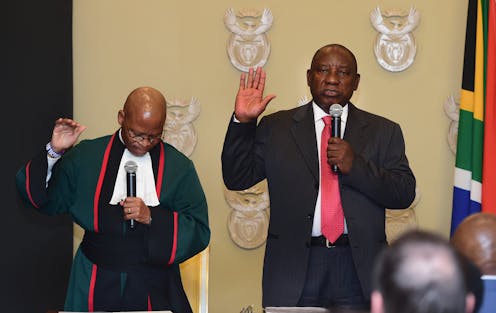
When President Cyril Ramaphosa sits down to brief a newly appointed Minister of International Relations and Development, he might wonder what to say.
Here are three suggestions which could help guide the conversation.
Strengthen diplomatic service
Extensive evidence suggests that a professional and well-trained diplomatic service is vital for the success of any country’s foreign policy. During the Zuma presidency South Africa’s diplomatic service has been aimless at best, and sometimes simply embarrassing.
Some of this has been caused by a failure to focus on the needs of professionals in the Department of International Relations and Cooperation. So, this will be a good place to start.
Since the Mandela presidency, transforming the diplomatic service has been a priority. This has succeeded in terms of racial equity, although some work remains to be done on gender equity. But this is not a straightforward issue. Not all countries are keen to receive women as foreign representatives.
Of course, this is no excuse: thinking and planning around this issue, especially at the managerial level, has to match the requirements for gender transformation within the country.
An effective diplomatic service needs a continuous training programme. Language and career-level training does take place within the department, but long-term career preparedness – from entry into the service to exiting it – has dropped away. Unfortunately, diplomatic training has been merged with policy planning , which has led to mission drift.
But the biggest obstacle to the development of a professional foreign service remains the issue of political appointments. All countries make these. But the operating principle is that they are limited, and made for strategic reasons – say, a well-connected individual appointed to a particular country to handle a specific issue.
In South Africa’s case, though, this has gotten entirely out of hand. Estimates are that some 80% of senior positions in South African missions abroad are occupied by ‘external non-career’ appointees. Many are casualties of the squabbles within the ruling party, the African National Congress.
Whatever the reason, the outcome has placed limits on the career prospects of the professional diplomatic corps.
Even more worrying is that many of these appointments have been made without due diligence. In the past few years, the dodgy backgrounds of a number of senior appointees have come to the fore. Besides embarrassing the country, it has undermined the professionalism of career diplomats.
Making use of a public process to select heads of diplomatic missions – along the lines of the Judicial Services Commission for the appointment of judges may be a way forward on this issue.
Take BRICS seriously
The opportunities that the idea of BRICS – the grouping of Brazil, Russia, India, China and South Africa – offers the country is poorly understood. As a result, BRICS gets a bad press, especially in establishment foreign policy circles.
This is a mistake, and needs to be changed, because BRICS offers new ways to think about – and engage with – the rise of new powers in a changing world. For good or ill, the liberal global order that was established in the late 1940s has given way to new ways of managing world affairs.
Many obstacles stand in the way of BRICS as a political project, but the idea has opened up a pathway to a non-Western-centred way of understanding international politics. South Africa can help to shape this new thinking about the future, which should draw on the spirit of the decolonisation debate.
The issue of where South Africa fits into BRICS and what this means for the world should be steered by a Minister (and Ministry) who understand that the country must help to make international rules, and not simply abide by them.
The region matters most
Southern Africa remains the formal focal point of the country’s foreign policy. Unfortunately, this is not always acknowledged.
The politics of each individual country in the region weighs on the fate of this country. A simple measure of this is the number of citizens from the region who are living and working in South Africa.
The following example carries the point. In some circles, it is thought that millions of Zimbabwean are living in South Africa. The figures for the citizens of other countries in the region are probably in the same ballpark.
South Africa must respond to the migration issue by accommodation, not the fierce acrimony that has emerged elsewhere. The hard fact is that the country’s borders cannot be sealed off from its neighbourhood, the only solution on offer by security-centred analysts who, unfortunately, dominate the debate about the region.
Foreign policy is not only about security: it is mostly about listening and understanding.
For the region to be at peace, South Africa has to recognise that the borders that divide its people are, after all, colonial constructs.
Foreign Policy begins at home
These three issues may seem banal – after all, the debates about South Africa’s post-apartheid foreign policy have largely focused on big-ticket items like the African Renaissance, making peace in Africa, and reforming the United Nations.
But these high-flying ideas have missed an old truth, namely that foreign policy invariably begins closer to home.

Peter Vale is affiliated with the South African Council on International Relations (SACOIR). He receives funding from the University of Johannesburg, Nanyang Technological University, Singapore, and the National Research Foundation.
Source: The Conversation – Articles (AFRICA)
Read more on The Conversation.
Join the fun: Add Your event | Submit a Press Release | Add your listing.


