What the hijacking of South Africa’s Treasury means for the economy:
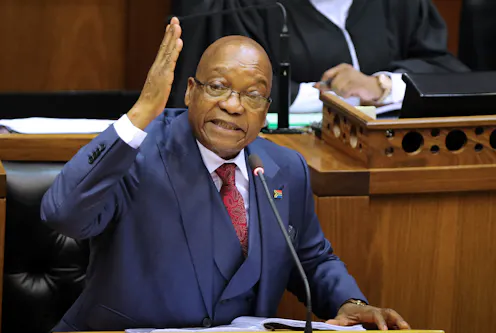
South Africa has been rocked by news that President Jacob Zuma has bulldozed the country’s National Treasury to adopt a fee free higher education proposal without following standard process and scrutiny. This is reportedly what’s behind the resignation of the Treasury’s respected head of budgeting, Michael Sachs. The Conversation Africa’s Sibonelo Radebe asked Seán Muller to weigh up the implications.
How significant is the resignation?
Reports indicate that the resignation came as a result of interference in the budgeting process. There appears to have been an attempt to push through irresponsible proposals relating to higher education funding. From a technocratic perspective this is a serious a blow to the Treasury’s credibility.
What’s unfolding can be seen as a continuation of the “state capture” inspired attack on National Treasury that began in 2015 with the firing of the then finance minister Nhlanhla Nene. The attack was temporarily halted and Zuma had to reverse the appointment of trusted ally Des van Rooyen.
The president relented by bringing back trusted finance minister Pravin Gordhan. But then he fired Gordhan early this year and replaced him with another ally Malusi Gigaba. This was followed by the departure of the department’s director general Lungisa Fuzile.
The head of the budget office is arguably one of the most important positions within the Treasury. The incumbent, Sachs, played a pivotal role in protecting the country’s public finances while also increasing transparency and engagement with civil society.
He is the son of former constitutional court judge and anti-apartheid activist Albie Sachs, and a former member of the ANC’s Economic Transformation Committee. He had unparalleled insight into both the bureaucratic and political sides of the budget process. His resignation indicates the extent to which political dysfunction has compromised responsible management of public finances.
How does the proposal for increasing higher education funding compromise the budget process?
One of the major achievements of post-1994 governments was to embed a thorough, bureaucratic and political process of developing the annual national budget and the medium-term budget. Within this process, any major changes to budget priorities are signalled in the medium-term budget. They are then gradually integrated into successive national budgets.
Any intention to dramatically change the structure of the budget – for instance, by cutting social grants in order to pay university fees – should have been contained in the medium-term budget.
In the current case, the Heher Commission, under retired Judge Jonathan Heher was established to investigate higher education funding. It handed its report to the president on the 30th of August, before the presentation of the 2017 medium-term budget policy statement. Its findings should have been released earlier and any decision reflected in the medium-term budget. That would have provided a basis for Parliament to facilitate democratic oversight of the proposals and alerted citizens and stakeholders to government’s intention.
What’s more worrying are reports that the president has ignored the Heher Commision’s recommendations. Given the extensive consultation by this commission, it would arguably be irrational and irresponsible to ignore its findings and implement an ill-conceived, “populist” removal of university fees.
Regardless of the merits of such proposals, to try and ram them through in the period between the medium term budget, in October, and the national budget in February is reckless. It will undermine the credibility of South Africa’s public finance management and carries negative implications for investment, credit ratings and economic growth.
What is your view on the call for free university education?
We should start with the widely accepted principle that no student who is suitably qualified for university education should be prevented from pursuing it. Given this principle we then need to ask the following questions:
-
How many students does the basic education system adequately prepare for higher education?
-
How many of those need financial support and to what extent?
-
What are the total cost implications of providing all such students with the necessary support, whether in grants or loans?
-
Can the country afford to do this for all such students immediately?
-
Even if we can afford it, is it the most equitable use of such funds?
I have argued previously that too many students are being admitted into the higher education system. Many are ill-prepared given the poor quality in the schooling system.
Evidence on the household incomes of students in higher education indicates that – relatively – they are much better off than the majority of South African youth. Youth outside the further education system get little, if any, direct support from government. And so a large increase in funding for university students is not the best way to assist poor youth.
What are the implications beyond education?
There are two major implications.
Firstly, it increases the chances of a downgrade of the country’s debt that’s held in local currency. Even before these recent events I argued this was almost inevitable. My view then was mainly informed by the revenue shortfalls indicated in the medium term budget, poor economic growth forecasts and the government abandoning its policy of fiscal consolidation (stabilising government debt).
The resignation of the head of the Treasury’s budget office makes the situation even more dire. The interference that induced it constitutes an unprecedented subversion of the country’s national budget process and National Treasury’s mandate to ensure stability and sustainability of public finances.
Secondly, the way in which the president intends to unilaterally ram through his favoured approach to higher education funding signals that a similar approach could be taken with a decision to pursue nuclear power. At the time of the medium-term budget, Finance Minister Malusi Gigaba indicated that government cannot afford nuclear. But shortly afterwards the new minister of energy, David Mahlobo, and Zuma both suggested that they are preparing to push it through. If that happened, it would further compromise South Africa’s public finances and economic growth.
There was some hope that a victory in December for the anti-state capture grouping in the governing African National Congress’s elective conference might be able to stabilise governance and public finances. But it now appears that a great deal more damage could still be done by the president before then.

Seán Mfundza Muller has received support from the Heinrich Boell Foundation to participate in parliamentary oversight processes relating to the 2017 medium-term budget policy statement, and is actively involved in providing technical support and advice to a number of civil society organisations on a range of public finance matters.
Source: The Conversation – Articles (AFRICA)
Read more on The Conversation.
Join the fun: Add Your event | Submit a Press Release | Add your listing.


