What would it mean to decolonise palaeontology? Here are some ideas:
The call by students to “decolonise science” still rings in many South African academics’ ears. But discussions about what t might entail, or even if it’s necessary, are fraught.
In many cases, that’s not because scientists don’t want to reduce the footprint of Western culture on their field of research. Instead, it’s because science is fundamentally meant to be universal. In a perfect world, science would know no cultural or racial discrimination. However, as centuries of scientific racism or European exceptionalism remind us, this isn’t a perfect world.
In palaeontology there isn’t a simple answer to questions about what a decolonised version of the field might look like. But certainly part of it must involve acknowledging Africa’s original fossil hunters, without whom a number of major finds might not have occurred. These were indigenous people who collected fossil shells, teeth and bones that have provided critical clues about our origins.
In most cases, these people seldom received credit for their finds. In the past, European researchers, who led many fossil expeditions in Africa, often didn’t bother to mention indigenous people’s contributions, an attitude that would not be tolerated anymore.
Ancient fossil hunters
When it comes to the history of African palaeontology, a few famous names come to mind: Louis and Mary Leakey; Robert Broom and Raymond Dart.
All of their finds were extremely important. But plenty of fossil finds happened in the preceding centuries. After all humankind was born on African soil. And people have roamed the continent for centuries – and they collected fossils along the way. Sometimes these fossils had a practical purpose, like being used as a pot lid; sometimes they were imbued with magical properties; and sometimes they were used for decoration.
Many South African sites dating back about 40 000 years ago to the Middle Stone Age indicate that trilobites – small fossilised relatives of crabs and lobsters – were found and transported dozens of kilometres away from their sites of origin by hunter-gatherers. Palaeontologists hypothesize the hunter-gatherers either liked the aesthetic of the fossils, or considered them of religious or medicinal importance.
A transported fossil elephant molar at Congo’s famous Ishango site suggests our ancestors were aware of the presence of unidentifiable animal remains in their surrounding.
And, as early as 300 000 years ago, the earliest Homo sapiens were collecting fossil sea shells in Morocco. The fossils in question were rather phallic, so it’s been hypothesised that they were involved in some kind of fertility ritual.
Some may say that this was not formal palaeontology. The French palaeontologist Georges Cuvier, who lived from 1769 to 1832, is usually credited as the discipline’s founding father. But it clearly demonstrates that some kind of palaeontological knowledge already existed when the first explorers from overseas arrived on the continent.
No credit given
Most people credit the son of a magistrate with the first discovery of a fossil in South Africa’s Karoo region, in 1827. But a closer look at the archives reveals that an unnamed Griqua person may actually deserve the title.
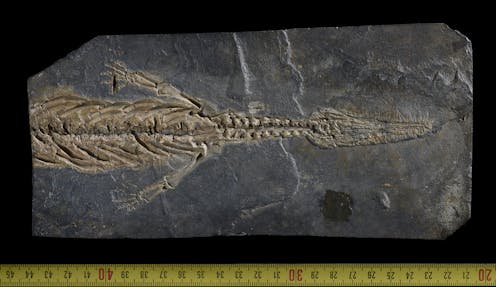
Some time in the early 1820s this person discovered the fossil of a Mesosaurus, a small reptile that lived some 280 million years ago.
The Mesosaurus‘ fossil presence in both Southern Africa and, later, South America, provided crucial evidence that the earth’s tectonic plates can shift.
The original collector, whose name was never recorded, is mentioned in passing in a report about the finding by the Frenchman who brought the fossil to Paris. We don’t know if the original collector was paid.
When thinking about how important this fossil became for science, it is sad to think that the original collector, who recognised there was some importance to what others might have dismissed as a useless rock, will never receive the credit he or she deserves for this discovery.
Recognising the unheralded
A first step to begin decolonising palaeosciences in Africa would be to give credit where it’s due. The unnamed Griqua collector was just one among many.
There is some work being done to ensure that this practice doesn’t continue. For example the two technicians who discovered the famous Australopithecus Little Foot, Nkwane Molefe and Stephen Motsumi, have been amply credited for their effort.
And in 2016 the National Museums of Kenya hailed “Africa’s unsung heroes in prehistory” by honouring technical staff and their important behind the scenes work.
My colleagues and I at the University of the Witwatersrand’s Evolutionary Studies Institute are also working on changing the narrative, such as by hosting a lecture series about South Africa’s first, and largely unacknowledged, fossil hunters.
This sort of initiative could be replicated elsewhere as a way to honour African fossil collectors’ long history and important ongoing contributions to our understanding of the ancient world.

Julien Benoit receives funding from the DST-NRF Centre of Excellence in Palaeosciences and the Palaeontological Scientific Trust.
Source: The Conversation – Articles (AFRICA)
Read more on The Conversation.
Join the fun: Add Your event | Submit a Press Release | Add your listing.


