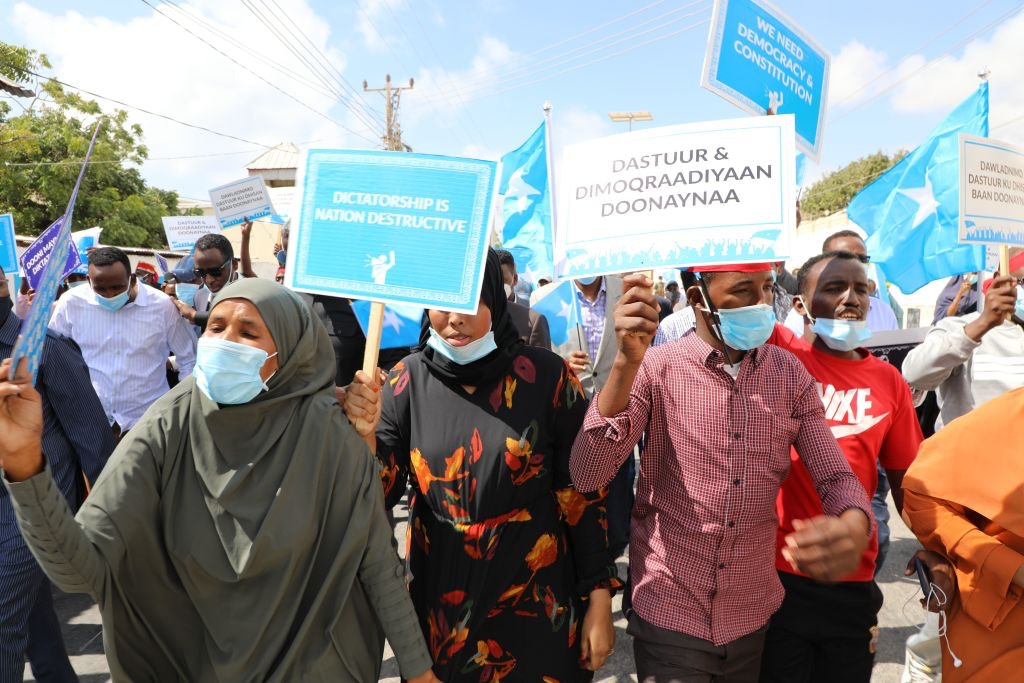
Somali government troops have clashed with opposition supporters on the streets of Mogadishu amid growing anger over delayed elections. There is growing anxiety over the expiry of the term of President Mohamed Abdullahi Mohamed, also known as “Farmaajo”, without the prospect of an immediate replacement. Dr Mohammed Ibrahim Shire explains how the country got here, and what needs to be done to end the stalemate.
What’s behind the protests and the army’s presence on the streets?
A week ago an alliance of Somali opposition leaders called for anti-government protests. The coalition includes former Somali presidents and ministers, many with diverging interests and agendas. The government banned the planned protest citing a recent COVID-19 surge as a reason. But it was later allowed, provided that the protests were peaceful and participants adhered to the country’s public health and social measures.
But the day before the planned protests things took a downward turn. Somalia’s constitution guarantees the right to peaceful demonstrations. At the same time the government sees it as its duty to police the protests. This is to ensure that participants are protected from disruption by others – especially Al-Shabaab.
The opposition alliance, however, refused police protection and instead deployed their own armed militias. Some belonged to Yusuf Mohammed Siad – also known as Indha’ade – a controversial figure and a former warlord.
In response, government banned the planned protest, arguing that state duties couldn’t be delegated to armed militias.
The ban exacerbated simmering tensions and led to gun battle in the capital overnight. Both sides traded accusations over the unprovoked street attacks.
Nevertheless, the opposition pushed ahead with the planned protest, defying the ban on public gatherings. This turned into a confrontation as protesters clashed with security forces.
How did we get to this point?
Somalia’s current disarray stems from the failure of the federal government and leaders of the five federal states to agree on the implementation of the September 17 revised election model.
Somalia has a unique electoral system built around a clan-based model. Clan elders indirectly choose the Lower House members, while the five federal states elect the Upper House members. Members of both houses select a president, who then nominates a prime minister.
In February last year Farmaajo signed a new electoral law to establish universal suffrage. This provoked cries of protest from the opposition, who argued that it would not be feasible to hold a one-person-one-vote poll without introducing a term extension for Farmaajo.
This view was backed by Halima Ismail, chairwoman of the National Independent Electoral Commission. She told parliament in June that conducting national elections under the new model would require a delay until August 2021.
A series of national consultative meetings were held between government and regional leaders to try and resolve the issue. An informal agreement materialised that resulted in abandoning the one-person, one-vote model, and instead adopting a complex indirect system used in the past. This involves delegates chosen by clan elders electing lawmakers who then elect the president.
All parties finally signed up to a electoral framework. The Somali parliament approved the revised electoral model, legalising and superseding the February electoral model as the framework for the 2020-2021 elections.
However, as government and regional leaders embarked on moving from the design phase to the implementation phase, many disagreements came to the fore. In particular, three contentious issues emerged that brought everything to a standstill.
The first one is the make up of the Federal Electoral Implementation Team. As soon as the Somali government appointed the team, federal state members such as Puntland and Jubbaland rejected it. They accused the government of filling it with government members drawn from the office of the president, security agencies and the diplomatic corps.
The second contentious topic is who would manage the parliamentary seats of Somaliland.
The third stumbling block was how to handle the 16 parliamentary seats allocated for Gedo province in Jubbaland state. The Jubbaland administration in Kismayo remains hugely unpopular in Gedo and parts of the Jubba regions. Residents argue that the Jubbaland administration is supported by neighbouring Kenya and does not represent the people of Jubbaland.
This tension occurred against the backdrop of a broader geopolitical dynamic between Somalia and Kenya. Somalia accuses Kenya of political meddling in the Jubbaland state, and sponsoring and harbouring fugitive Jubbaland minister, Abdirashid Janan. Kenya denies the charge.
What next?
The only feasible solution is to ensure that the September 17 deal is implemented. In theory, all parties have agreed on this revised electoral model, but it’s hampered by the three contentious issues.
A 14-member technical committee set up to resolve these issues announced that it had found ways to resolve the electoral impasse. It has called for an urgent meeting of the government and regional leaders. The Somali government has agreed and called for an urgent meeting in Mogadishu.
It’s a good sign that Somalia’s international partners have also welcomed the technical committee’s solutions. That said, it’s up to the Somali government and regional leaders to agree and adopt the proposed solutions and hold elections as soon as possible.


