What’s stopping young African scientists from achieving their potential:

Young African scientists face persistent barriers which cause them to leave their own countries, and even academia. This means the continent’s work force loses highly trained people who are crucial for scientific and technological advancement, and for economic development.
It’s estimated that 20,000 highly educated professionals leave the continent annually, with up to 30% of Africa’s scientists among them.
A number of factors contribute to this trend. The extreme factors include war and political instability. But the more common “pushes” are a desire for higher pay, better opportunities, and the search for a conducive research environment – one where infrastructure and management help drive careers and research potential.
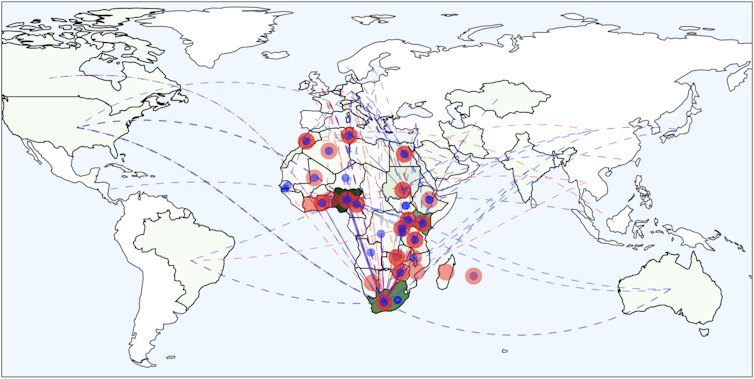
To identify all the barriers and develop strategies to address them, the Global Young Academy – an organisation of 200 talented young scientists and over 200 alumni from 83 countries – established the Global State of Young Scientists (GloSYS) Africa project. Working with local research partners and international higher education experts, the project aims to identify the challenges and motivations that shape young scientists’ career trajectories.
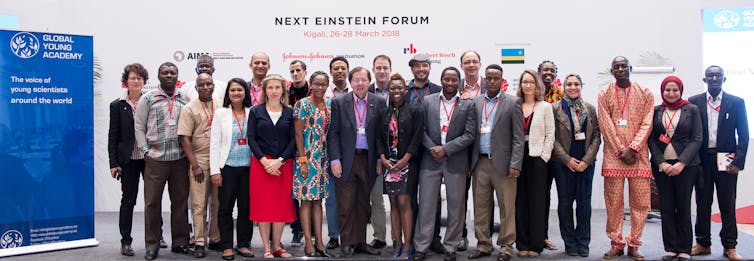
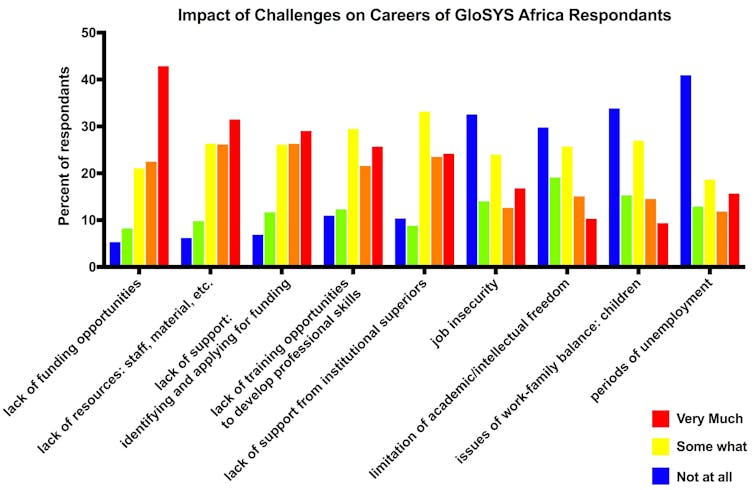
Our initial findings point to a lack of mentoring, resources and funding as key issues young scientists face across the continent. Using this data, we will be able to identify critical areas in which young scientists need support and develop innovative strategies to alleviate these challenges.
The project comes at an important time as, over the past few years, African countries have initiated programmes to increase the number of PhD graduates. But if governments don’t simultaneously develop support structures for graduates, and increase access to critical teaching and research infrastructure, these young scientists are set up to fail.
The study
The Global State of Young Scientists Africa project, uses an online survey (which is currently open to respondents) and in-depth interviews to gather as much detail as possible. It looks at young scientists’ motivations, career ambitions and the barriers they experience in fulfilling their career aspirations.
It targets researchers and scholars who have earned a Masters or PhD within the last 10 years, irrespective of their current employment status and sector. It’s also open to current PhD students in Africa and African scientists and scholars currently living in the diaspora.
Having this wide range of participants means the data will reflect a broad range of experiences. From early-career researchers with a history of moving within and out of Africa, to those who have never left their home countries. From department heads, to researchers who have trouble finding work despite their high qualifications. The team is also particularly interested in hearing from early career researchers outside of academia, as this helps us understand their reasons for not pursuing a career in research.
From our preliminary survey results – drawn from more than 700 young scientists’ responses – we have found that, even with diverse backgrounds, early-career researchers have a great deal in common. A lack of mentoring, infrastructure, resources (staff and material) and funding for research and resources are key reasons for not pursuing a career in academia. There is also a strong desire for more training in grant writing and professional skills.
Using this information, the GYA plans to develop programmes to address the challenges, as we’ve previously done.
This is the third survey done under the Global State of Young Scientists umbrella. The first was a global study of young scientists from 14 countries across five continents. The second was a regional study which focused on four Southeast Asian countries.
A major challenge identified from those two studies was the desire for training in leadership skills. As these young scientists began to grow their own research groups they needed the tools to deal with the challenges of integrating research, teaching, and fundraising. In response, Global Young Academy members developed and implemented science leadership programmes in Africa and Asia, in collaboration with creative facilitators KnowInnovation and Future Africa.
Obtaining these new skills created an incentive for the young scientists to pursue their career in academia. The fellows found, for instance, the science leadership programmes to be one to the most significant workshops of their careers.
From barriers to action
The African leg of the survey continues. Once common challenges have been identified, the team will then work with policymakers in Africa as well as with international funding bodies to develop evidence-based initiatives to address them.
It’s hoped that the Global State of Young Scientists Africa project will highlight further areas of need, so that the Academy can develop new innovative programmes in collaboration with science and education policymakers to improve young African scientists’ prospects.
Early career researchers from and in Africa can become involved by taking the GloSYS Africa survey. The survey will remain open until mid September 2018 with results to be published at the beginning of 2019.
Marie Luise Neumann, GloSYS project researcher for the Global Young Academy assisted in the writing of this article. Mobility data analysis was conducted by Dr Shin-Chou and his research team at the Institute of Statistical Science Academia Sinica, Taiwan

The GloSYS study receives funding from the German Federal Ministry of Education and Research (BMBF) and the Wellcome Trust. Anna Coussens receives funding from the Walter and Eliza Hall Institute of Medical Research, South African MRC, US National Institute of Heath. She is affiliated with the Global Young Academy and is a Laboratory Head at the Walter and Eliza Hall Institute of Medical Research.
Abidemi James Akindele, Badre Abdeslam, Fridah Kanana, and Mona Khoury-Kassabri do not work for, consult, own shares in or receive funding from any company or organisation that would benefit from this article, and have disclosed no relevant affiliations beyond their academic appointment.
Source: The Conversation – Articles (AFRICA)
Read more on The Conversation.
Join the fun: Add Your event | Submit a Press Release | Add your listing.


