When and where do Nile crocodiles attack? Here’s what we found:

The Nile crocodile is Africa’s largest, and most widely distributed, crocodile. It can be found in Egypt in the North, through Central and East Africa, down to South Africa. The largest specimens and concentrations of these crocodiles are in the lakes and rivers of Central and East Africa.
Research on crocodile attacks can provide insights into when and where they attack, and who they attack. This is all important information that can help inform actions to prevent attacks. But published data on Nile crocodiles are in short supply. Data only exist for 12 of the 30 African countries where bites are known to occur. Most cover short periods of time, and collection methods vary.
With the aim of filling in this gap – and improving safety for people and crocodiles – I’ve compiled a database of crocodile attacks on people in South Africa and eSwatini (formerly Swaziland) from 1949 to the present. This is the most comprehensive list drawn up for any country on the continent.
My colleagues and I analysed 67 years of this data, between 1949 and 2016. We found 214 reported and verified, unprovoked attacks. Most bites happened in rivers and in the hot season. And most of the victims were young boys.
This data can provide valuable information to help focus efforts to prevent attacks in the region.
High risk areas
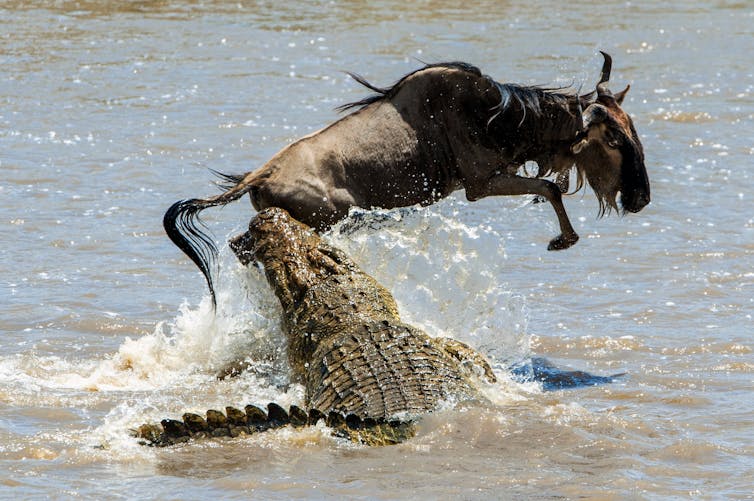
Only the Nile crocodile (Crocodylus niloticus) occurs naturally in South Africa and eSwatini, and they are formidable predators. A large adult is capable of preying on even the largest species of megafauna – like buffalo and wildebeest. At 15 feet long, big males can weigh up to 700kg, with up to 68 teeth, and are capable of staying submerged for more than an hour.
To analyse the data gathered, I worked with South African crocodile experts and fellow members of the IUCN Crocodile Specialist Group. We also looked at the status of crocodile populations in the region, and current management practices, to inform possible safety recommendations.
Most bites occurred in rivers in the warmer, low lying eastern parts of the study region, with the majority occurring between December and March – the summer months. Experts speculate that crocodiles attack during this season because it is hot, wet and the breeding season. In the rainy season there are higher water levels – making crocodiles more widespread. They may also be more aggressive because it’s the breeding season and, because crocodiles are cold-blooded, in warmer weather they are more active and more hungry.
Most attacks happened in waterways linked with major crocodile populations, namely the St Lucia Lake system, Ndumo Game Reserve and Kruger National Park.
Bite victims have mostly been males (65%), contradicting the assumption that women are disproportionately at risk because they perform domestic chores like washing clothes and fetching water.
A key finding is that 51% of victims were young – between the ages of 0 and 15. They were most commonly bitten when they were swimming or bathing. Many were bitten when they were fishing.
Whether someone died from an attack depended on whether the victim was accompanied or alone, the size of crocodile involved and the age of the victim. Small children are more vulnerable to fatal attacks. Only 35% of children who survived attacks escaped without help.
Closer to people
Continent-wide, Nile crocodiles are not classified as a threatened species, but some regional populations are classified as vulnerable”. This is based on observations of declining adult crocodile populations and nesting sites.
As is happening elsewhere in Africa, habitat transformation and increasing human use of waterways is having an impact on their numbers. Crocodiles are struggling to breed outside protected areas (in a region where they were once widespread) and they are also killed for medicinal use, food, and safety reasons.
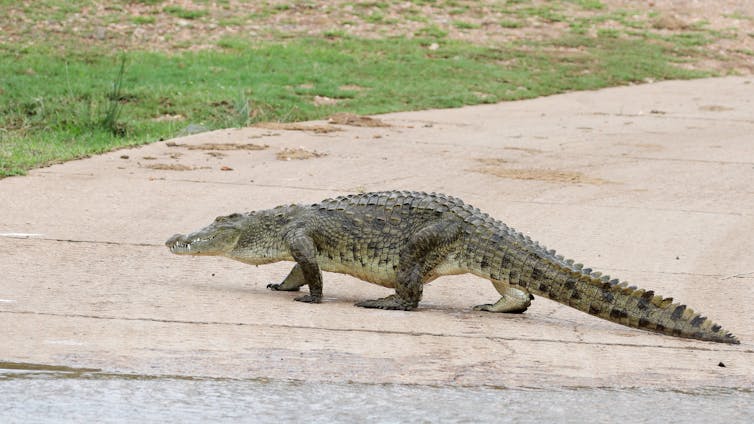
Crocodiles are also being forced to move into artificial water bodies – like dams – driving them closer to people. This is because seasonal rivers are drying up (their water is being used for irrigation and other purposes) and because of disturbances along riverbanks and pollution in rivers.
Illegal gillnet fishing on a number of larger crocodile-inhabited dams in South Africa are an ongoing safety concern, particularly as this occurs at night, when crocodiles are most active.
Safety measures
Currently attack mitigation policies are very varied, and not consistently applied. During our fieldwork we saw that there is minimal outreach work in rural areas, with some better efforts by provincial conservation management groups like Ezemvelo KZN Wildlife in South Africa, and Big Game Parks in eSwatini.
Policies in both countries are generally reactive, focused on removing problem animals, but it is not always clear who is responsible for doing so or how to contact them. It is not the policy of conservation authorities to build protective structures outside protected areas, or pay compensation for bites.
In our paper, my co-authors and I make a few safety recommendations based on our data and experience.
In the high risk areas that we’ve identified, local authorities can provide safe water crossing points, water tanks or piped water, and protective enclosures.
Because most of the attacks affected children, educating children should be a priority, particularly in identified high-risk areas. Outreach activities could be supported with existing material that provide information on crocodile biology and behaviour and advice on avoiding and responding to attacks.
Specialist teams should be formed, by government or local authorities, that are equipped and trained to capture and remove problem crocodiles. Where funds are unavailable, the US system of licensing private individuals to do this could be trialled.
These are just a few steps that can be taken to try to help humans and crocodiles to safely coexist in the region.
Data analysis was conducted with UK-based modeller, George Powell, and in consultation with South African crocodile experts and fellow members of the IUCN Crocodile Specialist Group – Xander Combrink and Hannes Botha. All are co-authors on the paper.

Simon Pooley receives funding from the Lambert Bequest to Birkbeck University of London, where he is Lambert Lecturer in Environment (Applied Herpetology) in the Department of Geography. Simon is also an Honourary Researcher at the School of Life Sciences, University of KwaZulu-Natal, Pietermaritzburg, South Africa, and during this research was a Visiting Researcher at WildCRU, University of Oxford, Tubney, UK. He is a member of the IUCN Crocodile Specialist Group and the IUCN Task Force on Human Wildlife Conflict. These views are personal, not representative of these organisations.
Source: The Conversation – Articles (AFRICA)
Read more on The Conversation.
Join the fun: Add Your event | Submit a Press Release | Add your listing.


