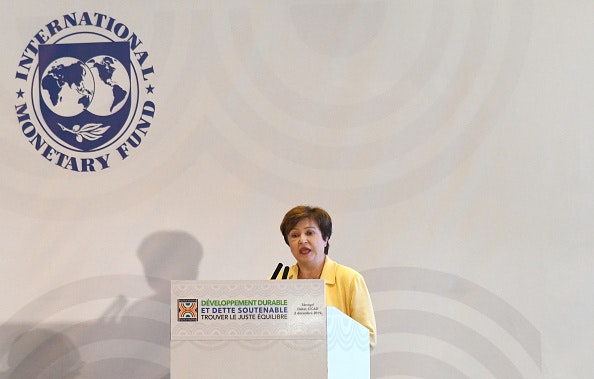
In most rich countries the news that a mission from the International Monetary Fund (IMF) is coming to visit is met with indifference. But, in most African countries the news can cause great consternation.
Why the difference?
History has a lot to do with it. The citizens of many African countries have suffered through their governments, under IMF pressure, cutting subsidies and social spending, firing public sector workers and increasing taxes. For example, a 2021 Oxfam study, found that the IMF encouraged 33 African countries to adopt austerity policies in the wake of the COVID pandemic.
On the other hand, with a few exceptions, such as Greece, citizens of rich countries have not experienced the IMF having any direct impact on their lives.
Another important reason is lack of knowledge. Usually, when the IMF comes to town, the public gets little information about the purpose of the IMF’s visit – or its likely outcomes. In other cases, people are concerned that they have limited ability to influence the outcome of the visit or its impact on their lives.
This article seeks to remove some of the mystery surrounding IMF visits to a country. It explains the two basic reasons for the IMF sending its staff on “missions” to a country. And what can be expected in each case.
The IMF’s remit
According to its Articles of Agreement, the IMF’s purposes include promoting monetary cooperation among its 190 member states so that they can more sustainably manage their macroeconomic situations and their international financial relations. This should help them promote and maintain high levels of employment and real income and develop their productive resources.
The IMF also provides financing to countries that do not have sufficient foreign exchange to meet all their needs and obligations so they do not have to resort to measures that are destructive of “national or international prosperity”.
To fulfil these responsibilities, the IMF sends its staff on two basic types of missions to member countries.
Surveillance missions
The first are surveillance missions. Article IV says that the IMF should exercise “firm surveillance” over the efforts of its member states to try and direct their economic and financial policies towards the objective of fostering orderly economic growth with reasonable price stability.
Thus, the IMF regularly – usually annually – sends a staff team to assess the state of each country’s macro economy, the risks it faces and its capacity to continue evolving in a sustainable way. This team usually meets with officials in each country’s ministry of finance and central bank. In addition, they can ask to meet other government officials. For example, during COVID, the IMF might have been interested in meeting with health department officials.
The IMF staff will also normally meet with members of parliament and with representatives of business and labour. They may also meet with representatives of civil society.
There are four important points to note about these missions.
First, while the IMF provides some guidance to its staff, it does not require them to follow any particular procedures for informing interested parties that it is visiting the country. The result is that it’s difficult for anybody interested in the visit to learn how they might engage with the mission or provide it with information.
Second, in principle, there is no limit on what issues the IMF can focus on during its mission. Consequently, IMF staff can raise any issue and request whatever information they think is relevant to assessing the state of the country’s macroeconomic situation. This has led to a gradual expansion in the range of issues the IMF may raise in these missions. They now range from fiscal policy, inflation and unemployment rates, and balance of payments deficits to issues about how the country is dealing with climate change, gender discrimination, public health and wealth inequality.
Third, the outcome of the mission is a report prepared by the staff that is discussed by the IMF’s Board of Executive Directors. The report is usually made public after the discussion, together with a press release.
The IMF also uses the information in preparing its reports on the global economy.
Fourth, the IMF can make recommendations to the government on actions that it should take to deal with any challenges that have been identified.
These recommendations are purely advisory. In principle, the country is free to ignore them. This may be the case if the country is confident that it will not need IMF financing in the future. This is the reason that the citizens of rich countries do not usually care that an IMF mission is visiting their countries. However, this is a luxury that a country cannot afford if it thinks it may need IMF financial support. Or that its access to international financial markets may be influenced by the IMF’s view. This, of course, is the case for most African countries.
Financing missions
The second type of mission is initiated by requests for IMF financing.
Their purpose is to assess the country’s need for financial support. And to negotiate the terms on which it will be provided.
The IMF effectively acts as a lender of last resort. Consequently, governments are reluctant to ask for IMF financing unless they cannot get enough foreign exchange from other sources.
The IMF provides the financing on an unsecured basis. It tries to ensure that it will be repaid by making the financing subject to policy conditions, known as conditionalities. The premise of these conditionalities is that the country is essentially living beyond its means and must reduce its expenditures to the level of its income, including the funds contributed by the IMF. In short, the IMF is demanding that the country makes sacrifices.
This means, inevitably, that the terms of IMF financing are controversial. First, the scale of the sacrifices necessary to restore a country to macroeconomic health are not easily determined. They depend on perceptions of the causes of the country’s crisis, assumptions about future economic developments and the capacity of the government to implement policy changes and the public to accept and absorb these changes. Reasonable people can, of course, have different views on these issues.
Second, the scope, terms and number of conditionalities the IMF chooses to attach to its financing can be very broad, or quite specific. For example, it can merely state the size of budget cuts that the country must make or the amount of additional revenues it must raise and then leave it up to the country to decide how to meet these conditions. Alternatively, it can specify which budget items should be cut, which taxes should be increased, and which structural reforms must be implemented in order to get IMF financing.
This effectively means that the conditionalities are matters for negotiation between the government and the IMF and that they depend on the balance of bargaining power between them. This means that the IMF is effectively a player in the domestic economic policy making process of countries that need its financing.
However, the IMF is not subject to the same legal requirements regarding participation or transparency as other players in this process. It is also less accountable to those who will be affected by its policy choices than the government itself.


