White men’s voices still dominate public science. Here’s how to change this:

Visibility in the mass media matters for scientists. It gets funders’ attention. It attracts top students. It can be a pathway to policy influence. Media coverage may even boost the number of times a piece of research is cited in scientific literature.
There are imbalances all over the world, and white men tend to get the lion’s share of visibility. For example, a study in Switzerland showed that journalists prefer to interview senior, male scientists while a 2015 book about celebrities in science featuring eight scientists who had achieved global fame included only one woman (neuroscientist Susan Greenfield) and one black scientist (Neil deGrasse Tyson, an astrophysicist).
In South Africa, too, there are major racial, gender and institutional imbalances in terms of which scientists are publicly visible. Although only 8% of South Africans are white, nearly 80% of the country’s visible scientists are white. And 63% of this group of visible scientists are men. Black women made up only 8% of the group. This is according to a 2017 study which I co-authored and which was published in the South African Journal of Science.
Scientists can be powerful influencers and role models. So there’s reason for concern when the same names and faces dominate coverage and visibility.
There are several role players in this situation, including individual journalists or news organisations; universities and research organisations and scientists themselves.
Journalists working under enormous time pressure may often find it easier to reach out to experts they already know rather than developing new relationships. Similarly, young scientists may find it hard to become recognised as experts worthy of being quoted in the media since journalists typically want to speak to research leaders. They may not have media experience or training.
Women may also find it harder than men to become recognised as experts on the public stage. For example researchers have shown that public engagement could hinder female scientists’ academic progress.
To diversify visibility, journalists should seek out fresh perspectives and expert voices that reflect society. Universities and other research organisations need to equip young, black and female scientists with the skills and confidence to engage with the mass media. Scientists must realise the value of being visible – and then make time for journalists and provide easily understandable explanations that demonstrate the relevance of their work.
Visibility feeds visibility
I contacted science journalists and science communicators who work as knowledge brokers between science and society in research organisations, asking them to list up to 10 scientists they considered to be visible in the public sphere.
Jointly, the 45 respondents identified 211 visible scientists. This represents less than 1% of the country’s total scientific workforce. According to government statistics, South Africa has 25 300 scientists at higher education institutions, not counting postdoctoral fellows and doctoral students.
The three most visible scientists in South Africa were fossil hunter Lee Berger, banting advocate Tim Noakes and Medical Research Council President Glenda Gray.
The country’s most prominent black scientists were the HIV expert Salim Abdool-Karim at the University of KwaZulu-Natal; dinosaur biology expert at the University of Cape Town, Anusuya Chinsamy-Turan; Wits University population geneticist Himla Soodyal; and health researchers Tebello Nyokong (Rhodes University) and Bongani Mayosi and Kelly Chibale, both at the University of Cape Town.
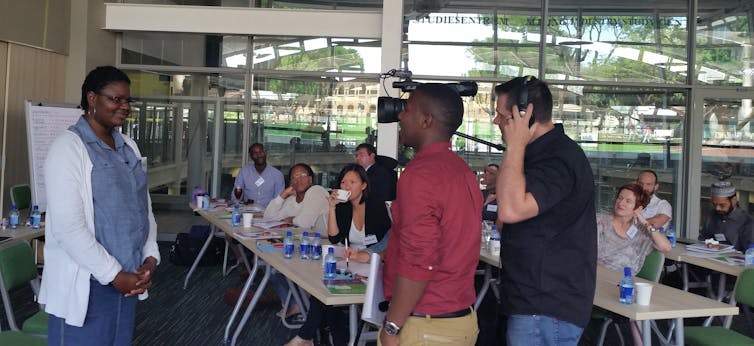
It is difficult to pin down exactly why these researchers became so prominent but, based on my PhD research, they have a few things in common. They are all acutely aware of the value of a high public profile, passionate about sharing their science with public audiences, and willing to walk the extra mile for journalists.
Shifting the narrative
So whose role is it to improve the visibility of scientists who are not white men?
I found that journalists have different opinions about their role in correcting racial, gender and age-related imbalances in terms of the scientists they feature.
“The journalist in me wants to write about the most newsworthy and credible science, independently of who did the research,” said Elsabe Brits, specialist science journalist at the Afrikaans language multimedia platform ‘Netwerk24’. “It is not my role to be an activist for women in science, but there are top women scientists who are doing incredible work and they are featured in the media.”
Brits believes that it is up to research organisations to promote their research champions, and that scientists themselves need to be more proactive in terms of sharing their work with the public.
Others feel it’s up to them to create more space for different voices. Munyaradzi Makoni, a freelance science writer based in Cape Town, said: “I try to interview at least one woman scientist for every story I write.”
Other role players can help to diversify the public science space. For instance, universities can promote women and black scientists to the media by featuring them in press releases and ensuring they appear in online expert lists.
Young, black women in science can also gain visibility via popular science events such as Pint of Science and Famelab.
It is also up to women scientists to become proactive users of social media. Stellenbosch University botanist Nox Makunga, also one of the “visible scientists” in my study, is among those using Twitter to share her research.
Women in science may also find value in networking via organisations such as SA WISE and writing for blogs like Women in Science Hub.
In my own experience of researching science communication, most scientists – particularly black women – embrace opportunities to be featured on the public stage. They are aware of the need to change science’s public image.
One of the black women scientists who was named among the “most visible” in our study was Professor Anusuya Chinsamy-Turan of the University of Cape Town. She is a dinosaur palaeobiologist who studies dinosaur bones to understand more about their biology and way of life. Chinsamy-Turan agreed with Makunga’s assessment:
Now that we have more black scientists, they must also become more publicly visible. We need to showcase science in communities where people hardly ever see a scientist so that young people can grasp the possibilities of a science career.

Marina Joubert receives funding from the South African Research Chair in Science Communication at Stellenbosch University, an initiative of the Department of Science and Technology, funded via the National Research Foundation.
Source: The Conversation – Articles (AFRICA)
Read more on The Conversation.
Join the fun: Add Your event | Submit a Press Release | Add your listing.


