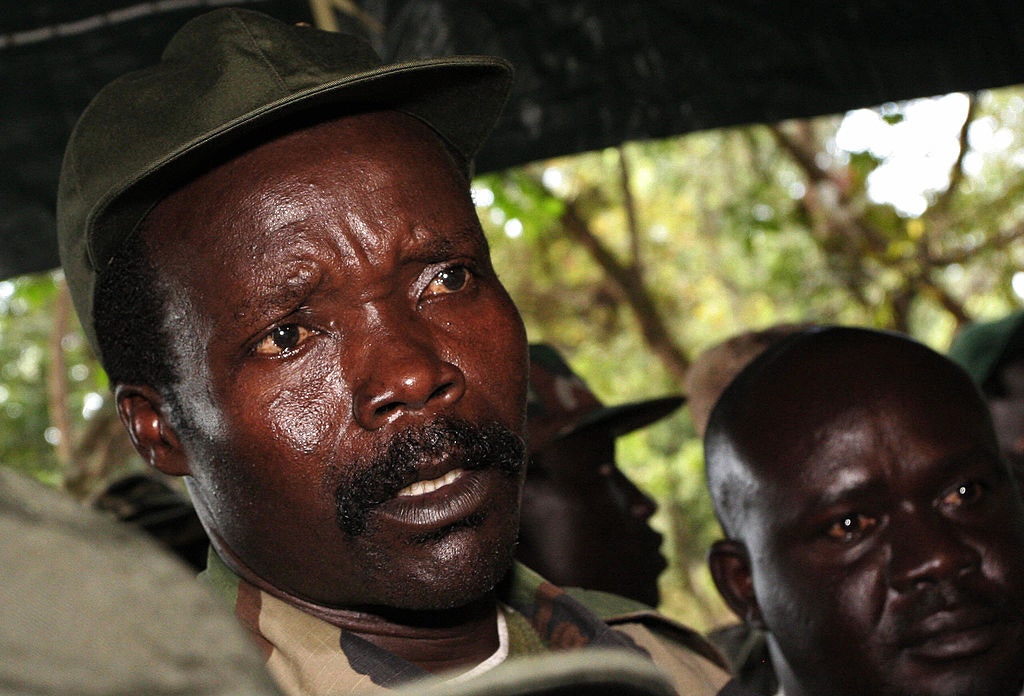
Eleven years ago, a documentary catapulted the name Joseph Kony onto the global stage. The controversial film Kony 2012 told the story of a Ugandan warlord whose forces are believed by the United Nations to be responsible for the deaths of more than 100,000 people, the abduction of at least 20,000 children and the displacement of more than two million people.
Though most of the world hadn’t heard of Kony before then, Ugandans knew and feared him. The founder of the Lord’s Resistance Army unleashed a wave of violence across northern Uganda for two decades.
In 2005, the International Criminal Court brought charges of crimes against humanity against Kony and four of his top commanders. In 2013 and 2021, the US announced a US$5 million bounty for information leading to Kony’s capture.
Read more: ICC upholds jail term for Ugandan rebel commander Ongwen – why it matters for Africa
He remains at large.
Now the International Criminal Court wants to confirm the charges against Kony in his absence. The hope is that this will renew international efforts to find Africa’s most wanted fugitive.
So, who is Joseph Kony?
His early life
Joseph Rao Kony was born in 1961 in Odek sub-county in northern Uganda. He was one of six children in the Acholi middle-class family of Luizi Obol and Nora Oting.
Kony’s parents were farmers. His father was a Catholic, his mother an Anglican. Kony was an altar boy until 1976. He dropped out of school at age 15 to become a traditional healer.
In 1987, aged 26, Kony founded the Lord’s Resistance Army, a Christian fundamentalist organisation that operated in northern Uganda until 2006.
Altar boy turned rebel leader
Kony rose to prominence after taking over the Holy Spirit Movement, a rebel group led by Alice Lakwena, his aunt, to topple the Ugandan government.
The Holy Spirit Movement was formed after Ugandan president Tito Okello, an Acholi, was overthrown by the National Resistance Army – led by Yoweri Museveni – in January 1986. The Acholis largely occupy northern Uganda.
Museveni’s National Resistance Army was a rebel outfit that later metamorphosed into the Uganda Peoples’ Defence Forces. Today it’s the national army.
When it came to power, the National Resistance Army appeared to deliberately target the Acholi population in the north. Villagers were violently attacked by army troops and subjected to food shortages. Houses were burnt down, leading to forced displacements. The scale of these attacks was never documented or substantiated.
Kony joined the Holy Spirit Movement to fight for the rights of the Acholi. By 1987, however, army troops had crushed the movement – Lakwena escaped into Kenya where she died in a refugee camp in 2007.
Kony established the Lord’s Resistance Army and proclaimed himself his people’s prophet. He soon turned against his supporters, supposedly in an effort to “purify” the Acholi and turn Uganda into a theocracy.
The rebel group carried out indiscriminate killings. It forcibly recruited boys as soldiers and girls as sex slaves.
Ideologically, the group espoused a mix of mysticism, Acholi nationalism and Christian fundamentalism. It claimed to be establishing a theocratic state based on the biblical 10 commandments and Acholi tradition.
Kony proclaimed himself the spokesperson of God. He claimed to have been visited by a multinational host of 13 spirits, including a Chinese phantom.
Kony’s military offensive
Kony and his rebel outfit committed a string of atrocities against civilians. The group waged war for more than two decades within Uganda – and later in the politically unstable neighbouring countries of Sudan, the Democratic Republic of Congo (DRC) and Central African Republic – in an effort to topple Museveni. The actual number of militia members varied over this period, hitting a high of 3,000 soldiers in the early 2000s.
After the 11 September 2001 terror attacks in the US, the American government designated the Lord’s Resistance Army a terrorist group.
In 2005, the International Criminal Court issued arrest warrants for top commanders of the Lord’s Resistance Army for crimes against humanity.
In August 2008, the US declared Kony a global terrorist, a designation that carries financial and other penalties.
Read more: Ugandan rebel Joseph Kony: the latest US arrest bid raises questions
The Lord’s Resistance Army was eventually forced out of Uganda following the failed Juba peace talks of 2006-2008 between the group’s leadership and the Ugandan government. The talks were mediated by the government of southern Sudan.
Kony and his militia went into hiding in the DRC. In December 2008, Uganda, DRC and Sudan launched an offensive dubbed Operation Lightning Thunder to track them down.
Kony’s rebel group attacked Congolese civilians suspected of supporting the operation. Villagers were raped, their limbs mutilated and hundreds killed. The group eventually splintered to evade capture, with most members escaping into the Central African Republic.
Uganda called off the operation in March 2009, saying the Lord’s Resistance Army was at its weakest point ever.
In November 2013, Central African Republic officials reported that Kony was ready to negotiate his surrender. He was reported to be in poor health in Nzoka, a town in the country’s eastern region. He never showed up.
By 2017, the rebel group’s membership had shrunk to an estimated 100 soldiers. In April that year, the US and Ugandan governments ended efforts to find Kony. They stated he no longer posed a significant security risk to Uganda. But he is still wanted by the International Criminal Court.
Kony today
Some of the fighters from the Lord’s Resistance Army took advantage of Uganda’s 2000 amnesty programme, which offered blanket immunity to any rebel who had taken up arms against the government since 1986.
Kony’s exact location, however, remains unknown. He’s thought to be hiding in the vast jungles of the Central African Republic or in Sudan.
While attempts to bring Kony to justice continue, post-conflict northern Uganda is on the slow path to economic and social recovery.


