Why forecasting floods should be a global collaborative effort:
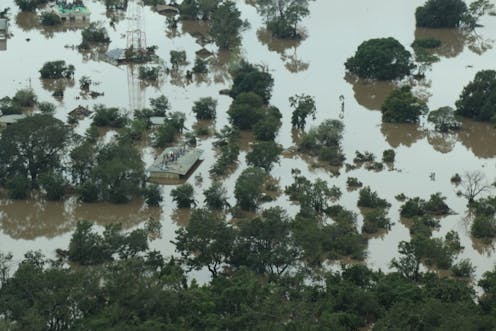
The number of people exposed to the risk of floods is rising. More and expanding human settlements are being built in flood-prone areas, especially in Africa, Asia and South America. This is undoubtedly linked to the dramatic increase in death tolls and economic damages from floods experienced in Africa over the past decades.
The largest flood events in Africa often cross countries’ borders. They overwhelm national and local authorities’ capacities. This makes early warning and response challenging, as was seen during tropical cyclones Idai and Kenneth in early 2019.
Cyclone Idai struck central Mozambique in March 2019. It also caused floods in Zimbabwe and Malawi. Around 1000 people died and hundreds of thousands were left homeless across the three countries. Six weeks later, Cyclone Kenneth devastated northern Mozambique. It brought extreme winds and flooding to the country, which was still reeling from Cyclone Idai. Dozens more people were killed. There was widespread destruction.
These cyclones, and the devastation they wrought, show how important it is to integrate local information and resources with global scale forecasts and support.
My colleagues and I from the University of Reading saw this first-hand during cyclones Idai and Kenneth. Together with the European Centre for Medium-Range Weather Forecasts and the University of Bristol, we provided real-time emergency flood hazard and exposure bulletins to the UK’s Department for International Development (DFID). This ministerial department leads the UK’s work to end extreme poverty and tackle global challenges to support people in developing countries across Africa, Asia and the Middle East. A number of other partners were involved, both from the affected countries and the rest of the world.
We harnessed our resources and access to global data, feeding this to local partners. Our regular flood bulletins contained interpretation of flood forecasts and satellite images from the Copernicus Emergency Management Service. Humanitarian response partners were able to identify where and when flooding would occur and recede. They could also work out when access would improve, as well as where future humanitarian need could emerge. This helped them to better plan their response and to target those most in need.
This shows how crucial it is to pair local capacity with a growing international community of disaster managers, humanitarians and scientists. All countries would benefit from a better integration of these services on a global scale.
Data, science and advice
There are already a number of international initiatives that show how this work can be done.
One example is the Global Flood Partnership. This cooperation framework between scientific organisations and flood disaster managers worldwide allows for the development of effective tools for better predicting and managing flood risk.
Another example is the Forecast-based Financing mechanism developed by the Red Cross Red Crescent Movement. This is used to kick-start and fund humanitarian activities before disasters such as floods have even occurred. It is supported by scientific evidence on the accuracy of hydro-meteorological forecasting systems.
One research project supporting Forecast-based Financing is the FATHUM project (Forecasts for Anticipatory Humanitarian Action). It’s led by the University of Reading and funded by DFID and the Natural Environment Research Council under the Science for Humanitarian Emergencies & Resilience (SHEAR) programme. The project’s international team includes partners in different sub-Saharan countries.
We work together on decision-making from flood forecasting systems to support humanitarian and local preparedness actions. This project includes strengthening forecasting and research capacities in higher education institutions in Uganda, South Africa and Mozambique, for example through research placements.
We saw just how valuable such global partnerships can be in the immediate aftermath of cyclones Idai and Kenneth. The governments of Mozambique, Malawi, and Zimbabwe mobilised their available resources for early response in the affected areas. The international community, meanwhile, sent humanitarian aid.
During Idai, my colleagues and I worked with DFID in close collaboration with the European Centre for Medium-Range Weather Forecasts and the University of Bristol. Our briefings included interpreting flood forecasts from the Copernicus Emergency Management Service Global Flood Awareness System (GloFAS) and the University of Bristol’s flood hazard maps. This allowed us to identify where and when flooding may occur. We were also able to pinpoint where and how many people might be affected.
These efforts were bolstered by partners on the ground in Mozambique. They shared local data on the state of river flooding and on the dams’ situation. This contributed to the production and validation of some of the information in our bulletins.
The briefings were shared with international and local humanitarian partners and Mozambique’s disaster management authorities. They were able to use these bulletins alongside local forecasts and warnings. They now had data to identify high-risk areas and decide where to set up emergency shelters, provide food and clean water.
Our work around Idai was highly appreciated by humanitarian response partners on the ground. UN humanitarian actors stated that “the reports produced were tremendously helpful”. So both DFID and the United Nations Office for the Coordination of Humanitarian Affairs asked the team to start producing bulletins ahead of Cyclone Kenneth. Armed with our forecasts and information, those on the ground put together an assessment team and put some emergency measures in place. These included contingency stock, hygiene kits for water treatment, and tarpaulins.
The importance of transnational cooperation
It is important to keep building relationships between national forecasting and disaster management services and international organisations and scientists. This will help to improve flood preparedness and early actions. And that is especially important for large-scale floods that cross borders.
Intergovernmental meteorological organisations, such as the European Centre for Medium-Range Weather Forecasts and the World Meteorological Organisation, are a good example of where such wide transnational cooperation has produced better services.
The weather forecasts produced and disseminated by these international centres have been improved significantly, especially in recent years. That’s happened thanks to the integration of local observations and satellite measurements into global forecasting systems. These are shared with national meteorological agencies worldwide.
Such collaboration is urgently needed, alongside other investments such as resilient planning of human settlements outside flood-prone areas. Working together on a global scale will likely save many more lives during future floods.

Andrea Ficchì receives funding from the UK's Natural Environment Research Council and Department for International Development (grant number NE/P000525/1). He is affiliated with the University of Reading (Water@Reading group) and is a visiting scientist at the European Centre for Medium-Range Weather Forecasts (ECMWF).
Source: The Conversation – Articles (AFRICA)
Read more on The Conversation.
Join the fun: Add Your event | Submit a Press Release | Add your listing.


