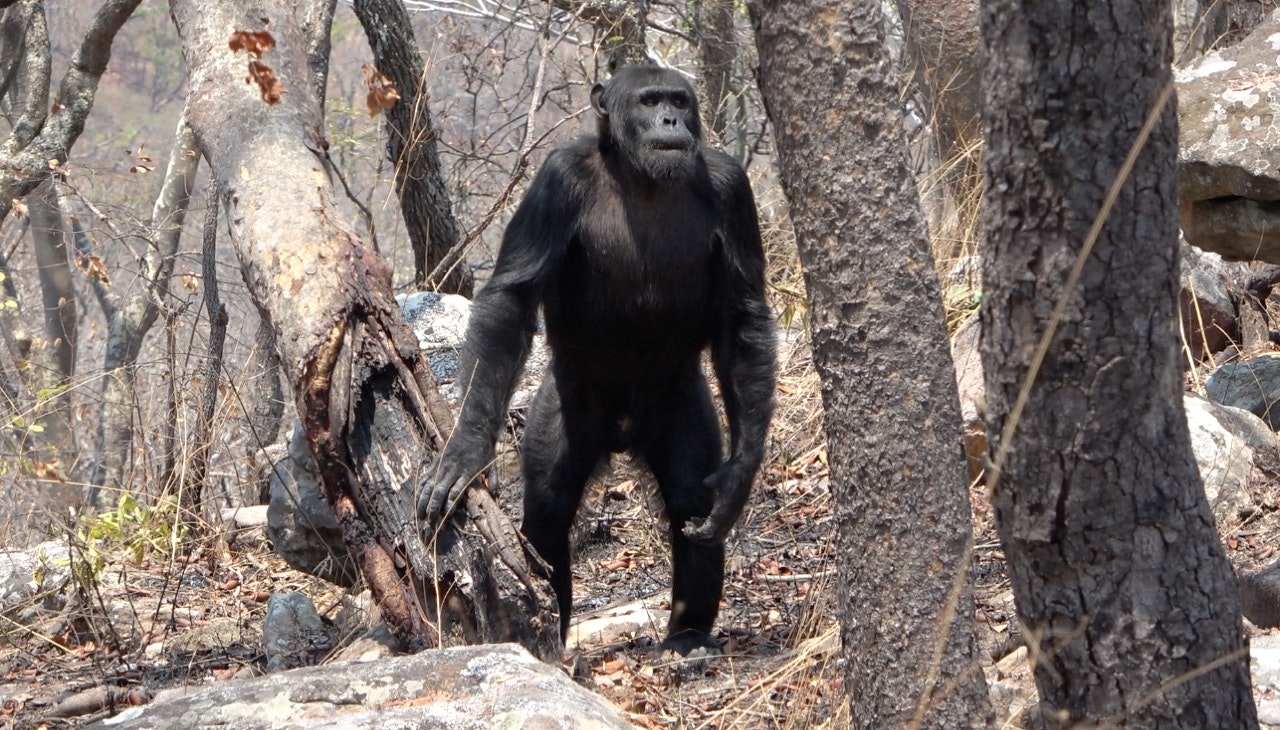
There’s no trait that distinguishes humans from all other mammals more clearly than the way we walk. Human habitual bipedalism – obligatory walking on two legs – has long been a defining trait of our species, as well as our ancestors as far back as 4.5 million years ago.
Science’s growing understanding of chimpanzee culture, communication and emotion may have blurred the understanding of “distinctly human”, but our obligatory bipedalism has stood the test of time.
Why, when, and where bipedalism evolved remains debated, however. Numerous evolutionary pressures have been proposed. Most are about the economics and energy use of walking on two legs (bipedalism is far more efficient than quadrupedalism). Other theories describe the advantages of carrying objects. Bipedalism frees the hands to do interesting things like make and use tools and reach for fruit. It also enables us to see over tall grass.
But almost all the theories suggest that bipedalism is an adaptation to getting around on land. It’s clear that early bipeds evolved when savanna grasslands became increasingly common as forests retreated 4-8 million years ago. Walking on two legs made it easier to forage and travel on the ground.
But there’s also evidence that contradicts this idea. Hominin anatomy, palaeo-ecology and the behaviour of some ape species present challenges to the theory. For example, early hominins had a long list of adaptations to life in the trees. These included long limbs, mobile shoulders and wrists, and curved fingers. All these features are present in our current tree-dwelling primate cousins.
Studies of what hominins ate and the animals they lived with (bushbucks, colobus monkeys) also suggest that these hominins did not live in grasslands. Instead, they inhabited mosaic landscapes, consisting most likely of a mixture of riparian forests and woodlands.
Finally, evidence from the only non-African great ape – the orangutan – suggests bipedalism was an adaptation to living in trees. It helped the apes to negotiate flexible branches high in the tropical rainforests of southeast Asia.
To further test hypotheses about how hominins may have foraged and moved in a mosaic habitat – and whether this habitat pushed them to evolve towards living on the ground and walking on two legs – we investigated the behaviour of wild chimpanzees in a savanna mosaic in the Issa valley in Tanzania.
Issa chimpanzees
Issa chimpanzees live in an environment dominated by woodland. It is interspersed with grasslands, rocky outcrops and forests alongside streams. We followed chimpanzees for 15 months, collecting data every two minutes on an individual’s positional behaviour, the vegetation type they were in (forest, woodland), and what they were doing (foraging, resting, grooming and so on).
We expected that chimpanzees would spend more time on the ground and standing or moving upright in open vegetation like woodlands where they cannot easily travel via the tree canopy. We thought they would be more terrestrial overall compared with their forest-dwelling cousins in other parts of Africa.
We found that Issa chimpanzees do indeed spend more time on the ground in woodlands than in forests. But they were not more terrestrial than other (forested) communities. In short, it is not a simple rule of fewer trees leads to more time on the ground.
It’s not clear why Issa chimpanzees spent so little time on the ground. It could be that they spend more time within feeding trees due to tougher foods that may take longer to process than those found in the forests. Alternatively, they could be staying out of the reach of Issa’s many predators, including wild dogs, hyenas, and lions. We don’t yet know what is driving Issa chimpanzees into the trees.
Our findings also suggest a decoupling between terrestial activity and bipedalism. Over 85% of bipedal events were when chimpanzees were in trees (mostly feeding), not on the ground, similar to what was described for orangutans.
Our data from Issa do not support the view that bipedalism evolved as a terrestrial behaviour, especially in more open habitats.
Why it matters
Our study represents the first test in a living ape of the long-held hypothesis that cool, dry and open environments during a critical junction in human evolution catalysed the evolution of terrestrial bipedalism.
Issa allows us to study ape-habitat interactions as they might have been millions of years ago. Hominins may not have responded to a mosaic landscape in exactly the same way as today’s chimpanzees do. But the way savanna chimpanzees move around and hold their bodies supports the idea that early hominin bipedalism evolved in the trees, not on the ground.


