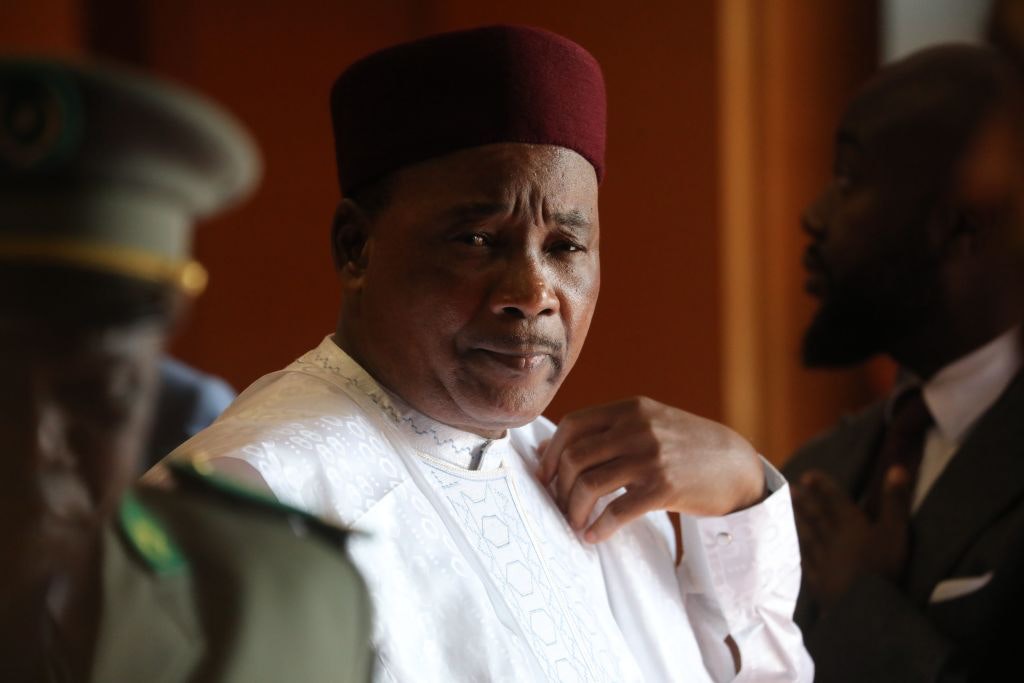
The president of Niger, Mahamadou Issoufou, has been awarded the 2020 Ibrahim Prize for Achievement in African Leadership. The annual prize is granted by the Mo Ibrahim Foundation, named after the Sudanese billionaire businessman and philanthropist who founded it. The prize – which includes a US$5 million award – aims to showcase exceptional role models from the continent and “recognise leaders who have strengthened democracy and human rights for the shared benefit of their people”.
Since its inception in 2007 the Ibrahim Foundation has granted the award to only seven other presidents. On eight occasions it found no eligible candidate.
To qualify for the award, candidates have to leave office at the end of their term. Since being elected in 2011, Issoufou has served two terms (10 years) and has indicated he will step down this year. This means Niger will have the first democratic transition between elected leaders since it became independent from France more than 60 years ago.
Nevertheless, as a scholar who has followed Issoufou’s tenure in power, I find the decision of the Ibrahim Foundation to select Issoufou as this year’s prize winner difficult to comprehend.
Overall, Issoufou has failed to strengthen fundamental democratic rights such as free and fair elections, freedom of association, and freedom of speech. If anything, the Issoufou era is a textbook case of democratic backsliding.
This is not to say that the Issoufou presidency is without merits. Niger has, so far, managed to avoid the volatile trajectory of its neighbouring countries. There has also been moderate progress with regard to the sustainable development goals.
However, when taking a closer look at his time in office, it’s not apparent that he should’ve been bestowed with a prize that is founded on principles of good governance and democratic election.
A very ambivalent record
Mahamadou Issoufou was elected president in 2011 after a brief period of military rule. Like no other candidate at the time, he embodied Niger’s democratic aspirations. As leader of the Nigerien Party for Democracy and Socialism, he was a prominent advocate of basic civil rights and political freedoms since the early 1990s.
When he challenged then President Tandja (2000-2010) in the 2009 presidential elections, Issoufou had faced arbitrary detention and false accusations of corruption for opposing Tandja.
However, just two years into his tenure the first mass protests against the Issoufou administration took place in Niger’s capital, Niamey. Protesters demanded an end to government corruption and improved living conditions.
Since then the relationship between Issoufou, on the one hand, and the opposition leaders and civil society leaders, on the other, has deteriorated.
During his time in office, his regime has had a heavy-handed reaction to dissent. It also hasn’t upheld the law. In 2017 students protesting for better living and studying conditions were arrested and injured; there were even some deaths.
The same is true for broader protests denouncing corruption and calling for improved living conditions. Hundreds of civil society activists found themselves in prison without due process.
There were also concerns over democratic transition. Issoufou’s reelection in 2016 was marred by several irregularities. His main challenger, Hama Amadou, was forced to contest the elections from prison due to his alleged involvement in a baby-smuggling ring. Although several courts upheld the ruling against Amadou, no evidence against him was ever made public. This implies Issoufou might have engaged in suppression of the opposition.
Human rights and corruption
In addition, Amnesty International identified a recent surge in human rights violations in Niger. For instance, journalists reporting critically on the government’s war against Boko Haram or on corruption within the state bureaucracy frequently faced expulsion or arbitrary arrest. When Issoufou took office in 2011, the World Press Freedom Index ranked Niger 29th worldwide. In 2020 Niger occupies position 57. This constitutes a significant decline.
There are also many concerns about the state of public finances under Issoufou. For long, donor officials have raised suspicions of government waste and corruption. In April 2020, for instance, a government audit revealed that almost 40% of the US$312 million Niger spent on defence procurement contracts over the previous three years had been lost through inflated costs or supplies that were not delivered.
In addition, the recently concluded presidential elections raised concerns about electoral conduct. Issoufou’s handpicked successor, Mohamed Bazoum, won the presidency in an electoral contest that was fought more narrowly than anticipated. The presidential run-off resulted in several questionable results, suggesting that the governing party manipulated the outcome in remote areas. Although it is too early to assess the electoral outcome conclusively, the violent protests that shook Niamey in the aftermath of the presidential run-off in late February demonstrated widespread loss of trust in the departing president and those close to him.
The fact that the internet was shut down for ten days after the announcement of the electoral results is reminiscent of elections in authoritarian nations and clearly does not warrant an award for leadership.
Many praise Issoufou for complying with the constitutionally prescribed two-term limit for presidents and celebrate that Niger is about to see the first democratic handover of power since independence. This certainly is a positive development and cannot be taken for granted.
Yet compliance with constitutional principles does not turn a president into an exceptional role model. Abiding by constitutional laws is merely a necessary condition for democratic governance. Nigerien commentators are rightly concerned that Issoufou appears to have received the award not for what he did but what he did not do.


