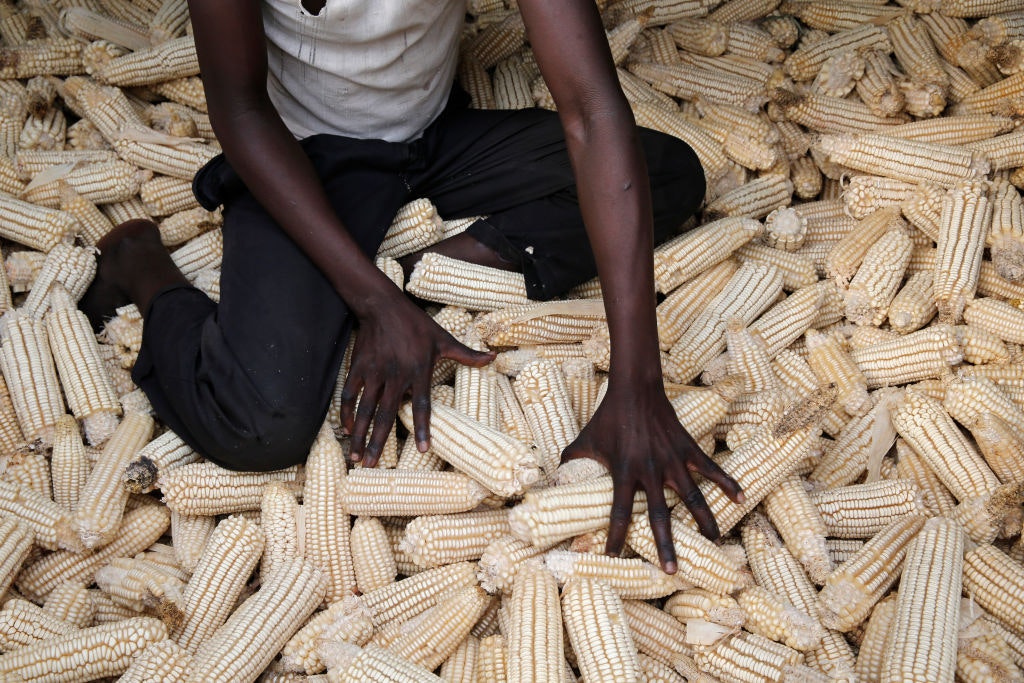
Maize is one of the most important cereal crops in Uganda. In particular, smallholder farmers rely on it for food and as a cash crop. They also grow it as an important export crop.
Over the years, total maize production in Uganda has gradually increased, from roughly 800,000 tonnes in 2000 to 2,575,000 tonnes in 2019. But this is largely due to a steady expansion of maize acreage, little from improved productivity.
Low productivity is one of the biggest challenges facing Uganda’s maize industry. The reason for this is that, as most maize farmers are smallholders, their use of agricultural technology, such as fertiliser and improved seed, is very limited. There are also concerns that changes in temperature and rainfall – specifically increases in temperature and decreases in rainfall – will further affect maize production.
To address these challenges, in 1991 Uganda released improved maize varieties with drought tolerance.
Although it depends on the conditions of the maize growing areas, studies indicated that compared with local varieties, drought-tolerant maize can increase yields by 15%. It also reduced the probability of crop failure by 30%.
But, even after 30 years, drought-tolerant maize has yet to be widely adopted by smallholders. In one study, which covered 1,000 households, just 14% used the modified seed in their fields.
I set out to understand why smallholders did or didn’t plant drought tolerant maize. To do this I used available literature, policy documents and reports.
I found that the constraints to adoption included:
- different farmer characteristics such as wealth or education level;
- a lack of information or understanding about the seeds;
- the attributes of the seeds themselves and whether they meet the farmers’ needs; and
- counterfeit seed and fertiliser in markets.
For drought-tolerant maize to be more widely adopted, it’s crucial that policymakers support smallholders with effective information campaigns and subsidies. They must also ensure the markets for the seed and complementary fertiliser are reliable and meet farmer needs.
Current constraints
There are two seed systems in Uganda. One is formal and the other informal. Through the formal system, improved seeds, including drought-tolerant seeds, are developed under the National Agricultural Research Organisation. The National Seed Certification Services regulates the formal seed sector from variety listing to seed certification for commercial seeds that private seed companies distribute. But in Uganda, 85% of seeds planted – which includes local maize varieties – are through the informal system.
Most maize farmers in Uganda are resource-constrained smallholders. Thus, their decision to adopt the drought-tolerant maize may be influenced by perceived economic risks. The seeds of the local maize varieties that farmers use are ones that they’ve saved from previous harvests, and may cost them nothing. In 2015, modified maize seed could cost up to Ush6,000 per kilo (about US$1.60) depending on the variety, while the local seed cost nothing.
However, a study calculating the costs and benefits of modified seed found that the drought-tolerant maize could be more economically beneficial. For instance, local maize could require more labour costs due to less resistance, if any, to pests, weeds and diseases. Also, the higher yield of the improved maize could compensate for the higher seed and fertiliser costs. This suggested that the reason for low adoption by smallholders may not be financial.
Information and education
A number of factors determine whether small-scale farmers adopt a new seed or not.
Farmers need information on how the seeds work, and will decide whether or not to use them based on this. Whether a farmer has relevant information is based on the farmers’ network, specifically, contact with extension services, NGOs or cooperative memberships. Their understanding is also affected by levels of education or farming experiences.
If the farmer decides to cultivate the new seed, it must be physically available, accessible, and affordable.
However, studies also show that even when critical conditions are met – farmers have awareness, access and can afford the seeds – universal adoption is highly unlikely.
One of the reasons for this is because farmers prefer traditional varieties. This could be because the traditional varieties may be more resistant to pests, taste more familiar or mature faster. There’s also evidence that some drought tolerant varieties don’t suit certain local conditions.
Counterfeit seeds are another issue. Between 30% and 40% of seeds traded in Uganda are thought to be counterfeit. Farmers will be less likely to take the risk of using modified seeds if they believe they might be counterfeit.
Political will
All of these barriers to a way forward in improved maize seed adoption can be tackled with government interventions and public-private cooperation.
First, the information bottleneck must be addressed with awareness campaigns and training via extension services or international aid programs. If it’s already been happening, there should be investigations into why it’s not working and ensure that the delivery of information is customised and simplified according to the characteristics of the target farmers.
The government must ensure that quality seed is available at local markets or through extension services. There also needs to be better supervision to prevent counterfeits from permeating the market.
It’s also important for the government to incorporate maize farmers’ preferences in the breeding process, based on their local conditions.
In addition, the government must help smallholders who lack cash and credit with a subsidy or voucher. International aid programmes could distribute free packages with the modified seeds and fertiliser to the most vulnerable.
The challenge of getting more farmers to adopt the drought-tolerant seed is certainly overwhelming. But it is necessary to improve livelihoods and eventually the maize industry of Uganda.


