Why Nigeria’s efforts to support poor people fail, and what can be done about it:
Urbanisation remains a big challenge for city managers in low- and middle-income countries. This includes Nigeria, where the proportion of the urban population increased from 17.5% in 1969 to 51.2% in 2019. An estimated 18% of the urban population live in poverty.
A 2018 UN report has projected that 55% of the world’s population will live in cities by 2030. It says half of the 130 million people living in cities lack access to adequate housing, water, sanitation, durable dwellings, adequate space, and secure tenure.
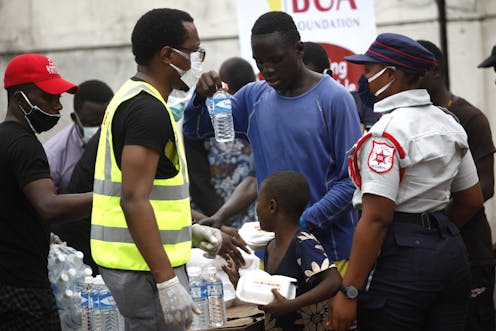
This makes it imperative for governments to apply social assistance programme for the poor and vulnerable . These can include income or material support such as retirement pensions or health care schemes, as well as feeding programmes for school age children and food handouts.
According to the World Bank, per capita spending on social assistance programmes is lower in low- and middle-income countries (less than $ 1,000) than in high-income countries ($ 4,000-$ 5,000). It reports that Nigeria’s total spending on social assistance programmes is 0.28% of GDP and covers only 7% of the population. This is low compared with South Africa (3.31%), Benin (2.95%), Rwanda (1.5%) and Ghana (0.58%).
There is ample evidence that social assistance programmes are failing to improve housing, access to health care and basic services. They are also failing to integrate the informal economy and improve local economic development in Nigeria.
Poor and vulnerable people live below the poverty line of $ 1.90. They bear the brunt of disasters, including the COVID-19 pandemic.
My research shows that a host of factors – such as social and economic exclusion – stand in the way of safe and liveable cities.
In a separate paper, I identified the need for proactive measures to create stronger institutions and policies in Africa. This will lead to wealth creation and reduce poverty, social injustices and inequality.
I also found out that this requires a bottom-up participatory approach. This makes for better understanding of issues at the local level. It also ensures that location-specific methods of assistance are designed and that local resources are harnessed.
The Nigerian government introduced a lockdown strategy to contain the spread of the virus. At the same time it initiated various palliative measures. But these have not reached their intended beneficiaries, and have been plagued with difficulties.
Shortcomings
The first problem is that the government has adopted a top-down distribution system which has been poorly coordinated and highly exclusive.
In addition, the requirements for accessing the relief packages were unclear, fraught with secrecy or too restrictive. In the case of unconditional cash transfer, grain distribution and credit loan scheme for households and businesses, selection methods were also vague.
The poor and vulnerable could not fulfil some of the bank related requirements for accessing the credit facility by the Central Bank of Nigeria.
Social assistance programmes in Nigeria include national cash transfers. This is aimed at financial support for the poor and vulnerable whose incomes or livelihoods are at risk due to natural, human or economic crises such as the COVID-19 pandemic and the associated lockdown.
Others include youth employment and community social development projects, like the home-grown school feeding programmes to address poverty and hunger.
Some of these programmes are being reactivated to address the consequences of COVID-19 lockdown on the poor and vulnerable.
Improvements
The Nigerian government could take a number of steps to improve the situation.
Firstly, it should apply the principle of accessibility as well as diversity. Interventions should be made accessible to the poor irrespective of age, class, ethnicity, gender or education, or residence or disability.
Secondly, the principle of social participation and human rights should be applied. This requires collaboration and partnership with pro-poor organisations and grassroot networks such as civil society or non-governmental organisations, religious groups, trade associations, and community development associations.
Thirdly, planning and implementation should be done in an open and transparent way. This could include using technology and social media for tracking and monitoring of beneficiaries and outcomes.
Fourthly, every available channel and language of communication must be used.
Lastly, there needs to be a bottom-up approach through the identification and use of local groups, resources and champions to create investment opportunities, increase incomes and build resilience of the poor and vulnerable.
Effective social assistance programmes will produce multiplier effects. They will help poor people escape poverty by enhancing their socio-economic status. They can also boost purchasing power, build resilience and catalyse local and regional economic development.

Peter Elias receives funding from the International Science Council, Network of African Science Academies, UK Research and Innovation (UKRI), Digital Innovation for Development in Africa (DIDA) and Global Challenge for Research Fund (GCRF). He is affiliated with the Academic Staff Union of Universities (ASUU). He works for the University of Lagos, Nigeria, a federal government owned institution.
Source: The Conversation – Articles (AFRICA)
Read more on The Conversation.
Join the fun: Add Your event | Submit a Press Release | Add your listing.


